Thank you for visiting SNEWPapers!
Sign up free
Literary
January 20, 1786
Fowle's New Hampshire Gazette And General Advertiser
Portsmouth, Rockingham County, New Hampshire
What is this article about?
A collection of personal resolutions advocating a life of moral virtue, temperance, and self-discipline, covering religion, health, social conduct, and avoidance of vices, reflecting on aging and contentment.
Clipping
OCR Quality
95%
Excellent
Full Text
A SET OF RESOLUTIONS.
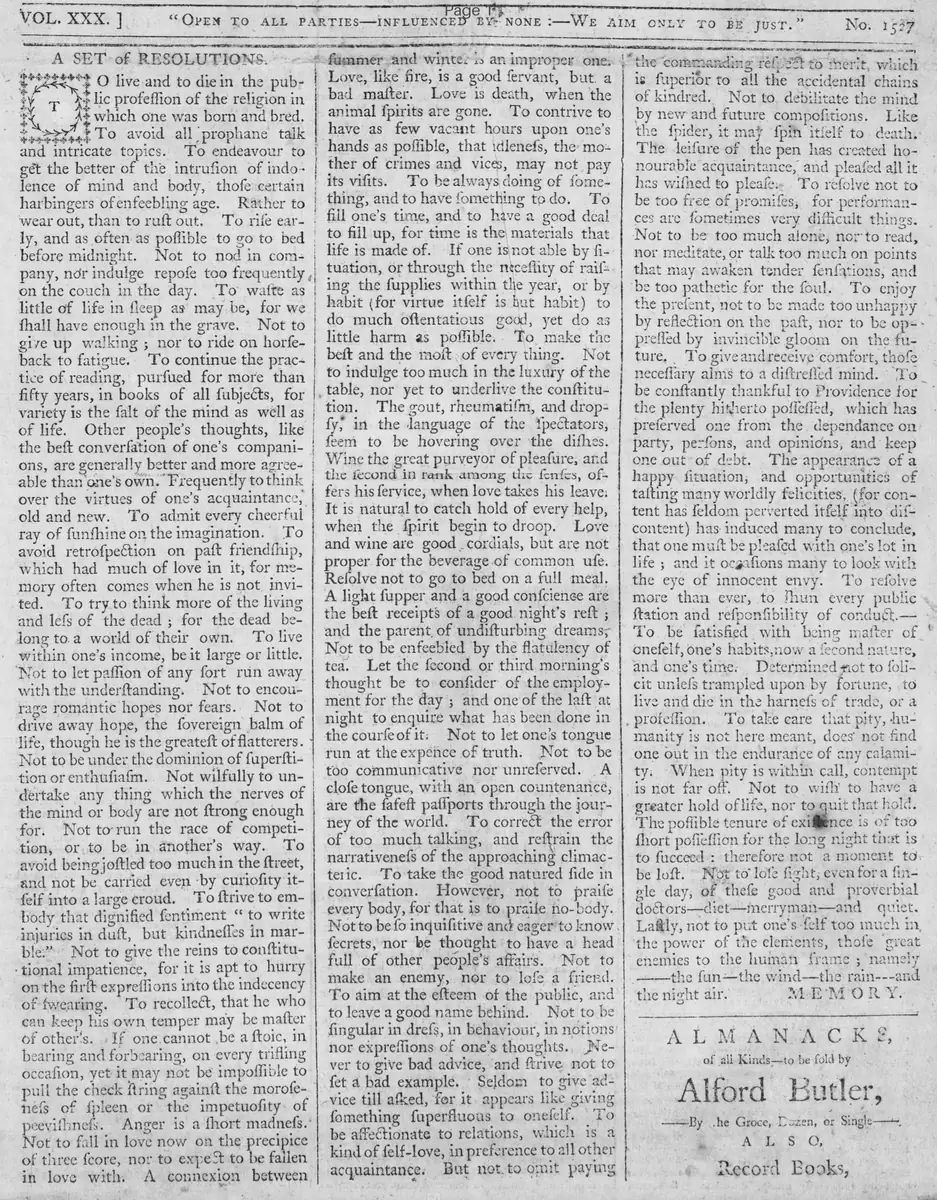
To live and to die in the public profession of the religion in which one was born and bred. To avoid all profane talk and intricate topics. To endeavour to get the better of the intrusion of indolence of mind and body, those certain harbingers of enfeebling age. Rather to wear out, than to rust out. To rise early, and as often as possible to go to bed before midnight. Not to nod in company, nor indulge repose too frequently on the couch in the day. To waste as little of life in sleep as may be, for we shall have enough in the grave. Not to give up walking; nor to ride on horseback to fatigue. To continue the practice of reading, pursued for more than fifty years, in books of all subjects, for variety is the salt of the mind as well as of life. Other people's thoughts, like the best conversation of one's companions, are generally better and more agreeable than one's own. Frequently to think over the virtues of one's acquaintance, old and new. To admit every cheerful ray of sunshine on the imagination. To avoid retrospection on past friendship, which had much of love in it, for memory often comes when he is not invited. To try to think more of the living and less of the dead: for the dead belong to a world of their own. To live within one's income, be it large or little. Not to let passion of any sort run away with the understanding. Not to encourage romantic hopes nor fears. Not to drive away hope, the sovereign balm of life, though he is the greatest flatterer. Not to be under the dominion of superstition or enthusiasm. Not wilfully to undertake any thing which the nerves of the mind or body are not strong enough for. Not to run the race of competition, or to be in another's way. To avoid being jostled too much in the street, and not be carried even by curiosity itself into a large crowd. To strive to embody that dignified sentiment "to write injuries in dust, but kindnesses in marble." Not to give the reins to constitutional impatience, for it is apt to hurry on the first expressions into the indecency of swearing. To recollect, that he who can keep his own temper may be master of others. If one cannot be a stoic, in bearing and forbearing, on every trifling occasion, yet it may not be impossible to pull the check string against the moroseness of pleen or the impetuosity of peevishness. Anger is a short madness. Not to fall in love now on the precipice of three score, nor to expect to be fallen in love with. A connection between summer and winter is an improper one. Love, like fire, is a good servant, but a bad master. Love is death, when the animal spirits are gone. To contrive to have as few vacant hours upon one's hands as possible, that idleness, the mother of crimes and vices, may not pay its visits. To be always doing something, and to have something to do. To fill one's time, and to have a good deal to fill up, for time is the material that life is made of. If one is not able by situation, or through the necessity of raising the supplies within the year, or by habit (for virtue itself is but habit) to do much ostentatious good, yet do as little harm as possible. To make the best and the most of every thing. Not to indulge too much in the luxury of the table, nor yet to underlive the constitution. The gout, rheumatism, and dropsy, in the language of the Spectators, seem to be hovering over the dishes. Wine the great purveyor of pleasure, and the second in rank among the senses, offers his service, when love takes his leave: It is natural to catch hold of every help, when the spirit begins to droop. Love and wine are good cordials, but are not proper for the beverage of common use. Resolve not to go to bed on a full meal. A light supper and a good conscience are the best receipts of a good night's rest; and the parent of undisturbing dreams. Not to be enfeebled by the flatulency of tea. Let the second or third morning's thought be to consider of the employment for the day; and one of the last at night to enquire what has been done in the course of it: Not to let one's tongue run at the expense of truth. Not to be too communicative nor unreserved. A close tongue, with an open countenance; are the safest passports through the journey of the world. To correct the error of too much talking, and restrain the narrativeness of the approaching climacteric. To take the good natured side in conversation. However, not to praise every body, for that is to praise no-body. Not to be so inquisitive and eager to know secrets, nor be thought to have a head full of other people's affairs. Not to make an enemy, nor to lose a friend. To aim at the esteem of the public, and to leave a good name behind. Not to be singular in dress, in behaviour, in notions nor expressions of one's thoughts. Never to give bad advice, and strive not to set a bad example. Seldom to give advice till asked, for it appears like giving something superfluous to oneself. To be affectionate to relations, which is a kind of self-love, in preference to all other acquaintance. But not to omit paying No. 1527 the commanding respect to merit, which is superior to all the accidental chains of kindred. Not to debilitate the mind by new and future compositions. Like the spider, it may spin itself to death. The leisure of the pen has created honourable acquaintance, and pleased all it has wished to please. To resolve not to be too free of promises; for performances are sometimes very difficult things. Not to be too much alone, nor to read, nor meditate, or talk too much on points that may awaken tender sensations, and be too pathetic for the soul. To enjoy the present, not to be made too unhappy by reflection on the past, nor to be oppressed by invincible gloom on the future. To give and receive comfort, those necessary alms to a distressed mind. To be constantly thankful to Providence for the plenty hitherto possessed, which has preserved one from the dependence on party, persons, and opinions, and kept one out of debt. The appearance of a happy situation, and opportunities of tasting many worldly felicities, (for content has seldom perverted itself into discontent) has induced many to conclude, that one must be pleased with one's lot in life; and it occasions many to look with the eye of innocent envy. To resolve more than ever, to shun every public station and responsibility of conduct. To be satisfied with being master of oneself, one's habits, now a second nature, and one's time: Determined not to solicit unless trampled upon by fortune, to live and die in the harness of trade, or a profession. To take care that pity, humanity is not here meant, does not find one out in the endurance of any calamity. When pity is within call, contempt is not far off. Not to wish to have a greater hold of life, nor to quit that hold. The possible tenure of existence is of too short possession for the long night that is to succeed: therefore not a moment to be lost. Not to lose sight; even for a single day, of these good and proverbial doctors—diet—merryman—and quiet. Lastly, not to put one's self too much in the power of the elements, those great enemies to the human frame; namely—the sun—the wind—the rain—and the night air.
To live and to die in the public profession of the religion in which one was born and bred. To avoid all profane talk and intricate topics. To endeavour to get the better of the intrusion of indolence of mind and body, those certain harbingers of enfeebling age. Rather to wear out, than to rust out. To rise early, and as often as possible to go to bed before midnight. Not to nod in company, nor indulge repose too frequently on the couch in the day. To waste as little of life in sleep as may be, for we shall have enough in the grave. Not to give up walking; nor to ride on horseback to fatigue. To continue the practice of reading, pursued for more than fifty years, in books of all subjects, for variety is the salt of the mind as well as of life. Other people's thoughts, like the best conversation of one's companions, are generally better and more agreeable than one's own. Frequently to think over the virtues of one's acquaintance, old and new. To admit every cheerful ray of sunshine on the imagination. To avoid retrospection on past friendship, which had much of love in it, for memory often comes when he is not invited. To try to think more of the living and less of the dead: for the dead belong to a world of their own. To live within one's income, be it large or little. Not to let passion of any sort run away with the understanding. Not to encourage romantic hopes nor fears. Not to drive away hope, the sovereign balm of life, though he is the greatest flatterer. Not to be under the dominion of superstition or enthusiasm. Not wilfully to undertake any thing which the nerves of the mind or body are not strong enough for. Not to run the race of competition, or to be in another's way. To avoid being jostled too much in the street, and not be carried even by curiosity itself into a large crowd. To strive to embody that dignified sentiment "to write injuries in dust, but kindnesses in marble." Not to give the reins to constitutional impatience, for it is apt to hurry on the first expressions into the indecency of swearing. To recollect, that he who can keep his own temper may be master of others. If one cannot be a stoic, in bearing and forbearing, on every trifling occasion, yet it may not be impossible to pull the check string against the moroseness of pleen or the impetuosity of peevishness. Anger is a short madness. Not to fall in love now on the precipice of three score, nor to expect to be fallen in love with. A connection between summer and winter is an improper one. Love, like fire, is a good servant, but a bad master. Love is death, when the animal spirits are gone. To contrive to have as few vacant hours upon one's hands as possible, that idleness, the mother of crimes and vices, may not pay its visits. To be always doing something, and to have something to do. To fill one's time, and to have a good deal to fill up, for time is the material that life is made of. If one is not able by situation, or through the necessity of raising the supplies within the year, or by habit (for virtue itself is but habit) to do much ostentatious good, yet do as little harm as possible. To make the best and the most of every thing. Not to indulge too much in the luxury of the table, nor yet to underlive the constitution. The gout, rheumatism, and dropsy, in the language of the Spectators, seem to be hovering over the dishes. Wine the great purveyor of pleasure, and the second in rank among the senses, offers his service, when love takes his leave: It is natural to catch hold of every help, when the spirit begins to droop. Love and wine are good cordials, but are not proper for the beverage of common use. Resolve not to go to bed on a full meal. A light supper and a good conscience are the best receipts of a good night's rest; and the parent of undisturbing dreams. Not to be enfeebled by the flatulency of tea. Let the second or third morning's thought be to consider of the employment for the day; and one of the last at night to enquire what has been done in the course of it: Not to let one's tongue run at the expense of truth. Not to be too communicative nor unreserved. A close tongue, with an open countenance; are the safest passports through the journey of the world. To correct the error of too much talking, and restrain the narrativeness of the approaching climacteric. To take the good natured side in conversation. However, not to praise every body, for that is to praise no-body. Not to be so inquisitive and eager to know secrets, nor be thought to have a head full of other people's affairs. Not to make an enemy, nor to lose a friend. To aim at the esteem of the public, and to leave a good name behind. Not to be singular in dress, in behaviour, in notions nor expressions of one's thoughts. Never to give bad advice, and strive not to set a bad example. Seldom to give advice till asked, for it appears like giving something superfluous to oneself. To be affectionate to relations, which is a kind of self-love, in preference to all other acquaintance. But not to omit paying No. 1527 the commanding respect to merit, which is superior to all the accidental chains of kindred. Not to debilitate the mind by new and future compositions. Like the spider, it may spin itself to death. The leisure of the pen has created honourable acquaintance, and pleased all it has wished to please. To resolve not to be too free of promises; for performances are sometimes very difficult things. Not to be too much alone, nor to read, nor meditate, or talk too much on points that may awaken tender sensations, and be too pathetic for the soul. To enjoy the present, not to be made too unhappy by reflection on the past, nor to be oppressed by invincible gloom on the future. To give and receive comfort, those necessary alms to a distressed mind. To be constantly thankful to Providence for the plenty hitherto possessed, which has preserved one from the dependence on party, persons, and opinions, and kept one out of debt. The appearance of a happy situation, and opportunities of tasting many worldly felicities, (for content has seldom perverted itself into discontent) has induced many to conclude, that one must be pleased with one's lot in life; and it occasions many to look with the eye of innocent envy. To resolve more than ever, to shun every public station and responsibility of conduct. To be satisfied with being master of oneself, one's habits, now a second nature, and one's time: Determined not to solicit unless trampled upon by fortune, to live and die in the harness of trade, or a profession. To take care that pity, humanity is not here meant, does not find one out in the endurance of any calamity. When pity is within call, contempt is not far off. Not to wish to have a greater hold of life, nor to quit that hold. The possible tenure of existence is of too short possession for the long night that is to succeed: therefore not a moment to be lost. Not to lose sight; even for a single day, of these good and proverbial doctors—diet—merryman—and quiet. Lastly, not to put one's self too much in the power of the elements, those great enemies to the human frame; namely—the sun—the wind—the rain—and the night air.
What sub-type of article is it?
Essay
What themes does it cover?
Moral Virtue
Temperance
What keywords are associated?
Personal Resolutions
Moral Virtue
Temperance
Healthy Living
Old Age
Self Control
Contentment
Literary Details
Title
A Set Of Resolutions.
Form / Style
Prose List Of Personal Resolutions
Key Lines
Rather To Wear Out, Than To Rust Out.
To Live Within One's Income, Be It Large Or Little.
Love, Like Fire, Is A Good Servant, But A Bad Master.
Idleness, The Mother Of Crimes And Vices, May Not Pay Its Visits.
A Light Supper And A Good Conscience Are The Best Receipts Of A Good Night's Rest; And The Parent Of Undisturbing Dreams.