Thank you for visiting SNEWPapers!
Sign up free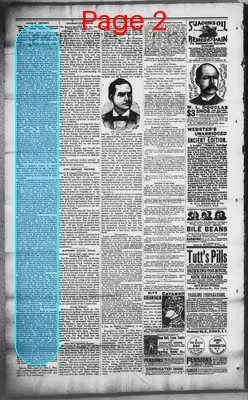
Story
April 19, 1890
Baxter Springs News
Baxter Springs, Cherokee County, Kansas
What is this article about?
Insurance Commissioner Wilder's annual report details the successful three-year campaign to eliminate fraudulent 'wildcat' insurance companies in Kansas, exposing crooks' tactics, the suffering of victims, and the restoration of honest practices under state supervision.
Clipping

OCR Quality
98%
Excellent
Full Text
Eighty Points in Insurance Commissioner Wilder's Annual Report—'Wildcats' Scored.
Topeka, Kan., April 12.—The twentieth annual insurance report has been received from the State Printer. Commissioner Wilder in his introductory says:
It has been the providence of nature, as Galt the Brahmin Pilpay, speaking of the oriental cat, 'to give to this creature nine lives instead of one.' This record was made in the very dawn and infancy of the race of cats. If the history of the Kansas cats in this series of reports seems somewhat long, repetitious and tiresome, the indulgent reader will bear in mind this ancient saw relative to feline longevity, and will brace up when he remembers that, although a bogus insurance company has as many lives as a cat, yet it liveth not forever; it may and surely will die when the nine lives are ended; and moreover it can be killed.
The work of clearing the State of fraudulent insurance companies was begun nearly three years ago, and the job is nearly finished. It has been a very unpleasant one. Every company put an end to has had interested friends, persons drawing salaries, to defend it and assail me. They have spared no epithets; nothing that was false and dirty and vile. This was expected and no complaint is made. The danger was in making the burden to the department greater than it could bear and thus breaking it down. The months have passed, calumny and bribery have done their work, the press and people have sustained the department and the bogus companies are dead.
Every wildcat company in Kansas has been organized by outsiders; by professional insurance crooks and lawbreakers who came here to work this field. The insurance crook is a very sharp man; he knows every trick of the trade. One of his favorite sayings for the past three years has been that the Superintendent didn't know anything about insurance. There was a good deal of truth in this. But technical insurance knowledge was not the great need of Kansas just then. We needed Inspector Byrnes. The crook dresses well and makes a favorable impression. He selects his town and makes the acquaintance of influential men; ropes them into his company far enough to get a charter and organization. But the company consists of these new comers, one or two crooks. They secure the insurance, lie to the department and pocket the cash receipts. The honest directors, whose names have been used to secure business, having no control whatever over the company, keep dropping out. The annual meetings are held by the crooks; they elect the officers; they fix their own salaries. Now they have things just as they want them. In their advertising they continue to use the names of good men as their directors: these are also displayed before the Legislature when the crooks are buying votes.
After a lengthy review of events prior and subsequent to the closing of the Topeka and Kansas Home insurance companies, the Commissioner continues, referring to the officers of those concerns:
This is a long story to be told of one set of thieves. It is told as a warning. The record is needed in the archives. Kansas has been a safe field for insurance pimps. Every variety of fraudulent insurance has reveled here. The tax levied on our people has been a heavy one. The home burns: the destitute owner recovers no insurance, although he has paid for it. The head of the family dies; he has paid for insurance, but his widow and children get nothing. Hanging to trees and lamp posts would be none too severe a punishment for many a rascal who has robbed our people. To meet these men, to listen to their falsehoods, to know their work, may cause the most serene disciple of sweetness and light to lose his serenity, and to make official reports that are wanting in dignity.
Three years of contest with outlaw insurance men and companies are drawing near to a peaceful close. Over the corpses of companies, the dead bodies of presidents and secretaries, the fugitive forms of fleeing frauds making fast time out of our beloved State, one is already able to catch the first bright light of rosy fingered Aurora, daughter of Dawn, as she gladdens the hill sides along the Missouri, the Marais des Cygnes and Marmaton, and joyful promises to bathe every mound and valley of kindly Kansas in the glorious effulgence of midday sun light. Let the glad girl come in! No wild animals remain here to disturb her footsteps; if her chariot burns on the journey, the last spoke in the wheels will be paid for by solvent, authorized companies; companies that have been through Chicago, twice through Boston, through Lynn and Seattle and Spokane and paid every dollar of loss. The young woman will hear a harpy that passes hiss as he flies over New York but will not wait to respond to 'Assessment No. 113, $13.' She will save her best sunshine for Kansas, where a trinity of law, Supreme Court and supervision guards the citizen from the alluring hallucination that a one dollar fee pays for a thousand dollar policy—pays it sure and pays it quick.
Charles IX.—and Vitellius before him—made the cold remark: 'The body of a dead enemy always smells well.' When we call to mind the men, women and children robbed of many thousands by insurance thieves in Kansas, we do not stop to shed tears over the fallen frauds. Nothing so well became them as their departure. Their presence here for many a year has left so many ruined homes that neither laws nor officers will ever permit their return. No post in human form has so wronged and robbed our State as the insurance fiend. In disaster and in death the dancing devil has been present. One of them testified in court in Topeka last February: 'I can get business for a company that has no assets.' And he had often done so. He was the president of a Topeka wildcat.
Whelps who have no moral or political character were deeply grieved because last year's report lacked dignity. Hynes, Hackney, Fuller, Burton, Ormsbee, the whole crowd of insurance ghouls, had their sensibilities shocked by the coarseness of that report. Subsequent events, examinations of companies and suits in court would hint that the truth of the report may have been the chief cause, with this class of persons, of its unpopularity. But dignity is the demand of the disgruntled; let them have it. These persons and their friends in the Legislature were also worried about the archives, the public archives, the archives of Kansas. 'Is this undignified report to be permitted to go into the public archives? Surely such an outrage will not be allowed.' If archives are 'a place wherein all the records are kept in chests and boxes,' then Kansas has none. But last year's insurance report is in such archives as Americans have in most of the States of our Union. The remedy for the 'lack of dignity' and archive preservation is the improvement of Kansas methods and morals. If unhandsome things are not done they will not be unhandsomely reported and perpetually saved.
Topeka, Kan., April 12.—The twentieth annual insurance report has been received from the State Printer. Commissioner Wilder in his introductory says:
It has been the providence of nature, as Galt the Brahmin Pilpay, speaking of the oriental cat, 'to give to this creature nine lives instead of one.' This record was made in the very dawn and infancy of the race of cats. If the history of the Kansas cats in this series of reports seems somewhat long, repetitious and tiresome, the indulgent reader will bear in mind this ancient saw relative to feline longevity, and will brace up when he remembers that, although a bogus insurance company has as many lives as a cat, yet it liveth not forever; it may and surely will die when the nine lives are ended; and moreover it can be killed.
The work of clearing the State of fraudulent insurance companies was begun nearly three years ago, and the job is nearly finished. It has been a very unpleasant one. Every company put an end to has had interested friends, persons drawing salaries, to defend it and assail me. They have spared no epithets; nothing that was false and dirty and vile. This was expected and no complaint is made. The danger was in making the burden to the department greater than it could bear and thus breaking it down. The months have passed, calumny and bribery have done their work, the press and people have sustained the department and the bogus companies are dead.
Every wildcat company in Kansas has been organized by outsiders; by professional insurance crooks and lawbreakers who came here to work this field. The insurance crook is a very sharp man; he knows every trick of the trade. One of his favorite sayings for the past three years has been that the Superintendent didn't know anything about insurance. There was a good deal of truth in this. But technical insurance knowledge was not the great need of Kansas just then. We needed Inspector Byrnes. The crook dresses well and makes a favorable impression. He selects his town and makes the acquaintance of influential men; ropes them into his company far enough to get a charter and organization. But the company consists of these new comers, one or two crooks. They secure the insurance, lie to the department and pocket the cash receipts. The honest directors, whose names have been used to secure business, having no control whatever over the company, keep dropping out. The annual meetings are held by the crooks; they elect the officers; they fix their own salaries. Now they have things just as they want them. In their advertising they continue to use the names of good men as their directors: these are also displayed before the Legislature when the crooks are buying votes.
After a lengthy review of events prior and subsequent to the closing of the Topeka and Kansas Home insurance companies, the Commissioner continues, referring to the officers of those concerns:
This is a long story to be told of one set of thieves. It is told as a warning. The record is needed in the archives. Kansas has been a safe field for insurance pimps. Every variety of fraudulent insurance has reveled here. The tax levied on our people has been a heavy one. The home burns: the destitute owner recovers no insurance, although he has paid for it. The head of the family dies; he has paid for insurance, but his widow and children get nothing. Hanging to trees and lamp posts would be none too severe a punishment for many a rascal who has robbed our people. To meet these men, to listen to their falsehoods, to know their work, may cause the most serene disciple of sweetness and light to lose his serenity, and to make official reports that are wanting in dignity.
Three years of contest with outlaw insurance men and companies are drawing near to a peaceful close. Over the corpses of companies, the dead bodies of presidents and secretaries, the fugitive forms of fleeing frauds making fast time out of our beloved State, one is already able to catch the first bright light of rosy fingered Aurora, daughter of Dawn, as she gladdens the hill sides along the Missouri, the Marais des Cygnes and Marmaton, and joyful promises to bathe every mound and valley of kindly Kansas in the glorious effulgence of midday sun light. Let the glad girl come in! No wild animals remain here to disturb her footsteps; if her chariot burns on the journey, the last spoke in the wheels will be paid for by solvent, authorized companies; companies that have been through Chicago, twice through Boston, through Lynn and Seattle and Spokane and paid every dollar of loss. The young woman will hear a harpy that passes hiss as he flies over New York but will not wait to respond to 'Assessment No. 113, $13.' She will save her best sunshine for Kansas, where a trinity of law, Supreme Court and supervision guards the citizen from the alluring hallucination that a one dollar fee pays for a thousand dollar policy—pays it sure and pays it quick.
Charles IX.—and Vitellius before him—made the cold remark: 'The body of a dead enemy always smells well.' When we call to mind the men, women and children robbed of many thousands by insurance thieves in Kansas, we do not stop to shed tears over the fallen frauds. Nothing so well became them as their departure. Their presence here for many a year has left so many ruined homes that neither laws nor officers will ever permit their return. No post in human form has so wronged and robbed our State as the insurance fiend. In disaster and in death the dancing devil has been present. One of them testified in court in Topeka last February: 'I can get business for a company that has no assets.' And he had often done so. He was the president of a Topeka wildcat.
Whelps who have no moral or political character were deeply grieved because last year's report lacked dignity. Hynes, Hackney, Fuller, Burton, Ormsbee, the whole crowd of insurance ghouls, had their sensibilities shocked by the coarseness of that report. Subsequent events, examinations of companies and suits in court would hint that the truth of the report may have been the chief cause, with this class of persons, of its unpopularity. But dignity is the demand of the disgruntled; let them have it. These persons and their friends in the Legislature were also worried about the archives, the public archives, the archives of Kansas. 'Is this undignified report to be permitted to go into the public archives? Surely such an outrage will not be allowed.' If archives are 'a place wherein all the records are kept in chests and boxes,' then Kansas has none. But last year's insurance report is in such archives as Americans have in most of the States of our Union. The remedy for the 'lack of dignity' and archive preservation is the improvement of Kansas methods and morals. If unhandsome things are not done they will not be unhandsomely reported and perpetually saved.
What sub-type of article is it?
Deception Fraud
Crime Story
Historical Event
What themes does it cover?
Deception
Crime Punishment
Justice
What keywords are associated?
Insurance Fraud
Wildcat Companies
Commissioner Report
Kansas Crooks
Fraudulent Schemes
State Supervision
Victim Compensation
What entities or persons were involved?
Commissioner Wilder
Inspector Byrnes
Hynes
Hackney
Fuller
Burton
Ormsbee
Where did it happen?
Kansas, Topeka, Kan.
Story Details
Key Persons
Commissioner Wilder
Inspector Byrnes
Hynes
Hackney
Fuller
Burton
Ormsbee
Location
Kansas, Topeka, Kan.
Event Date
April 12
Story Details
Commissioner Wilder recounts the three-year effort to eradicate fraudulent insurance companies in Kansas, detailing crooks' methods of deception, the victimization of citizens, and the triumph of state supervision ensuring solvent protections.