Thank you for visiting SNEWPapers!
Sign up free
Editorial
September 13, 1765
The New Hampshire Gazette And Historical Chronicle
Portsmouth, Greenland, Rockingham County, New Hampshire
What is this article about?
This continued editorial critiques the Stamp Act, arguing it unfairly burdens the poor by increasing legal costs, discourages lawsuits, imposes excessive fees on colonial legal professionals, and introduces a superintendent over courts that threatens judicial independence.
Clipping
OCR Quality
95%
Excellent
Full Text
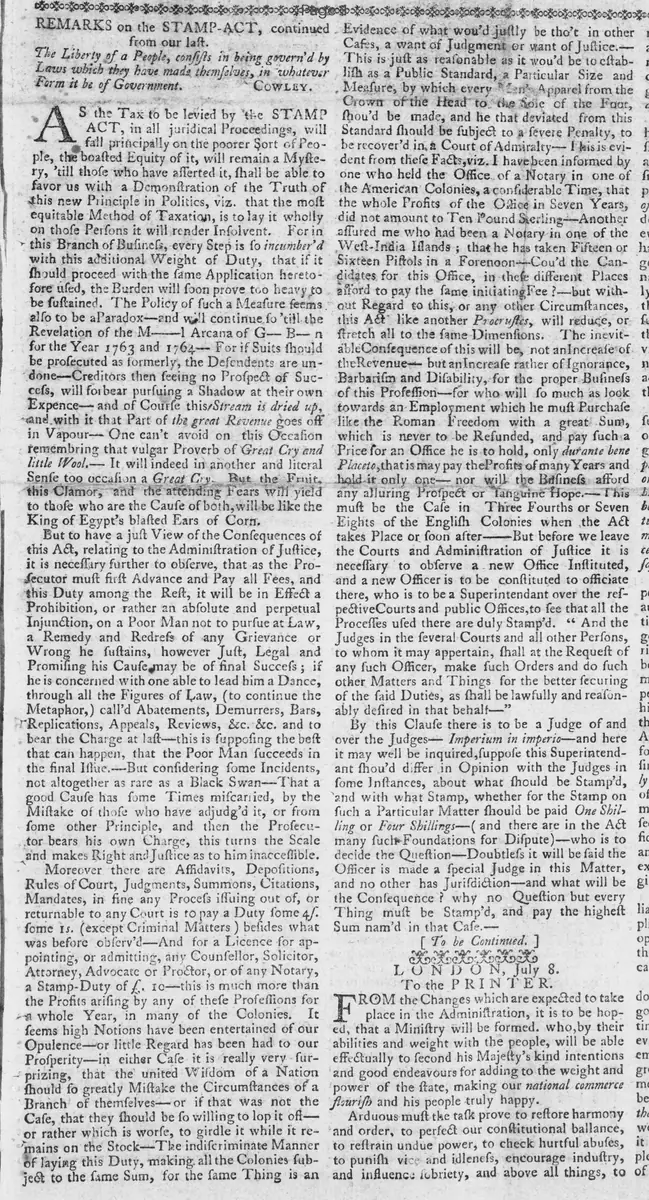
REMARKS on the STAMP-ACT, continued from our last.
The Liberty of a People, consists in being govern'd by Laws which they have made themselves, in whatever Form it be of Government.
COWLEY.
As the Tax to be levied by the STAMP ACT. in all juridical Proceedings, will fall principally on the poorer Sort of People, the boasted Equity of it, will remain a Mystery, 'till those who have asserted it, shall be able to favour us with a Demonstration of the Truth of this new Principle in Politics. viz. that the most equitable Method of Taxation, is to lay it wholly on those Persons it will render Insolvent. For in this Branch of Business. every Step is so incumber'd with this additional Weight of Duty, that if it should proceed with the same Application heretofore used, the Burden will soon prove too heavy to be sustained. The Policy of such a Measure seems also to be a Paradox--and will continue so 'till the Revelation of the M--l Arcana of G-- B-- n for the Year 1763 and 1764-- For if Suits should be prosecuted as formerly, the Defendants are undone--Creditors then seeing no Prospect of Success, will forbear pursuing a Shadow at their own Expence-- and of Course this Stream is dried up, and with it that Part of the great Revenue goes off in Vapour- One can't avoid on this Occasion remembring that vulgar Proverb of Great Cry and little Wool.-- It will indeed in another and literal Sense too occasion a Great Cry. But the Fruit this Clamor, and the attending Fears will yield to those who are the Cause of both,will be like the King of Egypt's blasted Ears of Corn.
But to have a just View of the Consequences of this Act, relating to the Administration of Justice, it is necessary further to observe, that as the Prosecutor must first Advance and Pay all Fees, and this Duty among the Rest, it will be in Effect a Prohibition, or rather an absolute and perpetual Injunction, on a Poor Man not to pursue at Law, a Remedy and Redress of any Grievance or Wrong he sustains, however Just, Legal and Promising his Cause may be of final Success ; if he is concerned with one able to lead him a Dance, through all the Figures of Law, (to continue the Metaphor,) call'd Abatements, Demurrers, Bars, Replications, Appeals, Reviews, &c. &c. and to bear the Charge at last--this is supposing the best that can happen, that the Poor Man succeeds in the final Issue.--But considering some Incidents, not altogether as rare as a Black Swan--That a good Cause has some Times miscarried, by the Mistake of those who have adjudg'd it, or from some other Principle, and then the Prosecutor bears his own Charge, this turns the Scale and makes Right and Justice as to him inaccessible.
Moreover there are Affidavits, Depositions, Rules of Court, Judgments, Summons, Citations, Mandates, in fine any Process issuing out of, or returnable to any Court is to pay a Duty some 4/. some 1s. (except Criminal Matters ) besides what was before observ'd--And for a Licence for appointing, or admitting, any Counsellor, Solicitor, Attorney, Advocate or Proctor, or of any Notary, a Stamp-Duty of £. 10-this is much more than the Profits arising by any of these Professions for a whole Year, in many of the Colonies. It seems high Notions have been entertained of our Opulence-or little Regard has been had to our Prosperity--in either Case it is really very surprising, that the united Wisdom of a Nation should so greatly Mistake the Circumstances of a Branch of themselves--or if that was not the Case, that they should be so willing to lop it off- or rather which is worse, to girdle it while it remains on the Stock--The indiscriminate Manner of laying this Duty, making all the Colonies subject to the same Sum, for the same Thing is an Evidence of what wou'd justly be tho't in other Cases, a want of Judgment or want of Justice.--
This is just as reasonable as it wou'd be to establish as a Public Standard. a Particular Size and Measure, by which every Man's Apparel from the Crown of the Head to the Sole of the Foot, should be made, and he that deviated from this Standard should be subject to a severe Penalty, to be recover'd in, a Court of Admiralty-- This is evident from these Facts,viz. I have been informed by one who held the Office. of a Notary in one of the American Colonies, a considerable Time, that the whole Profits of the Office in Seven Years, did not amount to Ten Pound Sterling--Another assured me who had been a Notary in one of the West-India Islands : that he has taken Fifteen or Sixteen Pistoles in a Forenoon--Cou'd the Candidates for this Office. in these different Places afford to pay the same initiating Fee ?--but without Regard to this, or any other Circumstances, this Act like another Procrustes. will reduce, or stretch all to the same Dimensions. The inevitable Consequence of this will be. not an Increase of the Revenue-- but an Increase rather of Ignorance, Barbarism and Disability. for the proper Business of this Profession--for who will so much as look towards an Employment which he must Purchase like the Roman Freedom with a great Sum, which is never to be Refunded, and pay such a Price for an Office he is to hold. only durante bene Placete, that is may pay the Profits of many Years and hold it only one-- nor will the Business afford any alluring Prospect or sanguine Hope.--This must be the Case in Three Fourths or Seven Eights of the English Colonies when the Act takes Place or soon after-r-But before we leave the Courts and Administration of Justice it is necessary to observe a new Office Instituted. and a new Officer is to be constituted to officiate there, who is to be a Superintendant over the respective Courts and public Offices. to see that all the Process used there are duly Stamp'd. " And the Judges in the several Courts and all other Persons, to whom it may appertain, shall at the Request of any such Officer, make such Orders and do such other Matters and Things for the better securing of the said Duties, as shall be lawfully and reason- ably desired in that behalf-"
By this Clause there is to be a Judge of and over the Judges-- Imperium in imperio--and here it may well be inquired, suppose this Superintend- ant should differ in Opinion with the Judges in some Instances, about what should be Stamp'd, and with what Stamp, whether for the Stamp on such a Particular Matter should be paid One Shil- ling or Four Shillings--(and there are in the Act many such Foundations for Dispute)--who is to decide the Question--Doubtless it will be said the Officer is made a special Judge in this Matter, and no other has Jurisdiction--and what will be the Consequence ? why no Question but every Thing must be Stamp'd, and pay the highest Sum nam'd in that Case.--
[ To be Continued. ]
The Liberty of a People, consists in being govern'd by Laws which they have made themselves, in whatever Form it be of Government.
COWLEY.
As the Tax to be levied by the STAMP ACT. in all juridical Proceedings, will fall principally on the poorer Sort of People, the boasted Equity of it, will remain a Mystery, 'till those who have asserted it, shall be able to favour us with a Demonstration of the Truth of this new Principle in Politics. viz. that the most equitable Method of Taxation, is to lay it wholly on those Persons it will render Insolvent. For in this Branch of Business. every Step is so incumber'd with this additional Weight of Duty, that if it should proceed with the same Application heretofore used, the Burden will soon prove too heavy to be sustained. The Policy of such a Measure seems also to be a Paradox--and will continue so 'till the Revelation of the M--l Arcana of G-- B-- n for the Year 1763 and 1764-- For if Suits should be prosecuted as formerly, the Defendants are undone--Creditors then seeing no Prospect of Success, will forbear pursuing a Shadow at their own Expence-- and of Course this Stream is dried up, and with it that Part of the great Revenue goes off in Vapour- One can't avoid on this Occasion remembring that vulgar Proverb of Great Cry and little Wool.-- It will indeed in another and literal Sense too occasion a Great Cry. But the Fruit this Clamor, and the attending Fears will yield to those who are the Cause of both,will be like the King of Egypt's blasted Ears of Corn.
But to have a just View of the Consequences of this Act, relating to the Administration of Justice, it is necessary further to observe, that as the Prosecutor must first Advance and Pay all Fees, and this Duty among the Rest, it will be in Effect a Prohibition, or rather an absolute and perpetual Injunction, on a Poor Man not to pursue at Law, a Remedy and Redress of any Grievance or Wrong he sustains, however Just, Legal and Promising his Cause may be of final Success ; if he is concerned with one able to lead him a Dance, through all the Figures of Law, (to continue the Metaphor,) call'd Abatements, Demurrers, Bars, Replications, Appeals, Reviews, &c. &c. and to bear the Charge at last--this is supposing the best that can happen, that the Poor Man succeeds in the final Issue.--But considering some Incidents, not altogether as rare as a Black Swan--That a good Cause has some Times miscarried, by the Mistake of those who have adjudg'd it, or from some other Principle, and then the Prosecutor bears his own Charge, this turns the Scale and makes Right and Justice as to him inaccessible.
Moreover there are Affidavits, Depositions, Rules of Court, Judgments, Summons, Citations, Mandates, in fine any Process issuing out of, or returnable to any Court is to pay a Duty some 4/. some 1s. (except Criminal Matters ) besides what was before observ'd--And for a Licence for appointing, or admitting, any Counsellor, Solicitor, Attorney, Advocate or Proctor, or of any Notary, a Stamp-Duty of £. 10-this is much more than the Profits arising by any of these Professions for a whole Year, in many of the Colonies. It seems high Notions have been entertained of our Opulence-or little Regard has been had to our Prosperity--in either Case it is really very surprising, that the united Wisdom of a Nation should so greatly Mistake the Circumstances of a Branch of themselves--or if that was not the Case, that they should be so willing to lop it off- or rather which is worse, to girdle it while it remains on the Stock--The indiscriminate Manner of laying this Duty, making all the Colonies subject to the same Sum, for the same Thing is an Evidence of what wou'd justly be tho't in other Cases, a want of Judgment or want of Justice.--
This is just as reasonable as it wou'd be to establish as a Public Standard. a Particular Size and Measure, by which every Man's Apparel from the Crown of the Head to the Sole of the Foot, should be made, and he that deviated from this Standard should be subject to a severe Penalty, to be recover'd in, a Court of Admiralty-- This is evident from these Facts,viz. I have been informed by one who held the Office. of a Notary in one of the American Colonies, a considerable Time, that the whole Profits of the Office in Seven Years, did not amount to Ten Pound Sterling--Another assured me who had been a Notary in one of the West-India Islands : that he has taken Fifteen or Sixteen Pistoles in a Forenoon--Cou'd the Candidates for this Office. in these different Places afford to pay the same initiating Fee ?--but without Regard to this, or any other Circumstances, this Act like another Procrustes. will reduce, or stretch all to the same Dimensions. The inevitable Consequence of this will be. not an Increase of the Revenue-- but an Increase rather of Ignorance, Barbarism and Disability. for the proper Business of this Profession--for who will so much as look towards an Employment which he must Purchase like the Roman Freedom with a great Sum, which is never to be Refunded, and pay such a Price for an Office he is to hold. only durante bene Placete, that is may pay the Profits of many Years and hold it only one-- nor will the Business afford any alluring Prospect or sanguine Hope.--This must be the Case in Three Fourths or Seven Eights of the English Colonies when the Act takes Place or soon after-r-But before we leave the Courts and Administration of Justice it is necessary to observe a new Office Instituted. and a new Officer is to be constituted to officiate there, who is to be a Superintendant over the respective Courts and public Offices. to see that all the Process used there are duly Stamp'd. " And the Judges in the several Courts and all other Persons, to whom it may appertain, shall at the Request of any such Officer, make such Orders and do such other Matters and Things for the better securing of the said Duties, as shall be lawfully and reason- ably desired in that behalf-"
By this Clause there is to be a Judge of and over the Judges-- Imperium in imperio--and here it may well be inquired, suppose this Superintend- ant should differ in Opinion with the Judges in some Instances, about what should be Stamp'd, and with what Stamp, whether for the Stamp on such a Particular Matter should be paid One Shil- ling or Four Shillings--(and there are in the Act many such Foundations for Dispute)--who is to decide the Question--Doubtless it will be said the Officer is made a special Judge in this Matter, and no other has Jurisdiction--and what will be the Consequence ? why no Question but every Thing must be Stamp'd, and pay the highest Sum nam'd in that Case.--
[ To be Continued. ]
What sub-type of article is it?
Taxation
Constitutional
What keywords are associated?
Stamp Act
Colonial Taxation
Legal Costs
Poor People
Access To Justice
Judicial Independence
Notary Fees
What entities or persons were involved?
Stamp Act
Parliament
Colonies
Great Britain
Notaries
Judges
Editorial Details
Primary Topic
Critique Of The Stamp Act's Burdens On Colonial Justice And The Poor
Stance / Tone
Strongly Critical And Oppositional
Key Figures
Stamp Act
Parliament
Colonies
Great Britain
Notaries
Judges
Key Arguments
Tax Falls Mainly On The Poor, Rendering Them Insolvent
Increases Costs In Legal Proceedings, Discouraging Suits
High Stamp Duties On Legal Documents Hinder Access To Justice
Excessive Fees For Legal Professionals Exceed Colonial Profits
Uniform Duties Ignore Colonial Economic Differences
Introduces Superintendent Over Courts, Creating Imperium In Imperio
Leads To Disputes Over Stamping And Higher Payments