Thank you for visiting SNEWPapers!
Sign up free
Story
March 1, 1944
Imperial Valley Press
El Centro, Imperial County, California
What is this article about?
In Washington on March 1, Senate and House conferees agree on a compromise federal war ballot for soldiers, requiring state certifications to address states' rights concerns. Rep. Rankin opposes it.
Clipping
OCR Quality
98%
Excellent
Full Text
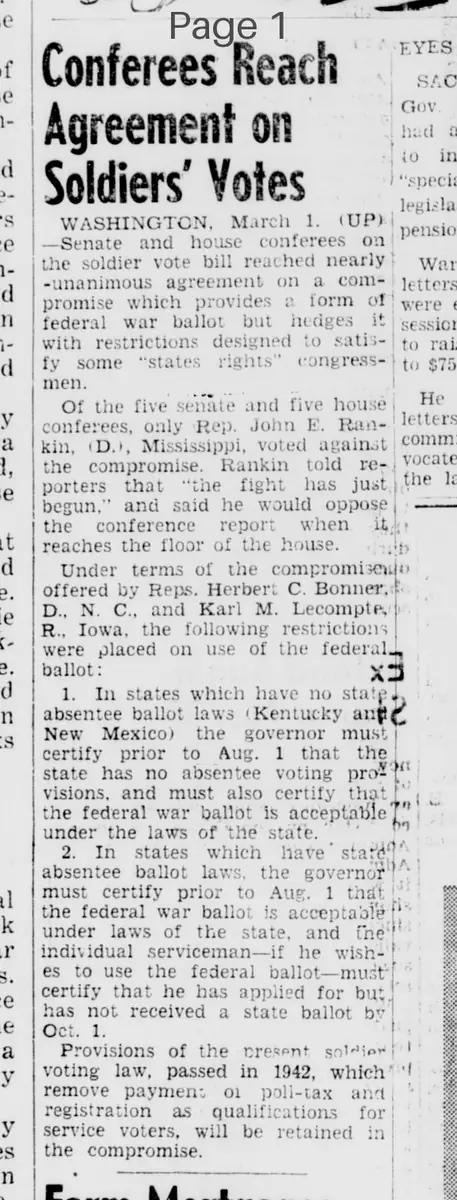
Conferees Reach Agreement on Soldiers' Votes
WASHINGTON, March 1. (UP)—Senate and house conferees on the soldier vote bill reached nearly unanimous agreement on a compromise which provides a form of federal war ballot but hedges it with restrictions designed to satisfy some "states rights" congressmen.
Of the five senate and five house conferees, only Rep. John E. Rankin, (D.), Mississippi, voted against the compromise. Rankin told reporters that "the fight has just begun," and said he would oppose the conference report when it reaches the floor of the house.
Under terms of the compromise—offered by Reps. Herbert C. Bonner, D., N. C., and Karl M. Lecompte, R., Iowa—the following restrictions were placed on use of the federal ballot:
1. In states which have no state absentee ballot laws (Kentucky and New Mexico) the governor must certify prior to Aug. 1 that the state has no absentee voting provisions, and must also certify that the federal war ballot is acceptable under the laws of the state.
2. In states which have standard absentee ballot laws, the governor must certify prior to Aug. 1 that the federal war ballot is acceptable under laws of the state, and the individual serviceman—if he wishes to use the federal ballot—must certify that he has applied for but has not received a state ballot by Oct. 1.
Provisions of the present soldier voting law, passed in 1942, which remove payment of poll-tax and registration as qualifications for service voters, will be retained in the compromise.
WASHINGTON, March 1. (UP)—Senate and house conferees on the soldier vote bill reached nearly unanimous agreement on a compromise which provides a form of federal war ballot but hedges it with restrictions designed to satisfy some "states rights" congressmen.
Of the five senate and five house conferees, only Rep. John E. Rankin, (D.), Mississippi, voted against the compromise. Rankin told reporters that "the fight has just begun," and said he would oppose the conference report when it reaches the floor of the house.
Under terms of the compromise—offered by Reps. Herbert C. Bonner, D., N. C., and Karl M. Lecompte, R., Iowa—the following restrictions were placed on use of the federal ballot:
1. In states which have no state absentee ballot laws (Kentucky and New Mexico) the governor must certify prior to Aug. 1 that the state has no absentee voting provisions, and must also certify that the federal war ballot is acceptable under the laws of the state.
2. In states which have standard absentee ballot laws, the governor must certify prior to Aug. 1 that the federal war ballot is acceptable under laws of the state, and the individual serviceman—if he wishes to use the federal ballot—must certify that he has applied for but has not received a state ballot by Oct. 1.
Provisions of the present soldier voting law, passed in 1942, which remove payment of poll-tax and registration as qualifications for service voters, will be retained in the compromise.
What sub-type of article is it?
Historical Event
What themes does it cover?
Justice
What keywords are associated?
Soldier Vote
Federal Ballot
States Rights
Legislative Compromise
War Ballot Restrictions
What entities or persons were involved?
John E. Rankin
Herbert C. Bonner
Karl M. Lecompte
Where did it happen?
Washington
Story Details
Key Persons
John E. Rankin
Herbert C. Bonner
Karl M. Lecompte
Location
Washington
Event Date
March 1
Story Details
Senate and House conferees reach compromise on federal war ballot for soldiers, with restrictions requiring state governors' certifications; only Rep. Rankin opposes.