Thank you for visiting SNEWPapers!
Sign up free
Editorial
April 27, 1846
American Republican And Baltimore Daily Clipper
Baltimore, Maryland
What is this article about?
Editorial opposes a proposed increase in U.S. postage rates discussed in the House of Representatives, arguing the recent reduction should remain to benefit public correspondence, as the post office is for accommodation, not revenue, and other expenditures can be cut instead.
Clipping
OCR Quality
98%
Excellent
Full Text
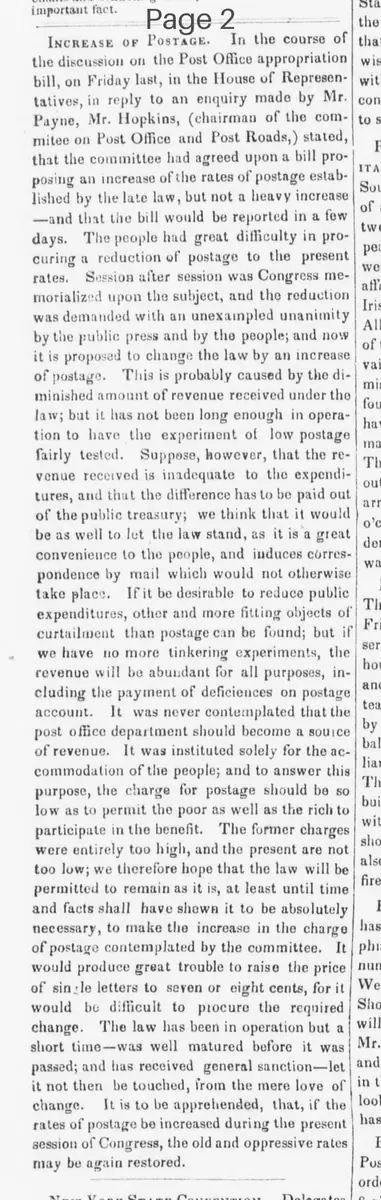
Increase of Postage.
In the course of the discussion on the Post Office appropriation bill, on Friday last, in the House of Representatives, in reply to an enquiry made by Mr. Payne, Mr. Hopkins, (chairman of the committee on Post Office and Post Roads,) stated that the committee had agreed upon a bill proposing an increase of the rates of postage established by the late law, but not a heavy increase—and that the bill would be reported in a few days.
The people had great difficulty in procuring a reduction of postage to the present rates. Session after session was Congress memorialized upon the subject, and the reduction was demanded with an unprecedented unanimity by the public press and by the people; and now it is proposed to change the law by an increase of postage.
This is probably caused by the diminished amount of revenue received under the law; but it has not been long enough in operation to have the experiment of low postage fairly tested.
Suppose, however, that the revenue received is inadequate to the expenditures, and that the difference has to be paid out of the public treasury; we think that it would be as well to let the law stand, as it is a great convenience to the people, and induces correspondence by mail which would not otherwise take place.
If it be desirable to reduce public expenditures, other and more fitting objects of curtailment than postage can be found; but if we have no more tinkering experiments, the revenue will be abundant for all purposes, including the payment of deficiencies on postage account.
It was never contemplated that the post office department should become a source of revenue. It was instituted solely for the accommodation of the people; and to answer this purpose, the charge for postage should be so low as to permit the poor as well as the rich to participate in the benefit.
The former charges were entirely too high, and the present are not too low; we therefore hope that the law will be permitted to remain as it is, at least until time and facts shall have shewn it to be absolutely necessary, to make the increase in the charge of postage contemplated by the committee.
It would produce great trouble to raise the price of single letters to seven or eight cents, for it would be difficult to procure the required change.
The law has been in operation but a short time—was well matured before it was passed; and has received general sanction—let it not then be touched, from the mere love of change.
It is to be apprehended, that, if the rates of postage be increased during the present session of Congress, the old and oppressive rates may be again restored.
In the course of the discussion on the Post Office appropriation bill, on Friday last, in the House of Representatives, in reply to an enquiry made by Mr. Payne, Mr. Hopkins, (chairman of the committee on Post Office and Post Roads,) stated that the committee had agreed upon a bill proposing an increase of the rates of postage established by the late law, but not a heavy increase—and that the bill would be reported in a few days.
The people had great difficulty in procuring a reduction of postage to the present rates. Session after session was Congress memorialized upon the subject, and the reduction was demanded with an unprecedented unanimity by the public press and by the people; and now it is proposed to change the law by an increase of postage.
This is probably caused by the diminished amount of revenue received under the law; but it has not been long enough in operation to have the experiment of low postage fairly tested.
Suppose, however, that the revenue received is inadequate to the expenditures, and that the difference has to be paid out of the public treasury; we think that it would be as well to let the law stand, as it is a great convenience to the people, and induces correspondence by mail which would not otherwise take place.
If it be desirable to reduce public expenditures, other and more fitting objects of curtailment than postage can be found; but if we have no more tinkering experiments, the revenue will be abundant for all purposes, including the payment of deficiencies on postage account.
It was never contemplated that the post office department should become a source of revenue. It was instituted solely for the accommodation of the people; and to answer this purpose, the charge for postage should be so low as to permit the poor as well as the rich to participate in the benefit.
The former charges were entirely too high, and the present are not too low; we therefore hope that the law will be permitted to remain as it is, at least until time and facts shall have shewn it to be absolutely necessary, to make the increase in the charge of postage contemplated by the committee.
It would produce great trouble to raise the price of single letters to seven or eight cents, for it would be difficult to procure the required change.
The law has been in operation but a short time—was well matured before it was passed; and has received general sanction—let it not then be touched, from the mere love of change.
It is to be apprehended, that, if the rates of postage be increased during the present session of Congress, the old and oppressive rates may be again restored.
What sub-type of article is it?
Economic Policy
Taxation
Infrastructure
What keywords are associated?
Postage Rates
Post Office Bill
Revenue Deficiency
Public Convenience
Congressional Appropriation
Mail Correspondence
What entities or persons were involved?
Mr. Payne
Mr. Hopkins
House Of Representatives
Congress
Committee On Post Office And Post Roads
Editorial Details
Primary Topic
Opposition To Proposed Increase In Postage Rates
Stance / Tone
Opposed To Increasing Postage Rates For Public Convenience
Key Figures
Mr. Payne
Mr. Hopkins
House Of Representatives
Congress
Committee On Post Office And Post Roads
Key Arguments
People Struggled For Years To Reduce Postage Rates, Now Proposing Increase Too Soon
Low Rates Not Tested Long Enough Despite Revenue Drop
Post Office For Public Accommodation, Not Revenue Source
Cut Other Expenditures Instead Of Raising Postage
Low Rates Encourage Mail Use By All Classes
Increasing To 7 8 Cents Would Cause Practical Troubles With Change
Law Recently Passed And Sanctioned, Avoid Unnecessary Changes