Thank you for visiting SNEWPapers!
Sign up free
Rhode Island American And Providence Gazette
Providence, Providence County, Rhode Island
What is this article about?
Henry Brougham addresses Glasgow University students in his 1825 inaugural discourse as Lord Rector, urging diligent study in youth to gain knowledge and virtue for future enlightenment of society, emphasizing writing for effective speaking and benevolent leadership over ambition.
Merged-components note: The epigraph text continues the extract from Henry Brougham's inaugural discourse, forming a single literary piece.
Clippings
1 of 2
OCR Quality
Full Text
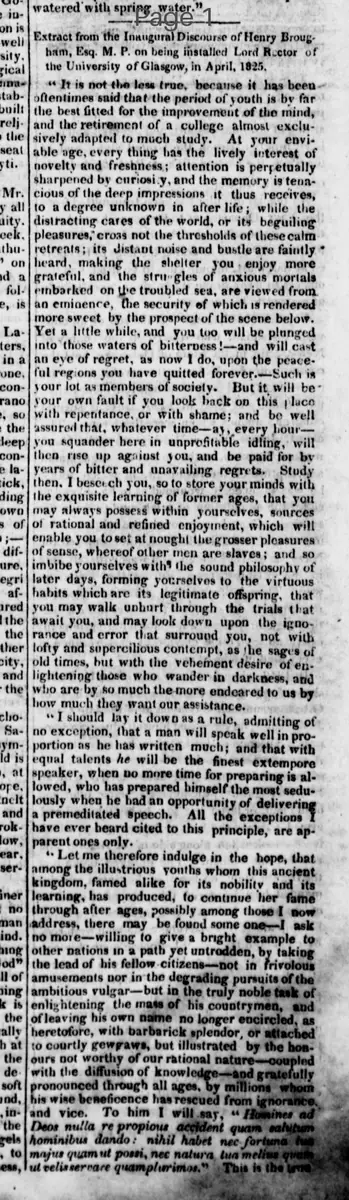
"It is not the less true, because it has been oftentimes said that the period of youth is by far the best fitted for the improvement of the mind, and the retirement of a college almost exclusively adapted to much study. At your enviable age, every thing has the lively interest of novelty and freshness; attention is perpetually sharpened by curiosity, and the memory is tenacious of the deep impressions it thus receives, to a degree unknown in after life; while the distracting cares of the world, or its beguiling pleasures, cross not the thresholds of these calm retreats; its distant noise and bustle are faintly heard, making the shelter you enjoy more grateful, and the struggles of anxious mortals embarked on the troubled sea, are viewed from an eminence, the security of which is rendered more sweet by the prospect of the scene below.
Yet a little while, and you too will be plunged into those waters of bitterness!—and will cast an eye of regret, as now I do, upon the peaceful regions you have quitted forever.—Such is your lot as members of society. But it will be your own fault if you look back on this place with repentance, or with shame; and be well assured that, whatever time—ay, every hour—you squander here in unprofitable idling, will then rise up against you, and be paid for by years of bitter and unavailing regrets. Study then, I beseech you, so to store your minds with the exquisite learning of former ages, that you may always possess within yourselves, sources of rational and refined enjoyment, which will enable you to set at nought the grosser pleasures of sense, whereof other men are slaves; and so imbibe yourselves with the sound philosophy of later days, forming yourselves to the virtuous habits which are its legitimate offspring, that you may walk unhurt through the trials that await you, and may look down upon the ignorance and error that surround you, not with lofty and supercilious contempt, as the sages of old times, but with the vehement desire of enlightening those who wander in darkness, and who are by so much the more endeared to us by how much they want our assistance.
"I should lay it down as a rule, admitting of no exception, that a man will speak well in proportion as he has written much; and that with equal talents he will be the finest extempore speaker, when no more time for preparing is allowed, who has prepared himself the most sedulously when he had an opportunity of delivering a premeditated speech. All the exceptions have ever heard cited to this principle, are apparent ones only
Let me therefore indulge in the hope, that among the illustrious youths whom this ancient kingdom, famed alike for its nobility and its learning, has produced, to continue her fame through after ages, possibly among those I now address, there may be found some one—I ask no more—willing to give a bright example to other nations in a path yet untrodden, by taking the lead of his fellow-citizens—not in frivolous amusements nor in the degrading pursuits of the ambitious vulgar—but in the truly noble task of enlightening the mass of his countrymen, and of leaving his own name no longer encircled, as heretofore, with barbarick splendor, or attached to courtly gewgaws, but illustrated by the honours not unworthy of our rational nature—coupled with the diffusion of knowledge—and gratefully pronounced through all ages, by millions whom his wise beneficence has rescued from ignorance and vice. To him I will say, "Homines ad Deos nulla re propinquius accedunt quam salutem hominibus dando: nihil habet nec fortuna tua majus quam ut possis, nec natura tua melius quam ut velis servare quamplurimos." This is the true...
Mark for the aim of all who either prize the enjoyment of future happiness, or set a right value upon a high and unalloyed retrospection. And if the mass of mankind, when they rest from their pious labours, shall be permitted to enjoy rest, if ever, in an appropriate reward of their virtue, the privilege of looking down upon the felicities with which their toils and sufferings have clothed the scene of their former existence; do not vainly imagine that in a state of exalted purity and wisdom, the founders of mighty dynasties, the conquerors of new empires, or the enormous vulgar crowd of evil doers, who have sacrificed to their own aggrandizement the good of their fellow-creatures, will be gratified by contemplating the monuments of their inglorious fame.--Theirs will be the delight--theirs the triumph--who can trace the remote effects of their enlightened benevolence in the improved condition of their species, and exult in the reflection, that the prodigious change they now survey with eyes that age and sorrow can make dim no more--of human knowledge become power--virtue sharing in the dominion; superstition trampled under foot--tyranny driven from the world, are the fruits, precious, though costly and tough won, yet long enduring, of all the hardships, and all the hazards they encountered here below.
What sub-type of article is it?
What themes does it cover?
What keywords are associated?
What entities or persons were involved?
Literary Details
Title
Extract From The Inaugural Discourse Of Henry Brougham, Esq. M. P. On Being Installed Lord Rector Of The University Of Glasgow, In April, 1825.
Author
Henry Brougham, Esq. M. P.
Subject
On Being Installed Lord Rector Of The University Of Glasgow, In April, 1825.
Key Lines