Thank you for visiting SNEWPapers!
Sign up free
The Key West Citizen
Key West, Monroe County, Florida
What is this article about?
An American exchange student shares impressions from visits with Soviet and Polish students. In the USSR, private gatherings reveal hidden Western influences and rare criticisms amid shortages and guarded conversations. In Poland, students express more open anti-Soviet sentiments and concerns about independence.
Clipping
OCR Quality
Full Text
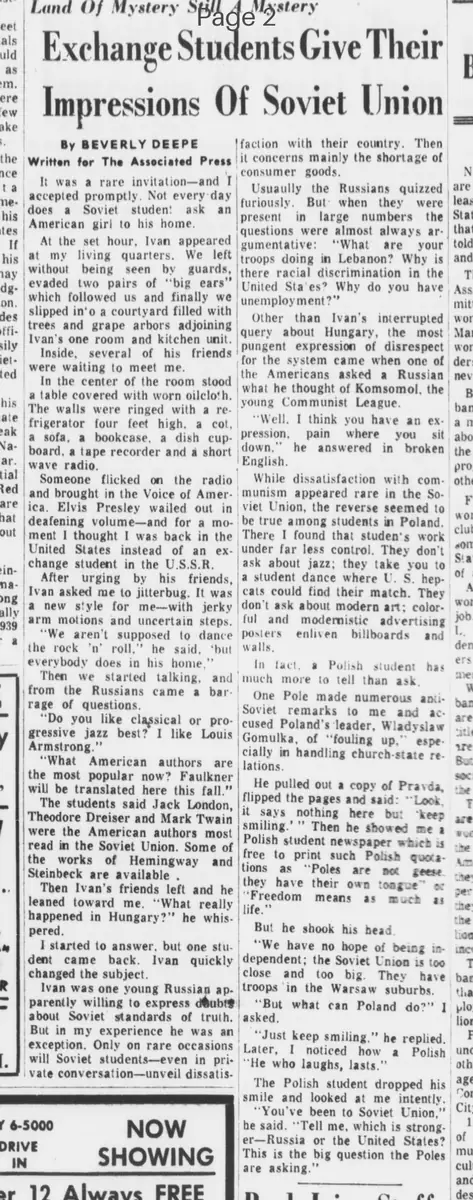
It was a rare invitation—and I accepted promptly. Not every day does a Soviet student ask an American girl to his home.
At the set hour, Ivan appeared at my living quarters. We left without being seen by guards, evaded two pairs of "big ears" which followed us and finally we slipped into a courtyard filled with trees and grape arbors adjoining Ivan's one room and kitchen unit.
Inside, several of his friends were waiting to meet me.
In the center of the room stood a table covered with worn oilcloth. The walls were ringed with a refrigerator four feet high, a cot, a sofa, a bookcase, a dish cupboard, a tape recorder and a short wave radio.
Someone flicked on the radio and brought in the Voice of America. Elvis Presley wailed out in deafening volume—and for a moment I thought I was back in the United States instead of an exchange student in the U.S.S.R.
After urging by his friends, Ivan asked me to jitterbug. It was a new style for me—with jerky arm motions and uncertain steps.
"We aren't supposed to dance the rock 'n' roll," he said, "but everybody does in his home."
Then we started talking, and from the Russians came a barrage of questions.
"Do you like classical or progressive jazz best? I like Louis Armstrong."
"What American authors are the most popular now? Faulkner will be translated here this fall."
The students said Jack London, Theodore Dreiser and Mark Twain were the American authors most read in the Soviet Union. Some of the works of Hemingway and Steinbeck are available.
Then Ivan's friends left and he leaned toward me. "What really happened in Hungary?" he whispered.
I started to answer, but one student came back. Ivan quickly changed the subject.
Ivan was one young Russian apparently willing to express doubts about Soviet standards of truth.
But in my experience he was an exception. Only on rare occasions will Soviet students—even in private conversation—unveil dissatisfaction with their country. Then it concerns mainly the shortage of consumer goods.
Usually the Russians quizzed furiously. But when they were present in large numbers the questions were almost always argumentative:
"What are your troops doing in Lebanon? Why is there racial discrimination in the United States? Why do you have unemployment?"
Other than Ivan's interrupted query about Hungary, the most pungent expression of disrespect for the system came when one of the Americans asked a Russian what he thought of Komsomol, the young Communist League.
"Well, I think you have an expression, pain where you sit down," he answered in broken English.
While dissatisfaction with communism appeared rare in the Soviet Union, the reverse seemed to be true among students in Poland.
There I found that students work under far less control. They don't ask about jazz; they take you to a student dance where U.S. hepcats could find their match. They don't ask about modern art: colorful and modernistic advertising posters enliven billboards and walls.
In fact, a Polish student has much more to tell than ask.
One Pole made numerous anti-Soviet remarks to me and accused Poland's leader, Wladyslaw Gomulka, of "fouling up," especially in handling church-state relations.
He pulled out a copy of Pravda, flipped the pages and said: "Look, it says nothing here but keep smiling." Then he showed me a Polish student newspaper which was free to print such Polish quotations as "Poles are not geese they have their own tongue"
"Freedom means as much as life."
But he shook his head. "We have no hope of being independent; the Soviet Union is too close and too big. They have troops in the Warsaw suburbs.
"But what can Poland do?" I asked.
"Just keep smiling," he replied.
Later, I noticed how a Polish student dropped his smile and looked at me intently.
"...You've been to Soviet Union," he said. "Tell me, which is stronger—Russia or the United States?
This is the big question the Poles are asking."
What sub-type of article is it?
What themes does it cover?
What keywords are associated?
What entities or persons were involved?
Where did it happen?
Story Details
Key Persons
Location
Soviet Union And Poland
Story Details
An American exchange student visits Ivan's home in the USSR, evading surveillance, listens to Western music, dances rock 'n' roll privately, discusses American culture, and hears rare whispers of doubt about Soviet truth and Hungary events. Soviet students rarely show dissatisfaction beyond consumer shortages and argue about U.S. issues. In Poland, students are freer, openly criticize the Soviets and Gomulka, express desire for independence despite Soviet presence, and question U.S. vs. Soviet strength.