Thank you for visiting SNEWPapers!
Sign up free
American Citizen
Canton, Madison County, Mississippi
What is this article about?
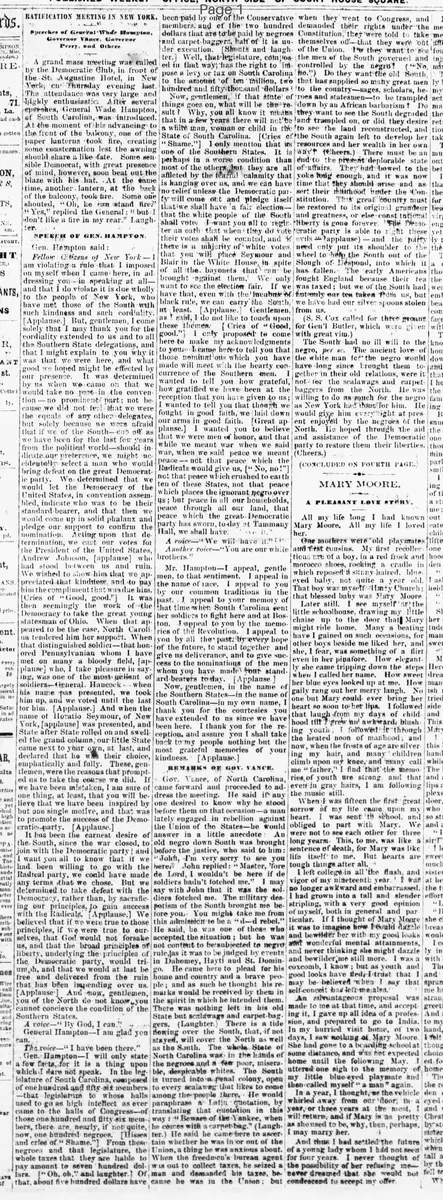
Grand Democratic mass meeting in New York with speeches by Gen. Wade Hampton of South Carolina, Gov. Vance of North Carolina, and Gov. Perry of South Carolina endorsing Horatio Seymour and Frank Blair nominations, criticizing Reconstruction and Radical rule in the South.
Merged-components note: Merged continuation of the article on speeches by General Wade Hampton, Governor Vance, and Governor Perry from page 1 (ending with 'CONCLUDED ON FOURTH PAGE.') to page 4.
Clippings
1 of 2
OCR Quality
Full Text
Governor Vance, Governor
Perry, and Others.
A grand mass meeting was called
by the Democratic Club, in front of
the St. Augustine Hotel, in New
York, on Thursday evening last.
The attendance was very large and
highly enthusiastic. After several
speeches, General Wade Hampton,
of South Carolina, was introduced.
At the moment of his advancing to
the front of the balcony, one of the
paper lanterns took fire, creating
some consternation lest the awning
should share a like fate. Some sensible Democrat, with great presence
of mind, however, soon beat out the
blaze with his hat. At the same
time, another lantern, at the back
of the balcony, took fire. Some one
shouted, "Oh, he can stand fire?"
"Yes," replied the General; but I
don't like a fire in my rear." Laughter.
SPEECH OF GEN. HAMPTON.
Gen. Hampton said:
Fellow Citizens of New York -I
am violating a rule that I imposed
on myself when I came here, in addressing you-in speaking at all-
and that I do violate it is due wholly
to the people of New York, who
have met those of the South with
such kindness and such cordiality.
[Applause.] But, gentlemen, I come
solely that I may thank you for the
cordiality extended to us and to all
the Southern State delegations, and
that I might explain to you why it
was that we were here, and what
good we hoped might be effected by
our presence. It was determined
by us when we came on that we
would take no part in the convention-no prominent part; not because we did not feel that we were
the equals of any other delegates.
but solely because we were afraid
that if we of the South-cut off as
we have been for the last few years
from the political world-should indicate our preference, we might accidentally select a man who would
bring defeat on the great Democratic party. We determined that we
would let the Democracy of the
United States, in convention assembled, indicate who was to be their
standard-bearer, and that then we
would come up in solid phalanx and
pledge our support to confirm the
nomination. Acting upon that determination, we cast our votes for
the President of the United States,
Andrew Johnson, [applause] who
had stood between us and ruin.
We wished to show him that we appreciated that kindness, and to pay
him the compliment that was due him.
[Cries of "Good, good."] It was
then seemingly the work of the
Democracy to take the great young
statesman of Ohio. When that appeared to be the case, North Carolina tendered him her support. When
that distinguished soldier-that honored Pennsylvanian whom I have
met on many a bloody field, [applause] who, I take pleasure in saying, was one of the most gallant of
soldiers-General Hancock- when
his name was presented, we took
him up, and we voted until the last
for him. [Applause.] And when the
name of Horatio Seymour, of New
York, [applause] was presented, and
State after State rolled on and swelled the grand column; our little State
came next to your own, at last, and
declared that he was their choice,
emphatically and fully. These, gentlemen, were the reasons that prompted us to take the course we did. If
we have been mistaken, I am sure of
one thing, at least, that you will believe that we have been inspired by
but one single motive, and that was
to promote the success of the Democratic party. [Applause.]
It has been the earnest desire of
the South, since the war closed, to
join with the Democratic party; and
I want you all to know that if we
had been willing to go with the
Radical party, we could have made
any terms that we chose. But we
determined to take defeat with the
Democracy, rather than, by sacrificing our principles, to gain success
with the Radicals. [Applause.] We
believed that if we were true to those principles, if we were true to our
selves, that God would not forsake
us, and that the broad principles of
liberty, underlying the principles of
the Democratic party, would triumph, and that we would at last be
free and delivered from the ruin
that has been impending over us.
[Applause.] And now, gentlemen,
you of the North do not know-you
cannot conceive the condition of the
Southern States.
A voice-"By God, I can."
General Hampton-I am glad you
can.
That voice-"I have been there."
Gen. Hampton-I will only state
a few facts, for it is a thing upon
which I dare not speak. In the legislature of South Carolina, composed
of one hundred and fifty-six members-that legislature to whose halls
used to go as high intellect as ever
came to the halls of Congress-of
those one hundred and fifty-six members, there are, nearly, if not quite,
now, one hundred negroes. [Hisses
and cries of "Shame."] From these
negroes and that legislature, the
whole taxes that they are liable to
pay amount to seven hundred dollars.
["Oh, oh," and laughter.] Of
that, about five hundred dollars have
been paid by one of the Conservative
members, and of the two hundred
dollars that are to be paid by negroes
and carpet-baggers, half of it is under execution. [Shouts and laughter.]
Well, that legislature, composed
in that way, has the right to impose a levy or tax on South Carolina
to the amount of ten million, two
hundred and fifty thousand dollars!
Now, gentlemen, if that state of
things goes on, what will be the result? Why, you all know it means
that in a few years there will not be
a white man, woman or child in the
State of South Carolina. [Cries of
"Shame."] I only mention that as
one of the Southern States. It is
perhaps in a worse condition than
most of the others, but they are all
affected by the fearful calamity that
is hanging over us, and we can have
no relief unless the Democratic party will come out and pledge itself
that we shall have a fair election-
that the white people of the South
shall vote -I want you all to register an oath that when they do vote
their votes shall be counted, and if
there is a majority of white votes
that you will place Seymour and
Blair in the White House, in spite
of all the bayonets that can be
brought against them. We only
want to see the election fair. If we
have that, even with the incubus of
black rule, we can carry the South,
at least. [Applause.] "Gentlemen,
as I said, I do not like to touch upon
these themes." Cries of "Good,
good."] I only proposed to come
here to make my acknowledgments
to you. I came here to tell you that
those nominations which you have
made will meet with the hearty concurrence of the Southern men.
I wanted to tell you how grateful,
how gratified we have been at the
reception that you have given to us;
I wanted to tell you that though we
fought in good faith, we laid down
our arms in good faith. [Great applause.] I wanted you to believe
that we were men of honor, and that
while we meant war when we said
war, when we said peace we meant
peace- not that peace which the
Radicals would give us, ["No, no!"]
not that peace which crushed to earth ten of these States, not that peace
which places the ignorant negro over
us; but peace in all our households,
peace through all our land, that
peace which the great Democratic
party has sworn, to-day at Tammany
Hall, we shall have
A voice-"We will have it."
Another voice-"You are our white
brothers."
Mr. Hampton-I appeal, gentlemen, to that sentiment. I appeal in
the name of race. I appeal to you
by our common traditions in the
past. I appeal to your memory of
that time when South Carolina sent
her soldiers to fight here and at Boston. I appeal to you by the memories of the Revolution. I appeal to
you by all the past: by every hope
of the future, to stand together and
give us deliverance, and to give success to the nominations of the men
whom you have made our standard-bearers to-day. [Applause.]
Now, gentlemen, in the name of
the Southern States-in the name of
South Carolina-in my own name, I
thank you for the courtesies you
have extended to us since we have
been here. I thank you for the reception, and assure you I shall take
back to my people nothing but the
most grateful memories of your
kindness. [Applause.]
Gov. Vance, of North Carolina,
came forward and proceeded to address the meeting. He said if any
one desired to know why he stood
before them on that occasion-a man
lately engaged in rebellion against
the Union of the States-he would
answer in a little anecdote : An
old negro down South was brought
before the justice, who said to him:
"John, I am very sorry to see you
here?" John replied: "Master, 'fore
de Lord, I wouldn't be here if de
soldiers hadn't fotched me." I may
say with John that it was the soldiers fotched me. The military despotism of the South brought me before you. You might take me from
this audience to be a "d-d rebel."
He said he was one of those who
accepted the situation; but he was
not content to be subjected to negro
rule, as it was to be judged by events in Dahomey, Hayti and St. Domingo.
He came here to plead for his
home and country and a brave people; and as such he thought his remarks would be received by them in
the spirit in which he intended them.
There was nothing left in his old
State but scalawags and carpet-baggers. (Laughter.) There is a tide
flowing over the South, that, if not
stayed, will cover the North as well
as the South. The whole State of
North Carolina was in the hands of
the negroes and a few poor, miserable, despicable whites. The South
is turned into a penal colony, open
to every scalawag that likes to come
among the people there. He would
paraphrase a Latin quotation, by
translating that quotation in this
way : "Beware of the Yankee, when
he comes with a carpet-bag." (Laughter.) He said he came here to ascertain whether he was in or out of the
Union, a thing he was anxious about.
When the freedmen's bureau agent
was out to collect taxes, he seized a
man and demanded his taxes, because he was in the Union; but
when they went to Congress, and
demanded their rights under the
Constitution, they were told to take
themselves off-that they were out
of the Union. Do they want to see
the men of the South governed and
controlled by the negro? (No,
no.) Do they want the old South,
that has supplied so many great men
to the country-sages, scholars, heroes and statesmen-to be trampled
down by an African barbarism? Do
they want to see the South degraded and trampled on, or did they desire to see the land reconstructed, and
the South again left to develop her
resources and her wealth in her own
way? (Cheers.) There must be an
end to the present deplorable state
of affairs. They had bowed to the
yoke long enough, and it was now
time that they should arise and assert their manhood under the Constitution. This great country must
be restored to its original grandeur
and greatness, or else constitutional
liberty is gone forever. The Democratic party is able to right these
evil (applause) -and the party
need only put its shoulder to the
wheel to throw the South out of the
Slough of Despond, into which it
has fallen. The early Americans
fought England because their tea
was taxed; but we of the South had
not only our tea taken from us, but
we have had our silver spoons stolen
from us.
(S. S. Cox called for three groans
for Gen'l Butler, which were given
with great vim.)
The South had no ill will to the
negro, per se. The ancient love of
the white man for the negro would
have long since brought them together in their old relations, were it
not for the scalawags and carpet-
baggers from the North. He was
willing to do as much for the negro
as New York had done for him. He
would give him every right at present enjoyed by the negroes of the
North. He hoped through the aid
and assistance of the Democratic
party to restore them their liberties.
(Cheers.)
(CONCLUDED ON FOURTH PAGE.)
Political.
"SPEECH OF GOV. PERRY."
Governor Perry, of South Carolina, said: I had the honor of addressing you last night, and would not do so again but for the events of this day. We have in the old Hall of Tammany nominated a standard bearer for the American Democracy—Horatio Seymour. [Cheers.] We have nominated General Frank Blair, of Missouri, a noble and gallant soldier, as Vice President on the Democratic ticket. I simply say to you on this occasion that I most heartily endorse the nominations which have been made this day, and that they will be endorsed by every Southern State I am sure. And I do believe, I am confident that when the election comes on, that with Horatio Seymour as our gallant leader, and Frank Blair as Vice President, we shall carry our ticket triumphantly for the Democratic party, in East, West, North and South.
Fellow-citizens, I do not believe in the military glory which is said to be long to the chief of the Radical party. I do not believe that their leader, who sacrificed a hundred thousand men in Virginia in marching to a point to which General McClellan marched without the loss of a man; I say I do not believe in such a man [Cheers and applause] General Grant threw his men against the veterans of General Lee, it would seem merely to have them slaughtered; and gentleman, I cannot believe that the brothers and kindred of these men can feel any enthusiasm toward the party that chose such a general. And, gentleman, further, when your soldiers were captured by the Confederates, and when the Confederates were so poor that they could not furnish their own or your soldiers with food such food as they ought to have, they applied to General Grant and to the United States Government: "We can't exchange. Because if we exchange the prisoners we will be renewing Confederate soldiers to fight us again, And although our soldiers are left to perish in Southern prisons, there they must perish and die for the country's sake." Now, gentlemen, I do not believe that the hundred of those soldiers who perished in the South can have a very great enthusiasm on Grant to the Presidency. But, we follow citizens have presented to the Republican a noble and distinguished citizen and statesman of your own State, of your own great Empire State—a citizen and statesman of the great metropolis of the United States. I felt certain to day of his election, for his nomination was made on the first ballot; the first time his name was mentioned was by the gallant delegation of Ohio. [A voice—"God bless them."] That name was received with a burst of applause throughout the convention: and the States wheeled into line: and last of all New York, which did not wish to obtrude herself or her preferences in the Convention, endorsed the nomination. [Enthusiastic cheers.] I feel sure that the great States of New York and Ohio, which have already shown such large Democratic majorities, will roll up still larger majorities for our candidates, I feel confident. also, that Virginia, the mother of States and of Statesmen, will give Horatio Seymour and Frank Blair a very large majority, notwithstanding the negro vote of that State I feel confident, also of North Carolina, and of South Carolina For, gentleman, as soon as the Federal army is withdrawn from South Carolina: as soon as the people of South Carolina are again free, the "carpet baggers" who have been ruling the negroes will disappear, and the negroes will rally round their true friends and vote with true friends. I am sure, also, of Georgia. Of Mississippi there is no doubt. for she has already rejected the negro constitution which was imposed on her. Alabama has also rejected the negro constitution, I am confident also of Louisiana. We know that we are safe for Ohio, Pennsylvania, New Jersey, New York and Connecticut, and I may say that of Indiana and Illinois I have as little doubt. (Gentlemen, it is a great principle that we are contending for. it is despotism and ruin on the one hand, and liberty and prosperity on the other. It is for you to choose which we will have. The Governor then reviewed at length the question of taxation, the Freedmen's Bureau, and military rule in the South. and concluded by returning thanks for the kind reception he had met with:)
What sub-type of article is it?
What keywords are associated?
What entities or persons were involved?
Where did it happen?
Domestic News Details
Primary Location
New York
Event Date
Thursday Evening Last
Key Persons
Outcome
endorsement of democratic nominations of horatio seymour for president and frank blair for vice president by southern delegates; expressions of support for fair elections and criticism of radical reconstruction policies.
Event Details
A large and enthusiastic Democratic mass meeting held in front of the St. Augustine Hotel in New York, featuring speeches by Southern leaders General Wade Hampton, Governor Vance of North Carolina, and Governor Perry of South Carolina. Hampton thanked Northern Democrats for hospitality, explained Southern delegates' convention strategy, criticized Reconstruction legislature in South Carolina, and appealed for support of Seymour and Blair to ensure fair elections. Vance shared an anecdote about his presence, decried negro rule and carpetbaggers in the South, and called for restoration of constitutional liberties. Perry endorsed the nominations, criticized General Grant's military record, predicted victory in multiple states, and discussed taxation, Freedmen's Bureau, and military rule.