Thank you for visiting SNEWPapers!
Sign up free
The Pascagoula Democrat Star
Pascagoula, Jackson County, Mississippi
What is this article about?
A scheming city youth courts a country girl for her secret inheritance, but she overhears the plot, rejects him, and returns to her honest fiancé, refusing the fortune that rightfully belongs to another.
Merged-components note: These three components form a continuous narrative story titled 'AN ACT OF JUSTICE' with sequential reading order and flowing text.
Clipping
OCR Quality
Full Text
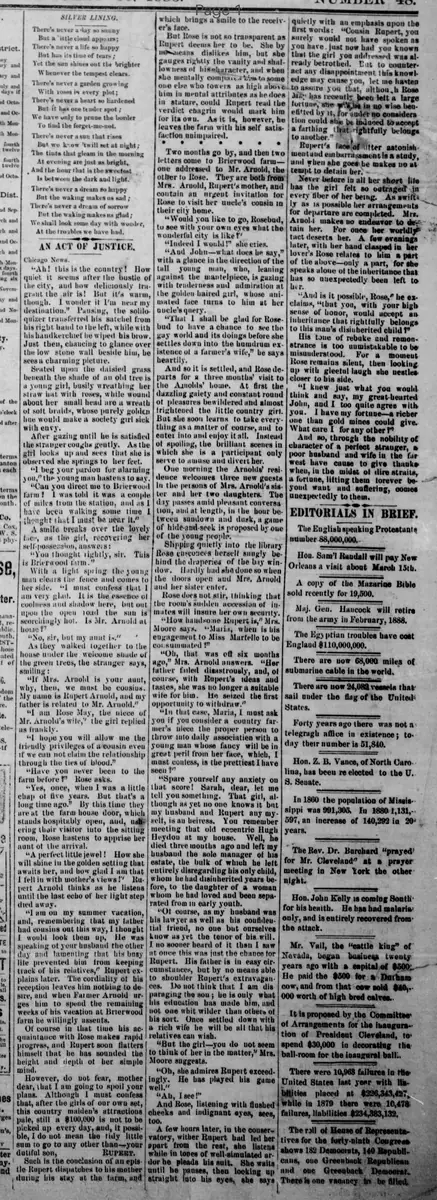
Chicago News.
"Ah! this is the country! How quiet it seems after the bustle of the city, and how deliciously fragrant the air is! But it's warm, though. I wonder if I'm near my destination." Pausing, the soliloquizer transferred his satchel from his right hand to the left, while with his handkerchief he wiped his brow. Just then, chancing to glance over the low stone wall beside him, he sees a charming picture.
Seated upon the daisied grass beneath the shade of an old tree is a young girl, busily wreathing her straw hat with roses, while wound about her small head are a wreath of soft braids, whose purely golden hue would make a society girl sick with envy.
After gazing until he is satisfied the stranger coughs gently. As the girl looks up and sees that she is observed she springs to her feet.
"I beg your pardon for alarming you," the young man hastens to say. "Can you direct me to Brierwood farm! I was told it was a couple of miles from the station, and as I have been walking some time I thought that I must be near it,"
A smile breaks over the lovely face, as the girl, recovering her self-possession, answers:
"You thought rightly, sir. This is Brierwood farm."
With a light spring the young man clears the fence and comes to her side. "I must confess that I am very glad. It is the essence of coolness and shadow here, but out upon the open road the sun is scorchingly hot. Is Mr. Arnold at home?"
"No, sir, but my aunt is."
As they walked together to the house under the welcome shade of the green trees, the stranger says, smiling:
"If Mrs. Arnold is your aunt, why, then, we must be cousins. My name is Rupert Arnold, and my father is related to Mr. Arnold."
"I am Rose May, the niece of Mr. Arnold's wife," the girl replied as frankly.
"I hope you will allow me the friendly privileges of a cousin even if we can not claim the relationship through the ties of blood."
"Have you never been to the farm before?" Rose asks.
"Yes, once, when I was a little chap of five years. But that's a long time ago." By this time they are at the farm house door, which stands hospitably open, and, ushering their visitor into the sitting room, Rose hastens to apprise her aunt of the arrival.
"A perfect little jewel! How she will shine in the golden setting that awaits her, and how glad I am that I fell in with mother's views!' Rupert Arnold thinks as he listens until the last echo of her light step died away.
"I am on my summer vacation, and, remembering that my father had cousins out this way, I thought I would look them up. He was speaking of your husband the other day and lamenting that his busy life prevented him from keeping track of his relatives," Rupert explains later. The cordiality of his reception leaves him nothing to desire, and when Farmer Arnold urges him to spend the remaining weeks of his vacation at Brierwood farm he willingly assents.
Of course in that time his acquaintance with Rose makes rapid progress, and Rupert soon flatters himself that he has sounded the height and depth of her simple mind.
However, do not fear, mother dear, that I am going to spoil your plans. Although I must confess that, after the girls of our own set, this country maiden's attractions pale, still a $100,000 is not to be picked up every day, and, if possible, I do not mean the tidy little sum to go to any other than—your dutiful son,
RUPERT.
Such is the conclusion of an epistle Rupert dispatches to his mother during his stay at the farm, and which brings a smile to the receiver's face.
But Rose is not so transparent as Rupert deems her to be. She by no means dislikes him, but she gauges rightly the vanity and shallowness of his character, and when she mentally compares him to some one else who towers as high above him in mental attributes as he does in stature, could Rupert read the verdict chagrin would mark him for its own. As it is, however, he leaves the farm with his self-satisfaction unimpaired.
Two months go by, and then two letters come to Brierwood farm—one addressed to Mr. Arnold, the other to Rose. They are both from Mrs. Arnold, Rupert's mother, and contain an urgent invitation for Rose to visit her uncle's cousin in their city home.
"Would you like to go, Rosebud, to see with your own eyes what the wonderful city is like?"
"Indeed I would!" she cries.
"And John—what does he say," with a glance in the direction of the tall young man, who, leaning against the mantelpiece, is gazing with tenderness and admiration at the golden haired girl, whose animated face turns to him at her uncle's query.
"That I shall be glad for Rosebud to have a chance to see the gay world and its doings before she settles down into the humdrum existence of a farmer's wife," he says heartily.
And so it is settled, and Rose departs for a three months' visit to the Arnolds' home. At first the dazzling gaiety and constant round of pleasures bewildered and almost frightened the little country girl. But she soon learns to take everything as a matter of course, and to enter into and enjoy it all. Instead of spoiling, the brilliant scenes in which she is a participant only serve to amuse and divert her.
One morning the Arnolds' residence welcomes three new guests in the persons of Mrs. Arnold's sister and her two daughters. The day passes amid pleasant conversation, and at length, in the hour between sundown and dusk, a game of hide-and-seek is proposed by one of the young people.
Slipping quietly into the library Rose ensconces herself snugly behind the draperies of the bay window. Hardly had she done so when the doors open and Mrs. Arnold and her sister enter.
Rose does not stir, thinking that the room's sudden accession of inmates will insure her own security.
"Oh, that was off six months ago," Mrs. Arnold answers. "Her father failed disastrously, and, of course, with Rupert's ideas and tastes, she was no longer a suitable wife for him. He seized the first opportunity to withdraw."
"In that case, Maria, I must ask you if you consider a country farmer's niece the proper person to throw into daily association with a young man whose fancy will be in great peril from her face, which, I must confess, is the prettiest I have seen?"
"Spare yourself any anxiety on that score! Sarah, dear, let me tell you something. That girl, although as yet no one knows it but my husband and Rupert and myself, is an heiress. You remember meeting that old eccentric Hugh Heydon at my house. Well, he died three months ago and left my husband the sole manager of his estate, the bulk of which he left entirely disregarding his only child, whom he had disinherited years before, to the daughter of a woman whom he had loved and been separated from in early youth.
"Of course, as my husband was his lawyer as well as his confidential friend, no one but ourselves know as yet the tenor of his will. I no sooner heard of it than I saw at once this was just the chance for Rupert. His father is in easy circumstances, but by no means able to shoulder Rupert's extravagances. Do not think that I am disparaging the son: he is only what his education has made him, and not one whit wilder than others of his sort. Once settled down with a rich wife he will be all that his relatives can wish.
"But the girl—you do not seem to think of her in the matter," Mrs. Moore suggests.
"Oh, she admires Rupert exceedingly. He has played his game well."
"Ah, I see!"
And Rose, listening with flushed cheeks and indignant eyes, sees, too.
A few hours later, in the conservatory, whither Rupert had led her apart from the rest, she listens while in tones of well-simulated ardor he pleads his suit. She waits until he pauses, then looking up straight into his eyes, she says quietly with an emphasis upon the first words: "Cousin Rupert, you surely would not have spoken as you have just now had you known that the girl you addressed was already betrothed. But to counteract any disappointment this knowledge may cause you, let me hasten to assure you that, although Rose May has recently been left a large fortune, she will be in no wise benefited by it, for under no consideration could she be induced to accept a farthing that rightfully belongs to another."
Rupert's face of utter astonishment and embarrassment is a study, and when she goes he makes no attempt to detain her.
Never before in all her short life has the girl felt so outraged in every fiber of her being. As swiftly as is possible her arrangements for departure are completed. Mrs. Arnold makes no endeavor to detain her. For once her worldly tact deserts her. A few evenings later, with her hand clasped in her lover's Rose relates to him a part of the above—only a part, for she speaks alone of the inheritance that has so unexpectedly been left to her.
"And is it possible, Rose," he exclaims, "that you, with your high sense of honor, would accept an inheritance that rightfully belongs to this man's disinherited child!"
His tone of rebuke and remonstrance is too unmistakable to be misunderstood. For a moment Rose remains silent, then looking up with gleeful laugh she nestles closer to his side.
"I knew just what you would think and say, my great-hearted John, and I too quite agree with you. I have my fortune—a richer one than gold mines could give. What care I for any other!"
And so, through the nobility of character of a perfect stranger, a poor husband and wife in the far west have cause to give thanks when, in the midst of dire straits, a fortune, lifting them forever beyond want and suffering, comes unexpectedly to them.
What sub-type of article is it?
What themes does it cover?
What keywords are associated?
What entities or persons were involved?
Where did it happen?
Story Details
Key Persons
Location
Brierwood Farm; Arnolds' City Home
Story Details
Rupert Arnold courts Rose May at her uncle's farm, scheming with his mother to marry her for a secret inheritance from Hugh Heydon. Rose overhears the plot, rejects Rupert, refuses the fortune belonging to Heydon's disinherited child, and reaffirms her betrothal to John.