Thank you for visiting SNEWPapers!
Sign up free
Portland Gazette, And Maine Advertiser
Portland, Cumberland County, Maine
What is this article about?
An anonymous 'Real Republican' critiques the Democratic-Republican administrations of Jefferson and Madison for economic mismanagement, hypocrisy on fiscal promises, excessive war spending, and accumulating national debt during the War of 1812, contrasting with Federalist era economy.
Merged-components note: These components form a single editorial piece critiquing the war and administration, with the second being a footnote integrated into the main text.
Clipping
OCR Quality
Full Text
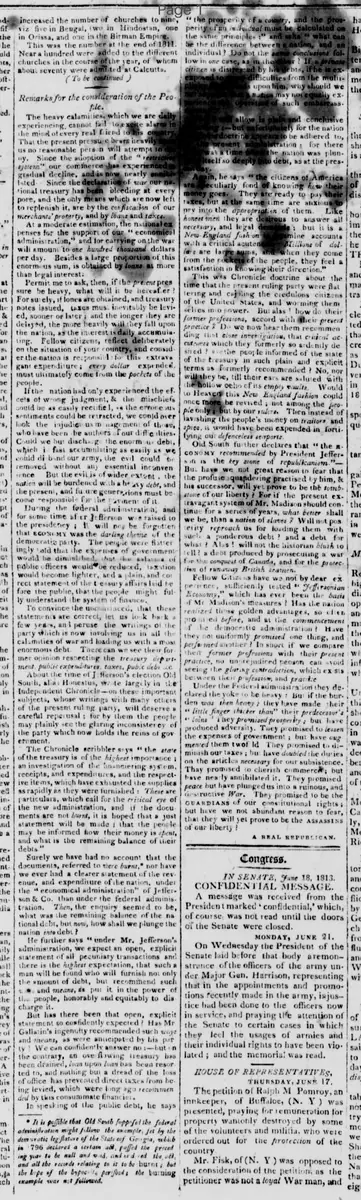
The heavy calamities, which we are daily experiencing, cannot fail to excite alarm in the mind of every real friend to his country. That the present pressure bears heavily on us no reasonable person will attempt to deny. Since the adoption of the "restrictive system" our commerce has experienced gradual decline, and is now nearly annihilated. Since the declaration of war our national treasury has been bleeding at every pore, and the only means which are now left to replenish it, are by the confiscation of our merchants' property, and by loans and taxes. At a moderate estimation, the national expenses for the support of our "economical administration," and for carrying on the war will amount to one hundred thousand dollars per day. Besides a large proportion of this enormous sum, is obtained by loans at more than legal interest:
Permit me to ask, then, if the present pressure be heavy, what will it be hereafter? For surely, if loans are obtained, and treasury notes issued, taxes must inevitably be levied, sooner or later: and the longer they are delayed, the more heavily will they fall upon the nation, as the interest is daily accumulating. Fellow citizens, reflect deliberately on the situation of your country, and consider the nation is responsible for this extravagant expenditure; every dollar expended must ultimately come from the pockets of the people.
If the nation had only experienced the effects of wrong judgment, & the mischiefs could be as easily rectified, as the erroneous sentiments could be retracted, we could overlook the injudicious management of those, who have been the authors of our difficulties. Could we but discharge the enormous debt, which is fast accumulating as easily as we could disband our army, the evil could be removed without any essential inconvenience.
But the evil is of wider extent, the nation will be burdened with a heavy debt, and the present, and future generations must become "responsible for the avenging of it".
During the federal administration, and for some time after Jefferson was raised to the presidency; I will not be forgotten that economy was the darling theme of the democratic party. The people were flatteringly told that the expenses of government would be diminished that the salaries of public officers would be reduced, taxation would become lighter, and a plain, and correct statement of the treasury affairs laid before the public, that the people might fully understand the system of finance.
To convince the unconvinced, that these statements are correct, let us look back a few years, and peruse the writings of the party which is now involving us in all the calamities of war and loading us with a most enormous debt. There can we see their former opinion respecting the treasury department. public expenditures, taxes. public debt. About the time of Jefferson's election Old South, alias, Honestus, were largely in the Independent Chronicle—on these important subjects, whose writings with many others of the present ruling party, will deserve a careful reperusal; for by them the people may plainly see the glaring inconsistency of the party which now holds the reins of government.
The Chronicle scribbler says "the state of the treasury is of the highest importance: an investigation of the financiering system, receipts, and expenditures, and the respective items, which have exhausted the supplies as rapidly as they were furnished: These are particulars, which call for the critical eye of the new administration, and if the documents are not burnt, it is hoped that a just statement will be made; that the people may be informed how their money is spent, and what is the remaining balance of their debts".
Surely we have had no account that the documents, referred to there burnt,* nor have we ever had a clearer statement of the revenue, and expenditure of the nation, under the "economical administration" of Jefferson & Co. than under the federal administration. Then, the enquiry seemed to be, what was the remaining balance of the national debt, but now, how shall we plunge the nation into debt?
He further says "under Mr. Jefferson's administration, we expect an open, explicit statement of all pecuniary transactions and there is the highest expectation, that such a man will be found who will furnish not only the amount of debt, but recommend such ways and means, as put it in the power of the people, honorably and equitably to discharge it."
But has there been that open, explicit statement so confidently expected? Has Mr Gallatin's ingenuity recommended such ways and means, as were anticipated by his party? We can confidently answer no:—but on the contrary, an overflowing treasury has been drained, loan upon loan has been resorted to, and nothing but a dread of the loss of office has prevented direct taxes from being levied, which were long ago recommended by this consummate financier.
In speaking of the public debt, he says
• It is possible that Old South supposed the federal administration might follow the example, set by the democratic legislature of the State of Georgia, which in 1796 declares a certain act, passed the preceding year to be null and void, and ordered the act and all the records relating to it to be burnt; but the hope of the hypocrite perished; the burning example was not followed.
"the prosperity of a country, and the prosperity of an individual must be, calculated on the same principles:" and see what can be the difference between a nation: and an individual! Do not the same conclusions' follow in one case, as in the other! If, a private citizen is distressed by his debts, if he is exposed to difficulty, from the multiplicity of his embarrassments, "why should we suffer a nation to experience such embarrassment: Luxury may not equally experience uberation of ,such embarrassments: callow, plain and conclusive : but unfortunately for the nation ; modern doctrine appears to be adhered to, by the present administration: For there was no time since the nation was thus itself so deeply in debt, as at the present.
In, he says "the citizens of America are peculiarly fond of knowing how their money goes. They are ready to pay their taxes, but at the same time are anxious to pry into the appropriation of them. Like honest men they are desirous to answer all necessary, and legal demands; but it is a New-England fashion to keep accounts with a critical acuteness. Millions of dollars are large sums, and when they come from the pocket of the people, they feel a satisfaction in knowing their direction."
This was Chronicle doctrine about the time that the present ruling party were flattering and cajoling the credulous citizens of the United States, and worming themselves into power. But alas! how do their former professions, accord with their present practice? Do we now hear them recommending that close investigation, that critical acuteness which they formerly so ardently desired? Are the people informed of the state of the treasury in such plain and explicit terms as formerly recommended? No, nor will they be, till their ears are saluted with the hollow echo of its empty vaults. Would to Heaven! this New England fashion could once more be revived; not among the people only; but by our rulers. Then instead of lavishing the people's money on traitors and spies, it would have been expended in fortifying our defenceless seaports.
Old South further declares that "the economy recommended by President Jefferson is the key stone of republicanism."—But, have we not great reason to fear that the profuse squandering practised by him, & his successor, will yet prove to be the tomb-stone of our liberty! For if the present extravagant system of Mr. Madison should continue for a series of years, what better shall we be, than a nation of slaves? Will not posterity reproach us for loading them with such a ponderous debt? and a debt for what? Alas! will not the historian blush to tell? a debt produced by prosecuting a war for the conquest of Canada, and for the protection of runaway British seamen.
Fellow Citizens have we not by dear experience, sufficiently tested "Jeffersonian Economy," which has ever been the basis of Mr Madison's measures? Has the nation realized those golden advantages, so often promised before, and at the commencement of the democratic administration? Have they not uniformly promised one thing, and performed another? In short if we compare their former professions with their present practice, no unprejudiced person can avoid seeing the glaring contradiction, which exists between their profession, and practice.
Under the Federal administration they declared the yoke to be heavy: But if the burden was then heavy; they have made their "little finger thicker than" their predecessor's "loins" they promised prosperity: but have produced adversity. They promised to lessen the expenses of government; but have augmented them two fold They promised to diminish our taxes; but have doubled the duties on the articles necessary for our subsistence.
They promised to cherish commerce; but have nearly annihilated it. They promised peace but have plunged us into a ruinous, and destructive War. They promised to be the GUARDIANS of our constitutional rights; but have we not abundant reason to fear, that they will yet prove to be the Assassins of our liberty?
A REAL REPUBLICAN.
What sub-type of article is it?
What keywords are associated?
What entities or persons were involved?
Editorial Details
Primary Topic
Critique Of Democratic Republican Fiscal Hypocrisy And War Expenditures
Stance / Tone
Strongly Critical Of Jefferson And Madison Administrations
Key Figures
Key Arguments