Thank you for visiting SNEWPapers!
Sign up free
The Independent Press
Abbeville, Abbeville County, South Carolina
What is this article about?
Preston S. Brooks, U.S. Representative from South Carolina's Fourth District, addresses constituents opposing the Know Nothing (American) Party, arguing it undermines Southern interests by allying with Northern abolitionists, restricting immigration and Catholic rights, and threatening slavery and constitutional balances.
Clipping
OCR Quality
Full Text
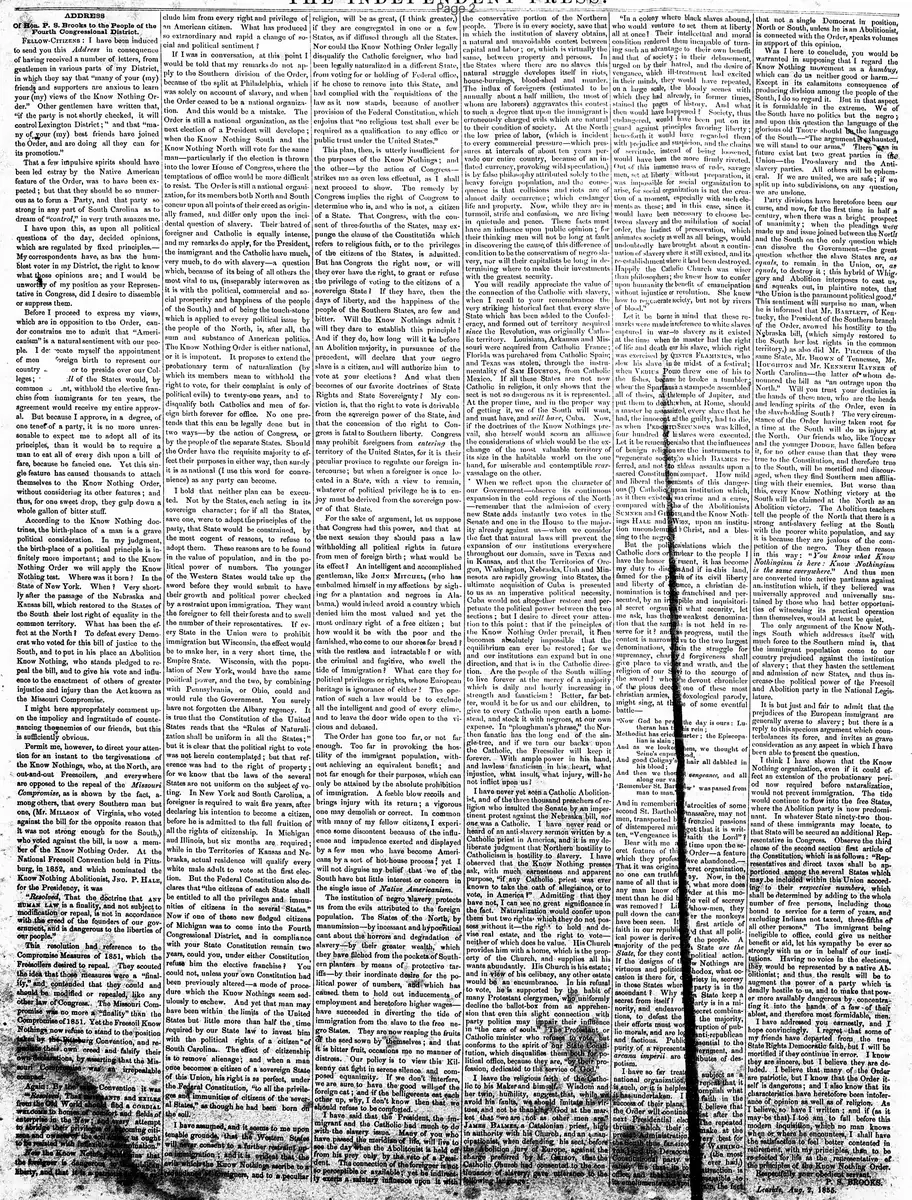
Fellow-Citizens: I have been induced to send you this Address in consequence of having received a number of letters, from gentlemen in various parts of my District, in which they say that "many of your (my) friends and supporters are anxious to learn your (my) views of the Know Nothing Order." Other gentlemen have written that, "if the party is not shortly checked, it will control Lexington District;" and that "many of your (my) best friends have joined the Order, and are doing all they can for its promotion."
That a few impulsive spirits should have been led astray by the Native American feature of the Order, was to have been expected; but that they should be so numerous as to form a Party, and that party so strong in any part of South Carolina as to dream of "control," in very truth amazes me.
I have upon this, as upon all political questions of the day, decided opinions which are regulated by fixed principles. My correspondents have, as has the humblest voter in my District, the right to know what those opinions are; and I would be unworthy of my position as your Representative in Congress, did I desire to dissemble or suppress them.
Before I proceed to express my views, which are in opposition to the Order, candor constrains me to admit that "Americanism" is a natural sentiment with our people. I deprecate myself the appointment of men of foreign birth to represent our country or to preside over our Colleges; all of the States would, by common consent, withhold the elective franchise from immigrants for ten years, the agreement would receive my entire approval. But because I approve, in a degree, of one tenet of a party, it is no more unreasonable to expect me to adopt all of its principles, than it would be to require a man to eat all of every dish upon a bill of fare, because he fancied one. Yet this single feature has caused thousands to attach themselves to the Know Nothing Order, without considering its other features; and thus, for one sweet drop, they gulp down a whole gallon of bitter stuff.
According to the Know Nothing doctrines, the birth-place of a man is a grave political consideration. In my judgment, the birth-place of a political principle is infinitely more important; and to the Know Nothing Order we will apply the Know Nothing test. Where was it born? In the State of New York. When? Very shortly after the passage of the Nebraska and Kansas bill, which restored to the States of the South their lost right of equality in the common territory. What has been the effect at the North? To defeat every Democrat who voted for this bill of justice to the South, and to put in his place an Abolition Know Nothing, who stands pledged to repeal the bill, and to give his vote and influence to the enactment of others of greater injustice and injury than the Act known as the Missouri Compromise.
I might here appropriately comment upon the impolicy and ingratitude of countenancing the enemies of our friends, but this is sufficiently obvious.
Permit me, however, to direct your attention for an instant to the tergiversations of the Know Nothings, who, at the North, are out-and-out Freesoilers, and everywhere are opposed to the repeal of the Missouri Compromise, as is shown by the fact, among others, that every Southern man but one, (Mr. MILLSON of Virginia, who voted against the bill for the opposite reason that it was not strong enough for the South,) who voted against the bill, is now a member of the Know Nothing Order. At the National Freesoil Convention held in Pittsburgh, in 1852, and which nominated the Know Nothing Abolitionist, Jno. P. Hale, for the Presidency, it was
"Resolved, That the doctrine that ANY BARGAIN LAW is a finality, and not subject to modification or repeal, is not in accordance with the creed of the founders of our government, and is dangerous to the liberties of our people."
This resolution had reference to the Compromise Measures of 1850, which the Freesoilers desired to repeal. They scouted the idea that those measures were a "finality" and contended that they could and should be modified or repealed, like any other law of Congress. The Missouri Compromise was no more a "finality" than the Compromise of 1850. Yet the Freesoil Know Nothings now refuse to stand to the position taken by the Pittsburgh Convention, and reject their own creed and falsify their resolutions, by asserting that the Missouri Compromise was an irrepealable line. By convention it was
Immigrants and exiles from the old world who find a cordial welcome to home comfort and fields of enterprise in the new world. Every attempt to abridge their privilege of becoming citizens ought to be resisted as a horrible distortion of our institutions. The Know Nothing doctrine would exclude him from every right and privilege of an American citizen. What has produced so extraordinary and rapid a change of social and political sentiment?
If I was in conversation, at this point I would be told that my remarks do not apply to the Southern division of the Order, because of the split at Philadelphia, which was solely on account of slavery, and when the Order ceased to be a national organization. And this would be a mistake. The Order is still a national organization, as the next election of a President will develop; when the Know Nothing South and the Know Nothing North will vote for the same man—particularly if the election is thrown into the lower House of Congress, where the temptations of office would be more difficult to resist. The Order is still a national organization, for its members both North and South concur upon all points of their creed as originally framed, and differ only upon the incidental question of slavery. Their hatred of foreigner and Catholic is equally intense, and my remarks do apply, for the President, the immigrant and the Catholic have much, very much, to do with slavery—a question which, because of its being of all others the most vital to us, (inseparably interwoven as it is with the political, commercial and social prosperity and happiness of the people of the South,) and of being the touch-stone which is applied to every political issue by the people of the North, is, after all, the sun and substance of American politics.
The Know Nothing Order is either national, or it is impotent. It proposes to extend the probationary term of naturalization (by which its members mean to withhold the right to vote, for their complaint is only of political evils) to twenty-one years, and to disqualify both Catholics and men of foreign birth forever for office. No one pretends that this can be legally done but in two ways—by the action of Congress, or by the people of the separate States. Should the Order have the requisite majority to effect their purposes in either way, then surely it is as national (I use this word for convenience) as any party can become.
I hold that neither plan can be executed. Not by the States, each acting in its sovereign character; for if all the States, save one, were to adopt the principles of the party, that State would be constrained, by the most cogent of reasons, to refuse to adopt them. These reasons are to be found in the value of population, and in the political power of numbers. The younger of the Western States would take up the sword before they would submit to have their growth and political power checked by a restraint upon immigration. They want the foreigner to fell their forests and to swell the number of their representatives. If every State in the Union were to prohibit immigration but Wisconsin, the effect would be to make her, in a very short time, the Empire State. Wisconsin, with the population of New York, would have the same political power, and the two, by combining with Pennsylvania, or Ohio, could and would rule the Government. You surely have not forgotten the Albany regency. It is true that the Constitution of the United States reads that the "Rules of Naturalization shall be uniform in all the States;" but it is clear that the political right to vote was not herein contemplated: but that reference was had to the right of property; for we know that the laws of the several States are not uniform on the subject of voting. In New York and South Carolina, a foreigner is required to wait five years, after declaring his intention to become a citizen, before he is admitted to the full fruition of all the rights of citizenship. In Michigan and Illinois, but six months are required; while in the Territories of Kansas and Nebraska, actual residence will qualify every white male adult to vote at the first election. But the Federal Constitution also declares that "the citizens of each State shall be entitled to all the privileges and immunities of citizens in the several States."
Now if one of these new fledged citizens of Michigan was to come into the Fourth Congressional District, and in compliance with your State Constitution remain two years, could you, under either Constitution, refuse him the elective franchise? You could not, unless your own Constitution had been previously altered—a mode of procedure which the Know Nothings seem sedulously to eschew. And yet that man may have been within the limits of the United States but little more than half the time required by our State law to invest him with the political rights of a citizen of South Carolina. The effect of citizenship is to remove alienage; and when a man once becomes a citizen of a sovereign State of this Union, his right is as perfect, under the Federal Constitution, "to all the privileges and immunities of citizens of the several States," as though he had been born on the soil.
I have assumed, and it seems to me upon tenable grounds, that the Western States will never consent to a further restraint upon immigration. and it is evident that the evils which the Know Nothings ascribe to a
religion, will be as great, (I think greater,) if they are congregated in one or a few States, as if diffused through all the States. Nor could the Know Nothing Order legally disqualify the Catholic foreigner, who had been legally naturalized in a different State, from voting for or holding of Federal office, if he chose to remove into this State. and had complied with the requisitions of the law as it now stands, because of another provision of the Federal Constitution, which enjoins that "no religious test shall ever be required as a qualification to any office or public trust under the United States."
This plan, then, is utterly insufficient for the purposes of the Know Nothings; and the other—by the action of Congress—strikes me as even less effectual. as I shall next proceed to show. The remedy by Congress implies the right of Congress to determine who is. and who is not, a citizen of a State. That Congress, with the consent of three-fourths of the States, may expunge the clause of the Constitution which refers to religious faith, or to the privileges of the citizens of the States, is admitted. But has Congress the right now, or will they ever have the right, to grant or refuse the privilege of voting to the citizens of a sovereign State? If they have, then the days of liberty, and the happiness of the people of the Southern States, are few and bitter. Will the Know Nothings admit? will they dare to establish this principle? And if they do, how long will it be before an Abolition majority, in pursuance of the precedent, will declare that your negro slave is a citizen, and will authorize him to vote at your elections? And what then becomes of our favorite doctrines of State Rights and State Sovereignty? My conviction is. that the right to vote is derivable from the sovereign power of the State, and that the concession of the right to Congress is fatal to Southern liberty. Congress may prohibit foreigners from entering the territory of the United States, for it is their peculiar province to regulate our foreign intercourse: but when a foreigner is once located in a State, with a view to remain, whatever of political privilege he is to enjoy must be derived from the sovereign power of that State.
For the sake of argument, let us suppose that Congress had this power, and that at the next session they should pass a law withholding all political rights in future from men of foreign birth; what would be its effect? An intelligent and accomplished gentleman, like JOHN MITCHELL, (who has embalmed himself in my affections by sighing for a plantation and negroes in Alabama.) would indeed avoid a country which denied him the most valued and yet the most ordinary right of a free citizen; but how would it be with the poor and the famished, who come to our shores for bread? with the restless and intractable? or with the criminal and fugitive, who swell the tide of immigration? What care they for political privileges or rights, whose European heritage is ignorance of either? The operation of such a law would be to exclude all the intelligent and good of every clime. and to leave the door wide open to the vicious and debased.
The Order has gone too far, or not far enough. Too far in provoking the hostility of the immigrant population, without achieving an equivalent benefit; and not far enough for their purposes, which can only be attained by the absolute prohibition of immigration. A feeble blow recoils and brings injury with its return; a vigorous one may demolish or correct. In common with many of my fellow citizens, I experience some discontent because of the influence and impudence exerted and displayed by a few men who have become Americans by a sort of hot-house process; yet I will not disguise my belief that we of the South have but little interest or concern in the single issue of Native Americanism.
The institution of negro slavery protects us from the evils attributed to the foreign population. The States of the North, by manumission—by incessant and hypocritical cant about the horrors and degradation of slavery—by their greater wealth, which they have filched from the pockets of Southern planters. by means of protective tariffs—by their inordinate desire for the political power of numbers, and which has caused them to hold out inducements of employment and heretofore higher wages—have succeeded in diverting the tide of immigration from the slave to the free negro States. They are now reaping the fruits of the seed sown by themselves; and that it is bitter fruit, occasions me no manner of distress. Our policy is to view this Kilkenny cat fight in serene silence and composed equanimity. If we don't interfere, we are sure to have the good will of the foreign cat; and if the belligerents eat each other up, why, I don't know that we should refuse to be comforted.
I have said that the President, the immigrant and the Catholic had much to do with the slavery issue. Many of you who have passed the meridian of life, will live to see the day when the Abolitionist is held off from his prey only by the veto of a President. The connection of the foreigner is not so perceptible or available yet he indirectly exerts a salutary influence upon it
the conservative portion of the Northern people. There is in every society, save that in which the institution of slavery obtains, a natural and unavoidable contest between capital and labor; or, which is virtually the same, between property and persons. In the States where there are no slaves this natural struggle develops itself in riots, house-burnings, blood-shed and murder. The influx of foreigners (estimated to be annually about a half million, the most of whom are laborers) aggravates this contest to such a degree that upon the immigrant is erroneously charged evils which are natural to their condition of society. At the North the low price of labor, (which is incident to every commercial pressure—which pressures at intervals of about ten years pervade our entire country. because of an inflated currency, provoking wild speculation,) is by false philosophy attributed solely to the heavy foreign population, and the consequence is that collisions and riots are of almost daily occurrence; which endanger life and property. Now, while they are in turmoil, strife and confusion, we are living in quietude and peace. These facts must have an influence upon public opinion; for their thinking men will not be long at fault in discovering the cause of this difference of condition to be the conservatism of negro slavery, nor will their capitalists be long in determining where to make their investments with the greatest security.
You will readily appreciate the value of the connection of the Catholic with slavery, when I recall to your remembrance the very striking historical fact that every slave State which has been added to the Confederacy, and formed out of territory acquired since the Revolution, was originally Catholic territory. Louisiana, Arkansas and Missouri were acquired from Catholic France: Florida was purchased from Catholic Spain: and Texas was stolen, through the instrumentality of Sam HOUSTON, from Catholic Mexico. If all these States are not now Catholic in religion, it only shows that the sect is not so dangerous as it is represented.
At the proper time, and in the proper way of getting it, we of the South will want, and must have, and will have, Cuba. Now, if the doctrines of the Know Nothings prevail, she herself would scorn an alliance the considerations of which would be the exchange of the most valuable territory of its size in the habitable world on the one hand, for miserable and contemptible rear vassalage on the other.
When we reflect upon the character of our Government—observe its continuous expansion in the cold regions of the North—remember that the admission of every new State adds instantly two votes in the Senate and one in the House to the majority already against us—when we consider the fact that natural laws will prevent the expansion of our institutions everywhere throughout our domain, save in Texas and in Kansas. and that the Territories of Oregon, Washington, Nebraska, Utah and Minnesota are rapidly growing into States, the ultimate acquisition of Cuba is presented to us as an imperative political necessity.
Cuba would not altogether restore and perpetuate the political power between the two sections: but I desire to direct your attention to this point: that if the principles of the Know Nothing Order prevail, it then becomes absolutely impossible that the equilibrium can ever be restored; for we and our institutions can expand but in one direction, and that is in the Catholic direction. Are the people of the South willing to live forever at the mercy of a majority which is daily and hourly increasing in strength and fanaticism? Better. far better. would it be for us and our children, to give to every Catholic upon earth a homestead, and stock it with negroes, at our own expense. In "ploughman's phrase," the Northern fanatic has the long end of the single-tree, and if we turn our backs upon the Catholic, the Freesoiler will keep it forever. With ample power in his hand, and lawless fanaticism in his heart. what injustice, what insult, what injury, will he not inflict upon us?
I have never yet seen a Catholic Abolitionist, and of the three thousand preachers of religion who insulted the Senate by an impertinent protest against the Nebraska bill, not one was a Catholic. I have never read or heard of an anti-slavery sermon written by a Catholic priest. in America, and it is my deliberate judgment that Northern hostility to Catholicism is hostility to slavery. I have observed that the Know Nothing presses ask, with much earnestness and apparent purpose, "if any Catholic priest was ever known to take the oath of allegiance, or to vote, in America?". Admitting. that they have not, I can see no great significance in the act. Naturalization would confer upon them but two rights which they do not possess without it—the right to hold and devise real estate, and the right to vote—neither of which does he value. His Church provides him with a home, which is the property of the Church, and supplies all his wants abundantly. His Church is his estate; and in view of his celibacy, any other estate would be an encumbrance. In his refusal to vote, he is supported by the habit of many Protestant clergymen, who uniformly decline the ballot-box from an apprehension that even this slight connection with party politics may impair their influence in "the care of souls." The Protestant or Catholic minister who refuses to vote but conforms to the spirit of our State Constitution, which disqualifies them both for political office, because they are, "by their profession, dedicated to the service of God."
I leave the religious faith of the Catholic to his Maker and himself. Wisdom and her twin, humility, suggest that, while we avoid his faults, we should imitate his virtues, and not be thanking God at the market that "we are not as other men are."
James Balmes, a Catalonian priest, high in authority with his Church, and an emancipationist, when defending his sect, before the abolition jury of Europe against the charge preferred by M. Guizot, that the Catholic Church had consented to the continuance of slavery, gave utterance to this
"In a colony where black slaves abound, who would venture to set them at liberty all at once? Their intellectual and moral condition rendered them incapable of turning such an advantage to their own benefit and that of society; in their debasement, urged on by their hatred, and the desire of vengeance, which ill-treatment had excited in their minds, they would have repeated, on a large scale, the bloody scenes with which they had already, in former times, stained the pages of history. And what then would have happened? Society, thus endangered, would have been put on its guard against principles favoring liberty; henceforth it would have regarded them with prejudice and suspicion, and the chains of servitude, instead of being loosened, would have been the more firmly riveted.
Out of this immense mass of rude, savage men, set at liberty without preparation, it was impossible for social organization to arise, for social organization is not the creation of a moment, especially with such elements as these; and in this case, since it would have been necessary to choose between slavery and the annihilation of social order, the instinct of preservation, which animates society as well as all beings, would undoubtedly have brought about a continuation of slavery where it still existed, and its re-establishment where it had been destroyed.
Happily the Catholic Church was wiser than philosophers; she knew how to confer upon humanity the benefit of emancipation without injustice or revolution. She knew how to regenerate society, but not by rivers of blood."
Let it be borne in mind that these remarks were made in reference to white slaves captured in war—to slavery as it existed at the time when the master had the right of life and death over his slave, which right was exercised by QUINTUS FLAMINIUS, who slew his slave in the midst of a festival; when Vedius Pollio threw one of his to the fishes. because he broke a tumbler; when the Spartans in a stampede assembled all of theirs, at the temple of Jupiter, and put them to death; when, at Rome, should a master be assassinated, every slave that he had, the innocent as the guilty, had to die, as when Pedanius Secundus was killed, four hundred of his slaves were executed.
Let it be remembered also that the influences of benign religion are the instruments to "regenerate society," to which Balmes referred, and not to senseless assaults upon a sacred Constitutional compact. How mild and liberal the tenets of this dangerous(!) Catholic pagan institution which, as it then existed was a crime and a curse, compared with those of the Abolitionists Sumner and Garrison and the Know Nothings Hale and Wilson, upon an institution uncondemned by Christ, and a blessing to the negro.
But the political relations which the Catholic does or may bear to the people I have the honor to represent. it has become my duty to discuss. And if in this land, famed for the purity of its civil liberty and liberty of conscience, a christian denomination is to be disfranchised and persecuted, by an irresponsible and inquisitorial secret organization what security, let me ask, has the weakest denomination that the same is not held in reserve for it? and so progress, until the contest is narrowed down to the two largest denominations, in the struggle for supremacy, charity and forgiveness shall give place to violence and wrath, and the religion of our Savior to the scourge of the sword? where the devout chronicler of the pious deeds of one of these most christian armies, might sing, at the close of some eventful battle—
"Now God be praised, the day is ours: Lutheran has turned his rein; Methodist has cried quarter; the Episcopal is slain; And as we looked on them, we thought of Seine's empire blood, And good Coligny's hair all dabbled in his blood; And then we thought of vengeance, and all along our way 'Remember St. Bartholomew!' was passed from man to man."
And in remembering the atrocities of some second St. Bartholomew massacre, may not men, transported by frenzied passions of distempered minds, forget that it is written, "Vengeance is mine, saith the Lord"?
Bear with me a moment upon the secret feature of this Order—a feature which they profess to have abandoned. That it was originally a secret organization, no one can truthfully deny. Now, in the name of all that is holy, what more does any man know of his neighbor at this moment than he did before the veil of secrecy was removed? Like show-men, they pull down the canopy after the monkeys have been seen. It is the first article of faith in our republic that all political power is derived from the people. A majority of the people of a State are the State, for they control its political action.
If the designs of the Know Nothings are virtuous and politically orthodox, what occasion is there for, brevity in, secrecy in those States where the party is in the ascendant? Why keep a secret from itself? If the party is in a minority, and endeavors by secret combinations. to defeat the majority, their efforts must work corruption of public morals, and are logically anti-republican and factious. Public discussion is essential to the purity of a representative government, and arcana imperii are attributes of despotism.
I have so far treated the Know Nothing Order as a national organization, if such it is helpless; if it has undertaken to accomplish the success of their plans the Order will continue to exist until the next Presidential election, and then test the thrusts which their present administration has put into the hands of the South thus far, since it has thrown around the Democratic Constitutional party. What satisfies me that its councils are dominated by the same spirit which dictated the emoluments and appointments of the
that not a single Democrat in position, North or South, unless he is an Abolitionist, is connected with the Order, speaks volumes in support of this opinion.
Was I here to conclude, you would be warranted in supposing that I regard the Know Nothing movement as a humbug, which can do us neither good or harm. Except in its calamitous consequence of producing division among the people of the South, I do so regard it. But in that aspect it is formidable in the extreme. We of the South have no politics but the negro; and upon this question the language of the glorious old Troup should be the language of the South—"The argument is exhausted, we will stand to our arms." There can in future exist but two great parties in the Union—the Pro-slavery and the Anti-slavery parties. All others will be ephemeral. If we are united, we are safe; if we split up into subdivisions, on any question we are undone.
Party divisions have heretofore been our curse, and now, for the first time in half a century, when there was a bright prospect of unanimity; when the pleadings were made up and issue joined between the North and the South on the only question which can dissolve the Government—the great question whether the slave States are, as equals, to remain in the Union, or, as equals, to destroy it; this hybrid of Whiggery and Abolition interposes to cast us, and squeaks out, in plaintive notes, that "the Union is the paramount political good."
This sentiment will surprise no man, when he is informed that Mr. Bartlett, of Kentucky, the President of the Southern branch of the Order, avowed his hostility to the Nebraska bill, (which simply restored to the South her lost rights in the common territory,) as also did Mr. Pugh of the same State, Mr. Brown of Tennessee, Mr. HOUGHTON and Mr. KENNEDY RAYNER of North Carolina—the latter of whom denounced the bill as "an outrage upon the North." Will you trust your destinies in the hands of these men, who are the heads and leading spirits of the Order, even in the slaveholding South? The very circumstance of the Order having taken root for a time at the South will do us injury at the North. Our friends who, like Toucey and the younger Dodge. have fallen before it, for no other cause than that they were true to the Constitution, and therefore true to the South, will be mortified and discouraged, when they find Southern men affiliating with their enemies. But worse than this, every Know Nothing victory at the South will be claimed at the North as an Abolition victory. The Abolition teachers tell the people of the North that there is a strong anti-slavery feeling at the South with the poorer white population, and say it is because they are jealous of the competition of the negro. They then reason in this way: "You know what Know Nothingism is here: Know Nothingism is the same everywhere." And thus men are converted into active partisans against an institution which, if they believed was universally approved and universally sustained by those who had better opportunities of witnessing its practical operation than themselves, would at least be quiet.
The only argument of the Know Nothings South which addresses itself with much force to the Southern mind is, that the immigrant population come to our country prejudiced against the institution of slavery; that they hasten the settlement and admission of new States, and thus increase the political power of the Freesoil and Abolition party in the National Legislature.
It is but just and fair to admit that the prejudices of the European immigrant are generally averse to slavery; but there is a reply to this specious argument which counterbalances its force, and invites as grave consideration as any aspect in which I have been able to present the question.
I think I have shown that the Know Nothing organization, even if it could effect an extension of the probationary period now required before naturalization, would not prevent immigration. The tide would continue to flow into the free States, where the Abolition party is now predominant. In whatever State ninety-two thousand of these immigrants may locate, to that State will be secured an additional Representative in Congress. Observe the third clause of the second section first article of the Constitution, which is as follows: "Representatives and direct taxes shall be apportioned among the several States which may be included within this Union according to their respective numbers, which shall be determined by adding to the whole number of free persons, including those bound to service for a term of years, and excluding Indians not taxed, three-fifths of all other persons."
The immigrant being ineligible to office, could give us neither benefit or aid, let his sympathy be ever so strongly with us or in behalf of our institutions. Having no voice in the elections. they, would be represented by a native Abolitionist: and thus the result will be to augment the power of a party which is deadly hostile to us, and to make that power more available and dangerous by concentrating it into the hands of a few of their ablest, and therefore most formidable, men.
I have addressed you earnestly, and I hope convincingly: I regret that some of my friends have departed, from the true State Rights Democratic faith, but I will be mortified if they continue in error. I know they are sincere, but I believe they are deluded. I believe that many of the Order are patriotic, but I know that the Order itself is dangerous; and I also know that its characteristics have heretofore been intolerance of opinion as well as of religion. As I believe, so have I written; and if (as it may be that) I too am to fall before this modern inquisition; which no man knows when or where he encounters, I shall have the satisfaction to feel better contented in retirement, with my principles than to be re-elected for life as the representative of the principles of the Know Nothing Order.
Respectfully, your obedient servant,
P. S. BROOKS.
What sub-type of article is it?
What themes does it cover?
What keywords are associated?
What entities or persons were involved?
Letter to Editor Details
Author
P. S. Brooks
Recipient
People Of The Fourth Congressional District
Main Argument
the know nothing order is a dangerous national movement allied with northern abolitionists that threatens southern slavery, constitutional rights of immigrants and catholics, and political balance; it cannot effectively restrict immigration or citizenship without violating state sovereignty and federal principles, and southerners should unite against it to protect pro-slavery interests.
Notable Details