Thank you for visiting SNEWPapers!
Sign up free
Springfield Weekly Republican
Springfield, Hampden County, Massachusetts
What is this article about?
John Bell of Tennessee, in a letter to the Louisville Journal, advocates granting suffrage to intelligent freedmen in the South, similar to Northern standards, to satisfy the North and counter radical Republican policies. He expresses concern for the colored population's future amid predicted high mortality.
Clipping
OCR Quality
Full Text
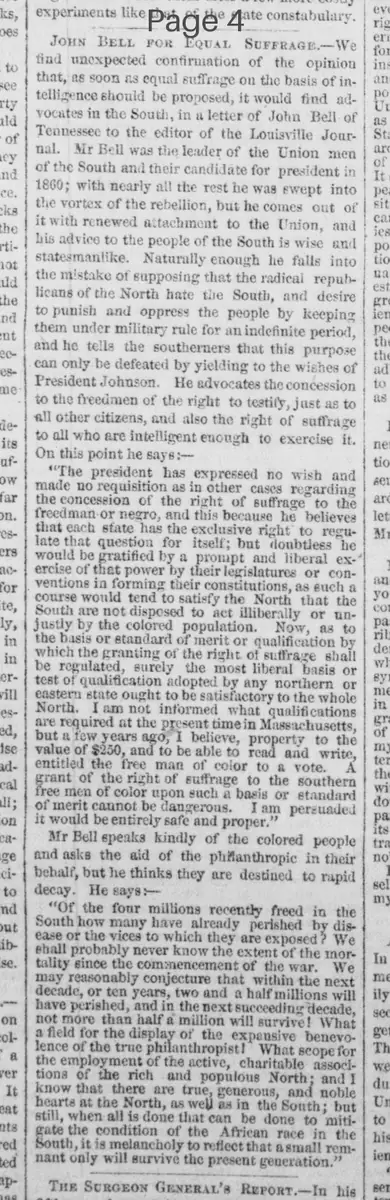
We find unexpected confirmation of the opinion that, as soon as equal suffrage on the basis of intelligence should be proposed, it would find advocates in the South, in a letter of John Bell of Tennessee to the editor of the Louisville Journal. Mr. Bell was the leader of the Union men of the South and their candidate for president in 1860; with nearly all the rest he was swept into the vortex of the rebellion, but he comes out of it with renewed attachment to the Union, and his advice to the people of the South is wise and statesmanlike. Naturally enough he falls into the mistake of supposing that the radical republicans of the North hate the South, and desire to punish and oppress the people by keeping them under military rule for an indefinite period, and he tells the southerners that this purpose can only be defeated by yielding to the wishes of President Johnson. He advocates the concession to the freedmen of the right to testify, just as to all other citizens, and also the right of suffrage to all who are intelligent enough to exercise it. On this point he says:
"The president has expressed no wish and made no requisition as in other cases regarding the concession of the right of suffrage to the freedman or negro, and this because he believes that each state has the exclusive right to regulate that question for itself; but doubtless he would be gratified by a prompt and liberal exercise of that power by their legislatures or conventions in forming their constitutions, as such a course would tend to satisfy the North that the South are not disposed to act illiberally or unjustly by the colored population. Now, as to the basis or standard of merit or qualification by which the granting of the right of suffrage shall be regulated, surely the most liberal basis or test of qualification adopted by any northern or eastern state ought to be satisfactory to the whole North. I am not informed what qualifications are required at the present time in Massachusetts, but a few years ago, I believe, property to the value of $250, and to be able to read and write, entitled the free man of color to a vote. A grant of the right of suffrage to the southern free men of color upon such a basis or standard of merit cannot be dangerous. I am persuaded it would be entirely safe and proper."
Mr. Bell speaks kindly of the colored people and asks the aid of the philanthropic in their behalf, but he thinks they are destined to rapid decay. He says:
"Of the four millions recently freed in the South how many have already perished by disease or the vices to which they are exposed? We shall probably never know the extent of the mortality since the commencement of the war. We may reasonably conjecture that within the next decade, or ten years, two and a half millions will have perished, and in the next succeeding decade, not more than half a million will survive! What a field for the display of the expansive benevolence of the true philanthropist!" What scope for the employment of the active, charitable associations of the rich and populous North; and I know that there are true, generous, and noble hearts at the North, as well as in the South; but still, when all is done that can be done to mitigate the condition of the African race in the South, it is melancholy to reflect that a small remnant only will survive the present generation."
What sub-type of article is it?
What themes does it cover?
What keywords are associated?
What entities or persons were involved?
Where did it happen?
Story Details
Key Persons
Location
South, Tennessee
Event Date
Post 1860
Story Details
John Bell, former Union leader and 1860 presidential candidate, writes a letter advocating for equal suffrage to intelligent freedmen in the South on the basis of qualifications like those in Northern states, to appease the North and demonstrate fairness. He predicts high mortality among freedmen and calls for philanthropy.