Thank you for visiting SNEWPapers!
Sign up free
Story
January 12, 1905
The Greeley Tribune
Greeley, Weld County, Colorado
What is this article about?
Jonathan Dore, captured by Indians at age 12 in June 1746 near Rochester, NH, assimilates into St. Francis tribe, marries, and fights in 1757 Fort William Henry massacre but spares a childhood acquaintance. After his Indian family is killed in a raid, he returns to civilization in 1759, settling in Lebanon, ME.
Clipping
OCR Quality
98%
Excellent
Full Text
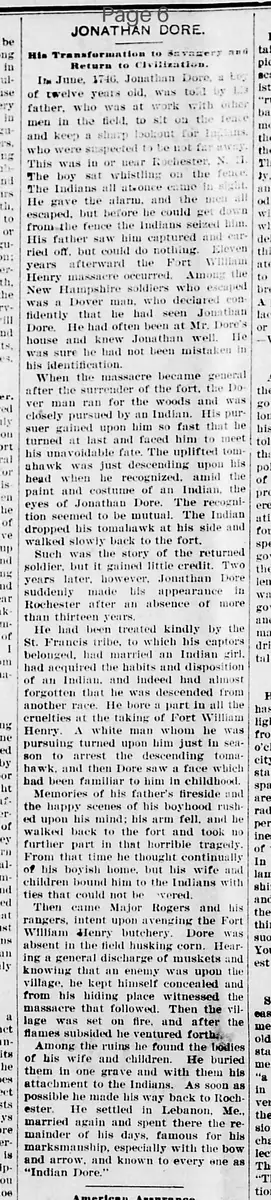
JONATHAN DORE.
His Transformation to Savagery and Return to Civilization.
In June, 1746, Jonathan Dore, a boy of twelve years old, was told by his father, who was at work with other men in the field, to sit on the fence and keep a sharp lookout for Indians, who were suspected to be not far away. This was in or near Rochester, N. H. The boy sat whistling on the fence. The Indians all at once came upon him. He gave the alarm, and the men all escaped, but before he could get down from the fence the Indians seized him. His father saw him captured and carried off, but could do nothing. Eleven years afterward the Fort William Henry massacre occurred. Among the New Hampshire soldiers who escaped was a Dover man, who declared confidently that he had seen Jonathan Dore. He had often been at Mr. Dore's house and knew Jonathan well. He was sure he had not been mistaken in his identification.
When the massacre became general after the surrender of the fort, the Dover man ran for the woods and was closely pursued by an Indian. His pursuer gained upon him so fast that he turned at last and faced him to meet his unavoidable fate. The uplifted tomahawk was just descending upon his head when he recognized, amid the paint and costume of an Indian, the eyes of Jonathan Dore. The recognition seemed to be mutual. The Indian dropped his tomahawk at his side and walked slowly back to the fort.
Such was the story of the returned soldier, but it gained little credit. Two years later, however, Jonathan Dore suddenly made his appearance in Rochester after an absence of more than thirteen years.
He had been treated kindly by the St. Francis tribe, to which his captors belonged, had married an Indian girl, had acquired the habits and disposition of an Indian, and indeed had almost forgotten that he was descended from another race. He bore a part in all the cruelties at the taking of Fort William Henry. A white man whom he was pursuing turned upon him just in season to arrest the descending tomahawk, and then Dore saw a face which had been familiar to him in childhood. Memories of his father's fireside and the happy scenes of his boyhood rushed upon his mind; his arm fell, and he walked back to the fort and took no further part in that horrible tragedy.
From that time he thought continually of his boyish home, but his wife and children bound him to the Indians with ties that could not be severed.
Then came Major Rogers and his rangers, intent upon avenging the Fort William Henry butchery. Dore was absent in the field husking corn. Hearing a general discharge of muskets and knowing that an enemy was upon the village, he kept himself concealed and from his hiding place witnessed the massacre that followed. Then the village was set on fire, and after the flames subsided he ventured forth. Among the ruins he found the bodies of his wife and children. He buried them in one grave and with them his attachment to the Indians. As soon as possible he made his way back to Rochester. He settled in Lebanon, Me., married again and spent there the remainder of his days, famous for his marksmanship, especially with the bow and arrow, and known to every one as "Indian Dore."
His Transformation to Savagery and Return to Civilization.
In June, 1746, Jonathan Dore, a boy of twelve years old, was told by his father, who was at work with other men in the field, to sit on the fence and keep a sharp lookout for Indians, who were suspected to be not far away. This was in or near Rochester, N. H. The boy sat whistling on the fence. The Indians all at once came upon him. He gave the alarm, and the men all escaped, but before he could get down from the fence the Indians seized him. His father saw him captured and carried off, but could do nothing. Eleven years afterward the Fort William Henry massacre occurred. Among the New Hampshire soldiers who escaped was a Dover man, who declared confidently that he had seen Jonathan Dore. He had often been at Mr. Dore's house and knew Jonathan well. He was sure he had not been mistaken in his identification.
When the massacre became general after the surrender of the fort, the Dover man ran for the woods and was closely pursued by an Indian. His pursuer gained upon him so fast that he turned at last and faced him to meet his unavoidable fate. The uplifted tomahawk was just descending upon his head when he recognized, amid the paint and costume of an Indian, the eyes of Jonathan Dore. The recognition seemed to be mutual. The Indian dropped his tomahawk at his side and walked slowly back to the fort.
Such was the story of the returned soldier, but it gained little credit. Two years later, however, Jonathan Dore suddenly made his appearance in Rochester after an absence of more than thirteen years.
He had been treated kindly by the St. Francis tribe, to which his captors belonged, had married an Indian girl, had acquired the habits and disposition of an Indian, and indeed had almost forgotten that he was descended from another race. He bore a part in all the cruelties at the taking of Fort William Henry. A white man whom he was pursuing turned upon him just in season to arrest the descending tomahawk, and then Dore saw a face which had been familiar to him in childhood. Memories of his father's fireside and the happy scenes of his boyhood rushed upon his mind; his arm fell, and he walked back to the fort and took no further part in that horrible tragedy.
From that time he thought continually of his boyish home, but his wife and children bound him to the Indians with ties that could not be severed.
Then came Major Rogers and his rangers, intent upon avenging the Fort William Henry butchery. Dore was absent in the field husking corn. Hearing a general discharge of muskets and knowing that an enemy was upon the village, he kept himself concealed and from his hiding place witnessed the massacre that followed. Then the village was set on fire, and after the flames subsided he ventured forth. Among the ruins he found the bodies of his wife and children. He buried them in one grave and with them his attachment to the Indians. As soon as possible he made his way back to Rochester. He settled in Lebanon, Me., married again and spent there the remainder of his days, famous for his marksmanship, especially with the bow and arrow, and known to every one as "Indian Dore."
What sub-type of article is it?
Biography
Historical Event
Survival
What themes does it cover?
Survival
Family
Fortune Reversal
What keywords are associated?
Indian Captivity
Fort William Henry Massacre
Return To Civilization
St Francis Tribe
Major Rogers Raid
What entities or persons were involved?
Jonathan Dore
Where did it happen?
Rochester, N. H.; Fort William Henry; Lebanon, Me.
Story Details
Key Persons
Jonathan Dore
Location
Rochester, N. H.; Fort William Henry; Lebanon, Me.
Event Date
June 1746 To 1759
Story Details
Boy captured by Indians in 1746, assimilates into tribe, spares acquaintance during 1757 Fort William Henry massacre, loses Indian family in raid, returns to Rochester.