Thank you for visiting SNEWPapers!
Sign up free
Voice Of Action
Seattle, King County, Washington
What is this article about?
A 1934 National Milk Survey reveals severe milk shortages in West Virginia mining families, consuming far below adequate levels, amid falling production due to drought and AAA policies. Critique highlights contradictions in reducing output while need rises, proposing solutions to cut profits, restore purchasing power, and secure farmers.
Clipping
OCR Quality
Full Text
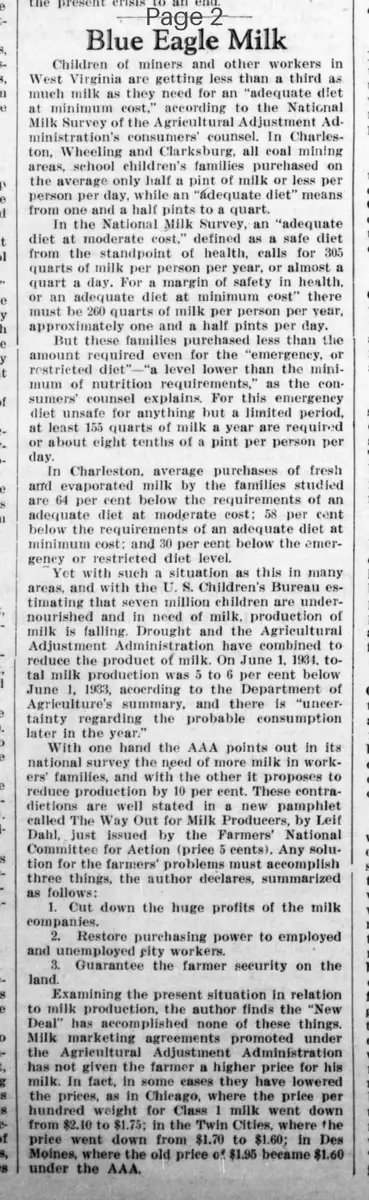
Children of miners and other workers in West Virginia are getting less than a third as much milk as they need for an "adequate diet at minimum cost," according to the National Milk Survey of the Agricultural Adjustment Administration's consumers' counsel. In Charleston, Wheeling and Clarksburg, all coal mining areas, school children's families purchased on the average only half a pint of milk or less per person per day, while an "adequate diet" means from one and a half pints to a quart.
In the National Milk Survey, an "adequate diet at moderate cost," defined as a safe diet from the standpoint of health, calls for 305 quarts of milk per person per year, or almost a quart a day. For a margin of safety in health, or an adequate diet at minimum cost there must be 260 quarts of milk per person per year, approximately one and a half pints per day.
But these families purchased less than the amount required even for the "emergency, or restricted diet"—"a level lower than the minimum of nutrition requirements," as the consumers' counsel explains. For this emergency diet unsafe for anything but a limited period, at least 155 quarts of milk a year are required or about eight tenths of a pint per person per day.
In Charleston, average purchases of fresh and evaporated milk by the families studied are 64 per cent below the requirements of an adequate diet at moderate cost; 58 per cent below the requirements of an adequate diet at minimum cost; and 30 per cent below the emergency or restricted diet level.
Yet with such a situation as this in many areas, and with the U. S. Children's Bureau estimating that seven million children are under-nourished and in need of milk, production of milk is falling. Drought and the Agricultural Adjustment Administration have combined to reduce the product of milk. On June 1, 1934, total milk production was 5 to 6 per cent below June 1, 1933, according to the Department of Agriculture's summary, and there is "uncertainty regarding the probable consumption later in the year."
With one hand the AAA points out in its national survey the need of more milk in workers' families, and with the other it proposes to reduce production by 10 per cent. These contradictions are well stated in a new pamphlet called The Way Out for Milk Producers, by Leif Dahl, just issued by the Farmers' National Committee for Action (price 5 cents). Any solution for the farmers' problems must accomplish three things, the author declares, summarized as follows:
1. Cut down the huge profits of the milk companies.
2. Restore purchasing power to employed and unemployed city workers.
3. Guarantee the farmer security on the land.
Examining the present situation in relation to milk production, the author finds the "New Deal" has accomplished none of these things.
Milk marketing agreements promoted under the Agricultural Adjustment Administration has not given the farmer a higher price for his milk. In fact, in some cases they have lowered the prices, as in Chicago, where the price per hundred weight for Class 1 milk went down from $2.10 to $1.75; in the Twin Cities, where the price went down from $1.70 to $1.60; in Des Moines, where the old price of $1.95 became $1.60 under the AAA.
What sub-type of article is it?
What themes does it cover?
What keywords are associated?
What entities or persons were involved?
Where did it happen?
Story Details
Key Persons
Location
West Virginia (Charleston, Wheeling, Clarksburg); Chicago; Twin Cities; Des Moines
Event Date
June 1, 1934
Story Details
National Milk Survey shows West Virginia mining families buy far less milk than needed for adequate diets, below even emergency levels. Milk production falls due to drought and AAA policies aiming to cut output by 10% despite undernourishment. Leif Dahl's pamphlet critiques AAA for failing to raise farmer prices and proposes cutting milk company profits, restoring worker purchasing power, and securing farmers.