Thank you for visiting SNEWPapers!
Sign up free
The New Hampshire Gazette And Historical Chronicle
Portsmouth, Greenland, Rockingham County, New Hampshire
What is this article about?
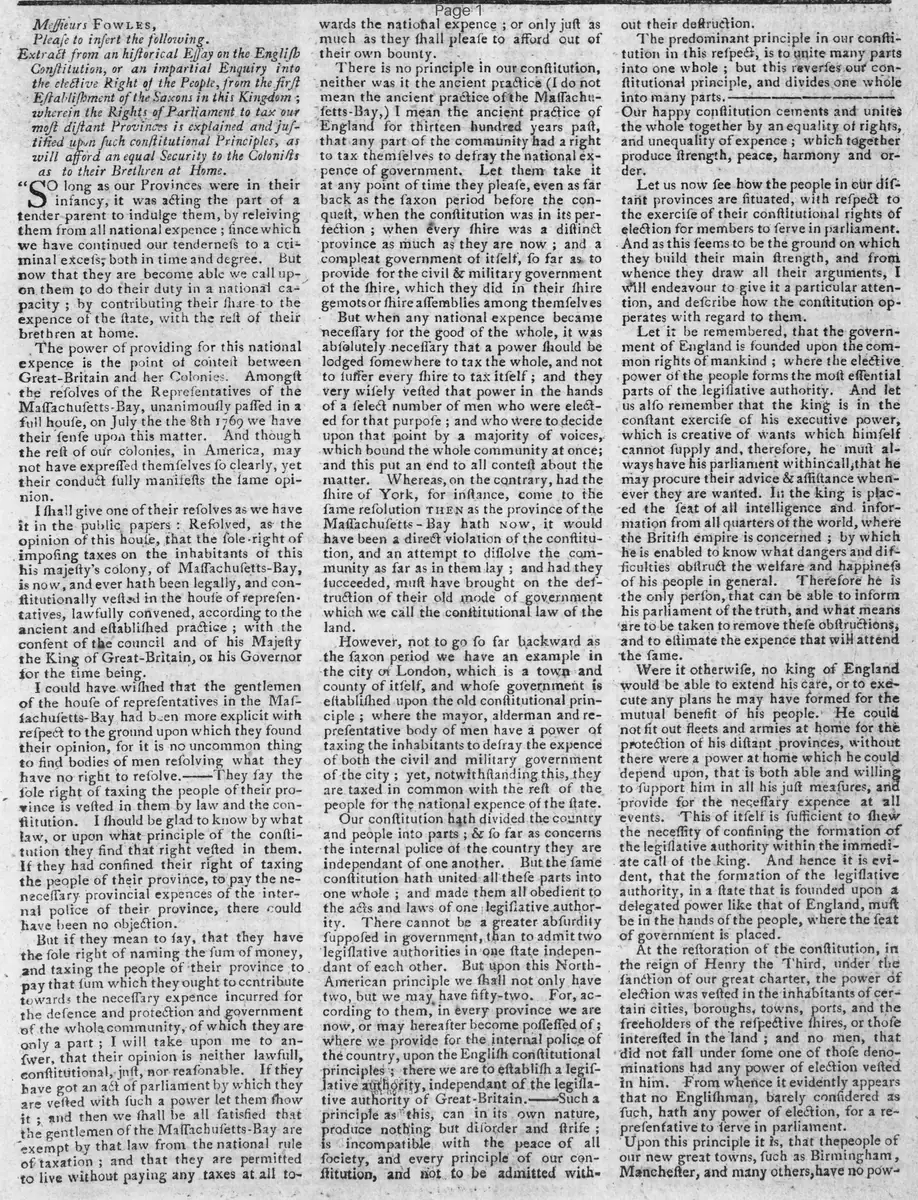
An anonymous letter to the printers defends Parliament's constitutional right to tax the American colonies for national expenses, arguing that colonies, like non-electoral areas in Britain, must contribute without direct representation. It critiques Massachusetts resolves from July 8, 1769, and references Saxon history and Magna Carta.
Merged-components note: Continuation of the letter to the editor across pages 1 and 2; the text flows directly from one component to the next, forming a single coherent essay submitted for publication.
Clippings
1 of 2
OCR Quality
Full Text
Please to insert the following.
Extract from an historical Essay on the English Constitution, or an impartial Enquiry into the elective Right of the People, from the first Establishment of the Saxons to this Kingdom:
wherein the Rights of Parliament to tax our most distant Provinces is explained and justified upon such constitutional Principles, as will afford an equal Security to the Colonies as to their Brethren at Home.
"So long as our Provinces were in their infancy, it was acting the part of a tender parent to indulge them, by relieving them from all national expense; since which we have continued our tenderness to a criminal excess, both in time and degree. But now that they are become able we call upon them to do their duty in a national capacity; by contributing their share to the expense of the state, with the rest of their brethren at home."
The power of providing for this national expense is the point of contest between Great-Britain and her Colonies. Amongst the resolves of the Representatives of the Massachusetts-Bay, unanimously passed in a full house, on July the 8th 1769 we have their sense upon this matter. And though the rest of our colonies, in America, may not have expressed themselves so clearly, yet their conduct fully manifests the same opinion.
I shall give one of their resolves as we have it in the public papers: Resolved, as the opinion of this house, that the sole-right of imposing taxes on the inhabitants of this his majesty's colony of Massachusetts-Bay, is now, and ever hath been legally, and constitutionally vested in the house of representatives, lawfully convened, according to the ancient and established practice; with the consent of the council and of his Majesty the King of Great-Britain, or his Governor for the time being.
I could have wished that the gentlemen of the house of representatives in the Massachusetts-Bay had been more explicit with respect to the ground upon which they find their opinion, for it is no uncommon thing to find bodies of men resolving what they have no right to resolve.--They say the sole right of taxing the people of their province is vested in them by law and the constitution. I should be glad to know by what law, or upon what principle of the constitution they find that right vested in them.
If they had confined their right of taxing the people of their province, to pay the necessary provincial expenses of the internal police of their province, there could have been no objection.
But if they mean to say, that they have the sole right of naming the sum of money, and taxing the people of their province to pay that sum which they ought to contribute towards the necessary expense incurred for the defence and protection and government of the whole community, of which they are only a part; I will take upon me to answer, that their opinion is neither lawful, constitutional, just, nor reasonable. If they have got an act of parliament by which they are vested with such a power let them show it: and then we shall be all satisfied that the gentlemen of the Massachusetts-Bay are exempt by that law from the national rule of taxation; and that they are permitted to live without paying any taxes at all to-
wards the national expense: or only just as much as they shall please to afford out of their own bounty.
There is no principle in our constitution, neither was it the ancient practice (I do not mean the ancient practice of the Massachusetts-Bay,) I mean the ancient practice of England for thirteen hundred years past, that any part of the community had a right to tax themselves to defray the national expense of government. Let them take it at any point of time they please. even as far back as the Saxon period before the conquest, when the constitution was in its perfection; when every shire was a distinct province as much as they are now; and a complete government of itself. So far as to provide for the civil & military government of the shire. which they did in their shire gemots or shire assemblies among themselves
But when any national expense became necessary for the good of the whole, it was absolutely necessary that a power should be lodged somewhere to tax the whole. and not to suffer every shire to tax itself: and they very wisely vested that power in the hands of a select number of men who were elected for that purpose: and who were to decide upon that point by a majority of voices, which bound the whole community at once; and this put an end to all contest about the matter. Whereas, on the contrary, had the shire of York. for instance. come to the same resolution then as the province of the Massachusetts - Bay hath now. it would have been a direct violation of the constitution, and an attempt to dissolve the community as far as in them lay; and had they succeeded. must have brought on the destruction of their old mode of government which we call the constitutional law of the land.
However, not to go so far backward as the Saxon period we have an example in the city of London, which is a town and county of itself, and whose government is established upon the old constitutional principles; where the mayor, aldermen and representative body of men have a power of taxing the inhabitants to defray the expense of both the civil and military government of the city; yet, notwithstanding this, they are taxed in common with the rest of the people for the national expense of the state.
Our constitution hath divided the country and people into parts; & so far as concerns the internal police of the country they are independent of one another. But the same constitution hath united all these parts into one whole: and made them all obedient to the acts and laws of one legislative authority. There cannot be a greater absurdity supposed in government, than to admit two legislative authorities in one state independent of each other. But upon this North-American principle we shall not only have two, but we may have fifty-two. For, according to them, in every province we are now, or may hereafter become possessed of; where we provide for the internal police of the country, upon the English constitutional principles: there we are to establish a legislative authority, independent of the legislative authority of Great-Britain.-Such a principle as this, can in its own nature, produce nothing but disorder and strife; is incompatible with the peace of all society. and every principle of our constitution, and not to be admitted with-
out their destruction.
The predominant principle in our constitution in this respect, is to unite many parts into one whole; but this reverses our constitutional principle, and divides one whole into many parts.
-Our happy constitution cements and unites the whole together by an equality of rights; and an inequality of expense; which together produce strength, peace, harmony and order.
Let us now see how the people in our distant provinces are situated, with respect to the exercise of their constitutional rights of election for members to serve in parliament.
And as this seems to be the ground on which they build their main strength, and from whence they draw all their arguments, I will endeavour to give it a particular attention, and describe how the constitution operates with regard to them.
Let it be remembered. that the government of England is founded upon the common rights of mankind; where the elective power of the people forms the most essential parts of the legislative authority. And let us also remember that the king is in the constant exercise of his executive power, which is creative of wants which himself cannot supply and, therefore. he must always have his parliament within call that he may procure their advice & assistance whenever they are wanted. In the king is placed the seat of all intelligence and. information from all quarters of the world. where the British empire is concerned; by which he is enabled to know what dangers and difficulties obstruct the welfare and happiness of his people in general. Therefore he is the only person, that can be able to inform his parliament of the truth, and what means are to be taken to remove these obstructions: and to estimate the expense that will attend the same.
Were it otherwise, no king of England would be able to extend his care, or to execute any plans he may have formed for the mutual benefit of his people.' He could not fit out fleets and armies at home for the protection of his distant provinces, without there were a power at home which he could depend upon, that is both able and willing to support him in all his just measures; and provide for the necessary expense at all events. This of itself is sufficient to show the necessity of confining the formation of the legislative authority within the immediate call of the king. And hence it is evident, that the formation of the legislative authority, in a state that is founded upon a delegated power like that of England, must be in the hands of the people, where the seat of government is placed.
At the restoration of the constitution. in the reign of Henry the Third, under the sanction of our great charter, the power of election was vested in the inhabitants of certain cities, boroughs, towns, ports, and the freeholders of the respective shires, or those interested in the land; and no men, that did not fall under some one of those denominations had any power of election vested in him. From whence it evidently appears that no Englishman, barely considered as such, hath any power of election, for a representative to serve in parliament.
Upon this principle it is, that the people of our new great towns, such as Birmingham, Manchester, and many others, have no pow-
The power of election vested in them; and consequently have no representatives in Parliament of their own election at all. And therefore the people in our distant provinces are precisely and literally in the same situation as the people in these great towns, and all the villages, and open country, which contain thousands and ten thousands of the people in Great-Britain who have no power of election: and consequently have no representation in parliament, any more than the Americans. Yet all this multitude of people who have no power of election, would receive no damage from not being electors, provided there was a competent number of electors in every place of election, so as to secure a constitutionally free and independent house of commons. As long as this is the case, it is of no consequence who elects them; for every man that is not an elector may receive the full benefit of our constitutional mode of government as an elector. Yet every Englishman, as such, whether he be born on this or that side of the Atlantic, hath a right to take up his power of election whenever he pleaseth to connect himself with some one of those towns, or become a freeholder; so as to satisfy the customary mode by which every other man obtains the power of election. But if this elective power were constitutionally so fixed to the person of an Englishman, that it must travel with him into any part of the world wherever he should think proper to settle; and that he should have there the same constitutional right as he had in England to elect representatives to serve in the parliament of Great-Britain, which is the point contended for; in that case we should be obliged to collect our legislative authority from the four quarters of the world, whenever Great-Britain shall think proper to establish colonies in Europe, Asia, Africa, and America. It is the determined law of election, that every man who is vested with the power of election, shall exercise that power in person upon the spot from whence he derives that power. For if I be a house-keeper in the city of Westminster, I am an elector for the city of Westminster so long as I continue there. But if I leave the city of Westminster and never return, I lose my power of election and never recover it. Or if I be a livery man of the city of London, and retire from London, though the right of election will still remain in my person, yet I cannot exercise that right, without I return back again to the city of London. In like manner it is with every man who leaves his native country and lives in our distant provinces; he willingly and voluntarily relinquishes the exercise of this elective power, in favour of something more substantial; and can never constitutionally, so long as he continues there, exercise that right in the election of any member to serve in the parliament of Great-Britain. All members of any society must submit and fall in with the constitutional laws of that society to which they belong; and not expect that the laws of the constitution are to give way to them. For, upon that principle, a constitution would be continually fluctuating, in order to accommodate itself to every change of things that might happen. It is the constitution itself (which must operate upon the spot where the seat of government is placed) that refuses our distant provinces to exercise their elective rights for the election of representatives to serve in parliament. For as they have placed themselves at such a distance, they have put it out of their own power to be electors; but in every other respect they may receive the full benefit of the constitution, as much as any man at home. But to say that no Englishman is to be taxed without his consent either in person or by his representatives, is merely sound without sense, and not true in fact; but must be limited by the constitutional mode of taxation, which only requires, that no Englishman shall be taxed without the consent of a representative body of men in parliament. Were it otherwise, as I have said before, a government founded upon the common rights of mankind could never advance beyond a certain limited point or form any advantageous plans by the extension of their territory, for the mutual benefit of the whole community.
What sub-type of article is it?
What themes does it cover?
What keywords are associated?
What entities or persons were involved?
Letter to Editor Details
Recipient
Messieurs Fowle
Main Argument
parliament has the constitutional right to tax the american colonies for national expenses, as colonies are part of the british community and must contribute like non-represented areas in britain; colonial assemblies have no sole right to determine national taxation.
Notable Details