Thank you for visiting SNEWPapers!
Sign up free
Story
June 16, 1902
The Daily Ardmoreite
Ardmore, Carter County, Oklahoma
What is this article about?
Points of contention in the anthracite coal strike: miners demand 8-hour day with current 10-hour pay, 5% wage increase, fair weighing, minimum wages, and union recognition; operators refuse and propose maintaining 1900-1901 wage advance.
Clipping
OCR Quality
98%
Excellent
Full Text
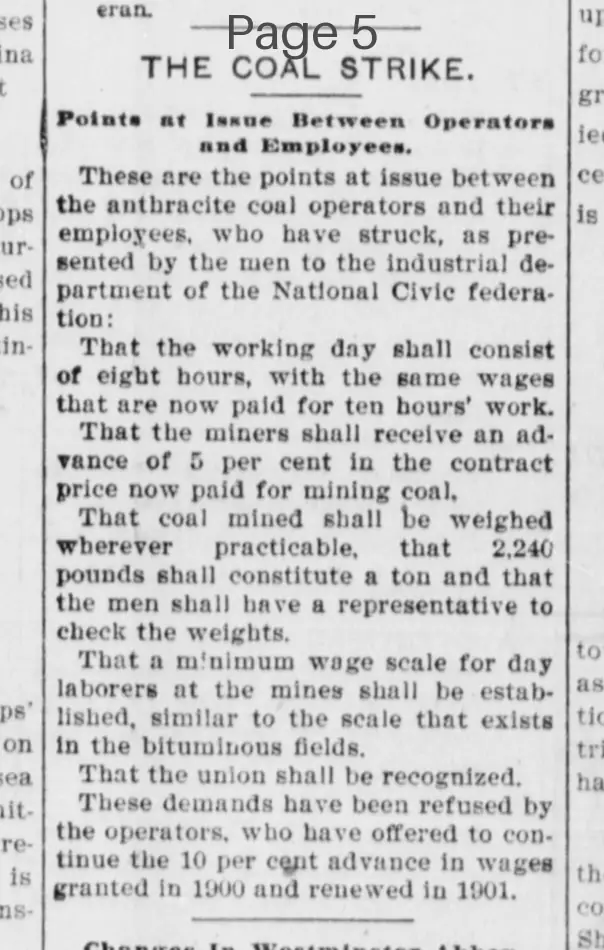
THE COAL STRIKE.
Points at Issue Between Operators and Employees.
These are the points at issue between the anthracite coal operators and their employees, who have struck, as presented by the men to the industrial department of the National Civic federation:
That the working day shall consist of eight hours, with the same wages that are now paid for ten hours' work.
That the miners shall receive an advance of 5 per cent in the contract price now paid for mining coal.
That coal mined shall be weighed wherever practicable, that 2,240 pounds shall constitute a ton and that the men shall have a representative to check the weights.
That a minimum wage scale for day laborers at the mines shall be established, similar to the scale that exists in the bituminous fields.
That the union shall be recognized.
These demands have been refused by the operators, who have offered to continue the 10 per cent advance in wages granted in 1900 and renewed in 1901.
Points at Issue Between Operators and Employees.
These are the points at issue between the anthracite coal operators and their employees, who have struck, as presented by the men to the industrial department of the National Civic federation:
That the working day shall consist of eight hours, with the same wages that are now paid for ten hours' work.
That the miners shall receive an advance of 5 per cent in the contract price now paid for mining coal.
That coal mined shall be weighed wherever practicable, that 2,240 pounds shall constitute a ton and that the men shall have a representative to check the weights.
That a minimum wage scale for day laborers at the mines shall be established, similar to the scale that exists in the bituminous fields.
That the union shall be recognized.
These demands have been refused by the operators, who have offered to continue the 10 per cent advance in wages granted in 1900 and renewed in 1901.
What sub-type of article is it?
Historical Event
What themes does it cover?
Justice
What keywords are associated?
Coal Strike
Anthracite Miners
Wage Demands
Union Recognition
Eight Hour Day
Where did it happen?
Anthracite Coal Fields
Story Details
Location
Anthracite Coal Fields
Event Date
1902
Story Details
Anthracite coal miners present demands to operators including an eight-hour workday with same pay as ten hours, 5% advance in mining wages, weighing coal with checkers, minimum wage for day laborers, and union recognition; operators refuse and offer to continue 10% wage advance from 1900-1901.