Thank you for visiting SNEWPapers!
Sign up free
Literary
March 2, 1825
Massachusetts Spy And Worcester Advertiser
Worcester, Worcester County, Massachusetts
What is this article about?
An essay exploring the origins and extremes of ancient Egyptian animal worship and superstitions, citing historians like Herodotus, Aelian, and Diodorus. It describes veneration of animals like cats and crocodiles, mourning rituals, and a violent incident involving a Roman, attributing it to symbolic hieroglyphic reverence turned idolatrous.
Merged-components note: Continuation of the article on Egyptian Superstitions across pages, as indicated by the text flow and sequential reading order.
Clippings
1 of 2
OCR Quality
95%
Excellent
Full Text
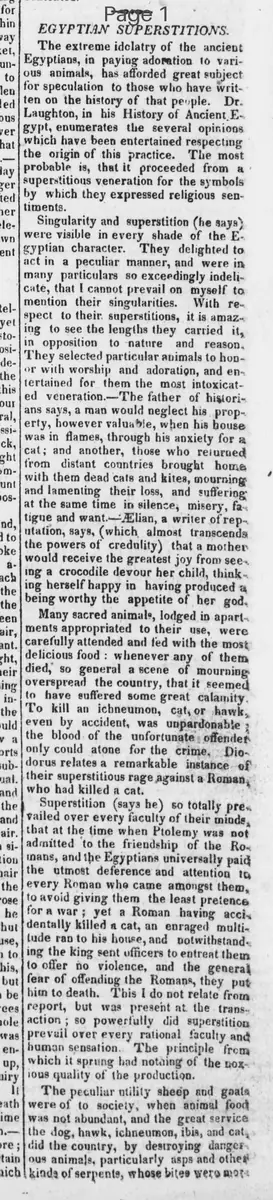
EGYPTIAN SUPERSTITIONS.
The extreme idolatry of the ancient Egyptians, in paying adoration to various animals, has afforded great subject for speculation to those who have written on the history of that people. Dr. Laughton, in his History of Ancient Egypt, enumerates the several opinions which have been entertained respecting the origin of this practice. The most probable is, that it proceeded from a superstitious veneration for the symbols by which they expressed religious sentiments.
Singularity and superstition were visible in every shade of the Egyptian character. They delighted to act in a peculiar manner, and were in many particulars so exceedingly indelicate, that I cannot prevail on myself to mention their singularities. With respect to their superstitions, it is amazing to see the lengths they carried it, in opposition to nature and reason. They selected particular animals to honor with worship and adoration, and entertained for them the most intoxicated veneration.—The father of historians says, a man would neglect his property, however valuable, when his house was in flames, through his anxiety for a cat; and another, those who returned from distant countries brought home with them dead cats and kites, mourning and lamenting their loss, and suffering at the same time in silence, misery, fatigue and want.—Ælian, a writer of reputation, says, (which almost transcends the powers of credulity) that a mother would receive the greatest joy from seeing a crocodile devour her child, thinking herself happy in having produced a being worthy the appetite of her god.
Many sacred animals, lodged in apartments appropriated to their use, were carefully attended and fed with the most delicious food: whenever any of them died, so general a scene of mourning overspread the country, that it seemed to have suffered some great calamity. To kill an ichneumon, cat, or hawk, even by accident, was unpardonable—the blood of the unfortunate offender only could atone for the crime. Diodorus relates a remarkable instance of their superstitious rage against a Roman, who had killed a cat.
Superstition (says he) so totally prevailed over every faculty of their minds, that at the time when Ptolemy was not admitted to the friendship of the Romans, and the Egyptians universally paid the utmost deference and attention to every Roman who came amongst them, to avoid giving them the least pretence for a war; yet a Roman having accidentally killed a cat, an enraged multitude ran to his house, and notwithstanding the king sent officers to entreat them to offer no violence, and the general fear of offending the Romans, they put him to death. This I do not relate from report, but was present at the transaction; so powerfully did superstition prevail over every rational faculty and human sensation.
The principle from which it sprung had nothing of the noxious quality of the production. The peculiar utility sheep and goats were of to society, when animal food was not abundant, and the great service the dog, hawk, ichneumon, ibis, and cat, did the country, by destroying dangerous animals, particularly asps and other kinds of serpents, whose bites were mortal, occasioned these animals to be much caressed and regarded: which partiality superstition converted by an easy transition into a sacred estimation. This, together with their custom of conveying ideas and sentiments of the divine attributes, elements, or heavenly bodies, by which hieroglyphics or figures of plants and animals, and applying that sacred respect and admiration to the symbols themselves, which they were only intended to indicate, gave birth to the high veneration they entertained for leeks, onions, and composed a system of unparalleled idolatry, degrading to human nature.
The extreme idolatry of the ancient Egyptians, in paying adoration to various animals, has afforded great subject for speculation to those who have written on the history of that people. Dr. Laughton, in his History of Ancient Egypt, enumerates the several opinions which have been entertained respecting the origin of this practice. The most probable is, that it proceeded from a superstitious veneration for the symbols by which they expressed religious sentiments.
Singularity and superstition were visible in every shade of the Egyptian character. They delighted to act in a peculiar manner, and were in many particulars so exceedingly indelicate, that I cannot prevail on myself to mention their singularities. With respect to their superstitions, it is amazing to see the lengths they carried it, in opposition to nature and reason. They selected particular animals to honor with worship and adoration, and entertained for them the most intoxicated veneration.—The father of historians says, a man would neglect his property, however valuable, when his house was in flames, through his anxiety for a cat; and another, those who returned from distant countries brought home with them dead cats and kites, mourning and lamenting their loss, and suffering at the same time in silence, misery, fatigue and want.—Ælian, a writer of reputation, says, (which almost transcends the powers of credulity) that a mother would receive the greatest joy from seeing a crocodile devour her child, thinking herself happy in having produced a being worthy the appetite of her god.
Many sacred animals, lodged in apartments appropriated to their use, were carefully attended and fed with the most delicious food: whenever any of them died, so general a scene of mourning overspread the country, that it seemed to have suffered some great calamity. To kill an ichneumon, cat, or hawk, even by accident, was unpardonable—the blood of the unfortunate offender only could atone for the crime. Diodorus relates a remarkable instance of their superstitious rage against a Roman, who had killed a cat.
Superstition (says he) so totally prevailed over every faculty of their minds, that at the time when Ptolemy was not admitted to the friendship of the Romans, and the Egyptians universally paid the utmost deference and attention to every Roman who came amongst them, to avoid giving them the least pretence for a war; yet a Roman having accidentally killed a cat, an enraged multitude ran to his house, and notwithstanding the king sent officers to entreat them to offer no violence, and the general fear of offending the Romans, they put him to death. This I do not relate from report, but was present at the transaction; so powerfully did superstition prevail over every rational faculty and human sensation.
The principle from which it sprung had nothing of the noxious quality of the production. The peculiar utility sheep and goats were of to society, when animal food was not abundant, and the great service the dog, hawk, ichneumon, ibis, and cat, did the country, by destroying dangerous animals, particularly asps and other kinds of serpents, whose bites were mortal, occasioned these animals to be much caressed and regarded: which partiality superstition converted by an easy transition into a sacred estimation. This, together with their custom of conveying ideas and sentiments of the divine attributes, elements, or heavenly bodies, by which hieroglyphics or figures of plants and animals, and applying that sacred respect and admiration to the symbols themselves, which they were only intended to indicate, gave birth to the high veneration they entertained for leeks, onions, and composed a system of unparalleled idolatry, degrading to human nature.
What sub-type of article is it?
Essay
What themes does it cover?
Religious
Moral Virtue
Social Manners
What keywords are associated?
Egyptian Superstitions
Animal Worship
Idolatry
Hieroglyphics
Historical Essay
Ancient Egypt
Literary Details
Title
Egyptian Superstitions.
Subject
On Ancient Egyptian Idolatry And Animal Worship
Key Lines
The Father Of Historians Says, A Man Would Neglect His Property, However Valuable, When His House Was In Flames, Through His Anxiety For A Cat;
Ælian, A Writer Of Reputation, Says, (Which Almost Transcends The Powers Of Credulity) That A Mother Would Receive The Greatest Joy From Seeing A Crocodile Devour Her Child, Thinking Herself Happy In Having Produced A Being Worthy The Appetite Of Her God.
Superstition (Says He) So Totally Prevailed Over Every Faculty Of Their Minds, That At The Time When Ptolemy Was Not Admitted To The Friendship Of The Romans... They Put Him To Death.
This I Do Not Relate From Report, But Was Present At The Transaction; So Powerfully Did Superstition Prevail Over Every Rational Faculty And Human Sensation.