Thank you for visiting SNEWPapers!
Sign up free
Editorial
May 10, 1802
Jenks's Portland Gazette
Portland, Cumberland County, Maine
What is this article about?
This editorial, part II on 'The Poor,' advocates for a suburban charitable institution providing employment in gardening and manufacturing, education for children, suitable clothing for worship attendance, and access to religious instruction by clergymen to promote moral and physical well-being among the destitute.
Clipping
OCR Quality
95%
Excellent
Full Text
For this Gazette.
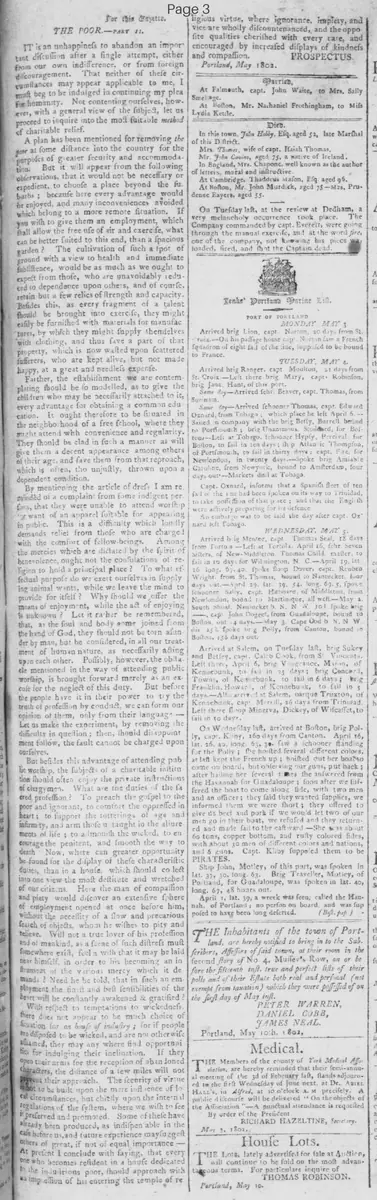
THE POOR.—PART II.
It is an unhappiness to abandon an important discussion after a single attempt, either from our own indifference, or from foreign discouragement. That neither of these circumstances may appear applicable to me, I must beg to be indulged in continuing my plea for humanity. Not contenting ourselves, however, with a general view of the subject, let us proceed to inquire into the most suitable method of charitable relief.
A plan has been mentioned for removing the poor at some distance into the country for the purposes of greater security and accommodation. But it will appear from the following observations, that it would not be necessary or expedient, to choose a place beyond the suburbs; because here every advantage would be enjoyed, and many inconveniences avoided which belong to a more remote situation. If you wish to give them an employment, which shall allow the free use of air and exercise, what can be better suited to this end, than a spacious garden? The cultivation of such a spot of ground with a view to health and immediate subsistence, would be as much as we ought to expect from those, who are unavoidably reduced to dependence upon others, and of course, retain but a few relics of strength and capacity. Besides this, as every fragment of a talent should be brought into exercise, they might easily be furnished with materials for manufactures, by which they might supply themselves with clothing, and thus save a part of that property, which is now wasted upon scattered sufferers, who are kept alive, but not made happy, at a great and needless expense.
Further, the establishment we are contemplating should be so modelled, as to give the children who may be necessarily attached to it, every advantage for obtaining a common education. It ought therefore to be situated in the neighbourhood of a free school, where they might attend with convenience and regularity. They should be clad in such a manner as will give them a decent appearance among others of their age, and save them from that reproach, which is often, tho unjustly, thrown upon a dependent condition.
By mentioning the article of dress I am reminded of a complaint from some indigent persons, that they were unable to attend worship 'for want of an apparel suitable for appearing in public.' This is a difficulty which loudly demands relief from those who are charged with the comfort of fellow-beings. Among the mercies which are dictated by the spirit of benevolence, ought not the consolations of religion to hold a principal place? To what effectual purpose do we exert ourselves in supplying animal wants, while we leave the mind to provide for itself? Why should we offer the means of enjoyment, while the art of enjoying is unknown? Let it rather be remembered, that, as the soul and body come joined from the hand of God, they should not be torn asunder by man, but be considered, in all our treatment of human nature, as necessarily acting upon each other. Possibly, however, the obstacle mentioned in the way of attending public worship, is brought forward merely as an excuse for the neglect of this duty. But before the people have it in their power to try the truth of profession by conduct, we can form our opinion of them, only from their language—
Let us make the experiment, by removing the difficulty in question: then, should disappointment follow, the fault cannot be charged upon ourselves.
But besides this advantage of attending public worship, the subjects of a charitable institution should often enjoy the private instructions of clergymen. What are the duties of the sacred profession? To preach the gospel to the poor and ignorant, to comfort the oppressed in heart; to support the tottering, of age and infirmity, and arm those untaught in the allurements of life; to admonish the wicked, to encourage the penitent, and smooth the way to death. Now, where can greater opportunity be found for the display of these characteristic duties, than in a house, which should collect into one view the most destitute and wretched of our citizens. Here the man of compassion and piety would discover an extensive sphere of employment opened at once before him, without the necessity of a slow and precarious search of objects, whom he wishes to pity and relieve. Will not a true lover of his profession and of mankind, as a scene of such distress must somewhere exist, feel a wish that it may be laid near himself, in order to his becoming an instrument of the various, mercy which it demands? Need he be told, that in such an employment the finest and best sensibilities of the heart will be constantly awakened & gratified?
With respect to temptations to wickedness, there does not appear to be much choice of situation for a house of industry; or if people are disposed to be wicked, and are not otherwise ashamed, they may any where find opportunities for indulging their inclination. If they open their arms for the reception of abandoned characters, the distance of a few miles will not prevent their approach. The security of virtue is not to be built upon the mere influence of local circumstances, but chiefly upon the internal regulations of the system, where we wish to see it preserved and promoted. Some of these have already been produced as indispensable in the case before us, and future experience may suggest others of great, if not of equal importance—
At present I conclude with saying that every one who becomes resident in a house dedicated to the industrious poor, should approach with an impression of his entering the temple of religious virtue, where ignorance, impiety, and vice are wholly discountenanced, and the opposite qualities cherished with every care, and encouraged by increased displays of kindness and compassion.
THE POOR.—PART II.
It is an unhappiness to abandon an important discussion after a single attempt, either from our own indifference, or from foreign discouragement. That neither of these circumstances may appear applicable to me, I must beg to be indulged in continuing my plea for humanity. Not contenting ourselves, however, with a general view of the subject, let us proceed to inquire into the most suitable method of charitable relief.
A plan has been mentioned for removing the poor at some distance into the country for the purposes of greater security and accommodation. But it will appear from the following observations, that it would not be necessary or expedient, to choose a place beyond the suburbs; because here every advantage would be enjoyed, and many inconveniences avoided which belong to a more remote situation. If you wish to give them an employment, which shall allow the free use of air and exercise, what can be better suited to this end, than a spacious garden? The cultivation of such a spot of ground with a view to health and immediate subsistence, would be as much as we ought to expect from those, who are unavoidably reduced to dependence upon others, and of course, retain but a few relics of strength and capacity. Besides this, as every fragment of a talent should be brought into exercise, they might easily be furnished with materials for manufactures, by which they might supply themselves with clothing, and thus save a part of that property, which is now wasted upon scattered sufferers, who are kept alive, but not made happy, at a great and needless expense.
Further, the establishment we are contemplating should be so modelled, as to give the children who may be necessarily attached to it, every advantage for obtaining a common education. It ought therefore to be situated in the neighbourhood of a free school, where they might attend with convenience and regularity. They should be clad in such a manner as will give them a decent appearance among others of their age, and save them from that reproach, which is often, tho unjustly, thrown upon a dependent condition.
By mentioning the article of dress I am reminded of a complaint from some indigent persons, that they were unable to attend worship 'for want of an apparel suitable for appearing in public.' This is a difficulty which loudly demands relief from those who are charged with the comfort of fellow-beings. Among the mercies which are dictated by the spirit of benevolence, ought not the consolations of religion to hold a principal place? To what effectual purpose do we exert ourselves in supplying animal wants, while we leave the mind to provide for itself? Why should we offer the means of enjoyment, while the art of enjoying is unknown? Let it rather be remembered, that, as the soul and body come joined from the hand of God, they should not be torn asunder by man, but be considered, in all our treatment of human nature, as necessarily acting upon each other. Possibly, however, the obstacle mentioned in the way of attending public worship, is brought forward merely as an excuse for the neglect of this duty. But before the people have it in their power to try the truth of profession by conduct, we can form our opinion of them, only from their language—
Let us make the experiment, by removing the difficulty in question: then, should disappointment follow, the fault cannot be charged upon ourselves.
But besides this advantage of attending public worship, the subjects of a charitable institution should often enjoy the private instructions of clergymen. What are the duties of the sacred profession? To preach the gospel to the poor and ignorant, to comfort the oppressed in heart; to support the tottering, of age and infirmity, and arm those untaught in the allurements of life; to admonish the wicked, to encourage the penitent, and smooth the way to death. Now, where can greater opportunity be found for the display of these characteristic duties, than in a house, which should collect into one view the most destitute and wretched of our citizens. Here the man of compassion and piety would discover an extensive sphere of employment opened at once before him, without the necessity of a slow and precarious search of objects, whom he wishes to pity and relieve. Will not a true lover of his profession and of mankind, as a scene of such distress must somewhere exist, feel a wish that it may be laid near himself, in order to his becoming an instrument of the various, mercy which it demands? Need he be told, that in such an employment the finest and best sensibilities of the heart will be constantly awakened & gratified?
With respect to temptations to wickedness, there does not appear to be much choice of situation for a house of industry; or if people are disposed to be wicked, and are not otherwise ashamed, they may any where find opportunities for indulging their inclination. If they open their arms for the reception of abandoned characters, the distance of a few miles will not prevent their approach. The security of virtue is not to be built upon the mere influence of local circumstances, but chiefly upon the internal regulations of the system, where we wish to see it preserved and promoted. Some of these have already been produced as indispensable in the case before us, and future experience may suggest others of great, if not of equal importance—
At present I conclude with saying that every one who becomes resident in a house dedicated to the industrious poor, should approach with an impression of his entering the temple of religious virtue, where ignorance, impiety, and vice are wholly discountenanced, and the opposite qualities cherished with every care, and encouraged by increased displays of kindness and compassion.
What sub-type of article is it?
Social Reform
Moral Or Religious
Education
What keywords are associated?
Poor Relief
Charitable Institutions
Suburban Poor Houses
Education For Poor Children
Religious Instruction
Moral Reform
Gardening Employment
What entities or persons were involved?
The Poor
Clergymen
Editorial Details
Primary Topic
Suitable Methods Of Charitable Relief For The Poor
Stance / Tone
Advocacy For Humane, Integrated Poor Relief
Key Figures
The Poor
Clergymen
Key Arguments
Suburban Location Preferred Over Remote Country For Accessibility And Advantages.
Provide Employment In Gardening For Health And Subsistence.
Supply Materials For Manufacturing Clothing To Reduce Expenses.
Ensure Proximity To Free Schools For Children's Education.
Provide Decent Clothing To Enable Worship Attendance And Avoid Stigma.
Integrate Religious Consolations And Instructions For Moral Well Being.
Internal Regulations Key To Preventing Wickedness, Not Location.