Thank you for visiting SNEWPapers!
Sign up free
Editorial
January 22, 1942
Atlanta Daily World
Atlanta, Fulton County, Georgia
What is this article about?
Editorial commemorates Robert E. Lee's birthday, praising his Confederate leadership and post-war advocacy for reconciliation without rancor. It notes educated Southern Negroes' reverence for Lee and urges applying his and Wade Hampton's philosophies of loyalty to address current racial tensions and opportunities amid national crisis. From Jackson (Miss.) Advocate.
Clipping
OCR Quality
95%
Excellent
Full Text
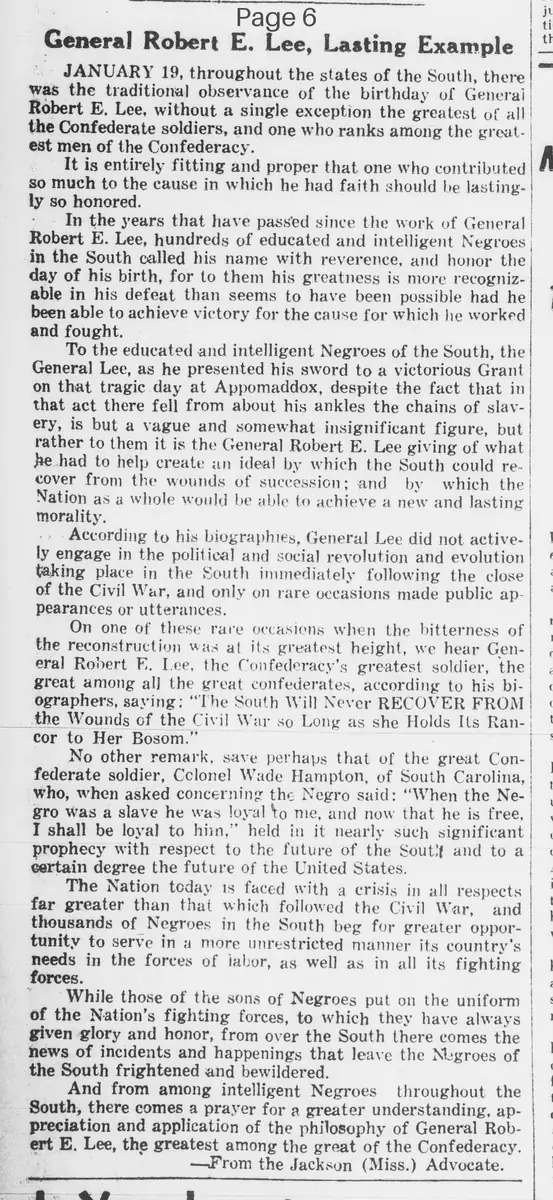
General Robert E. Lee, Lasting Example
JANUARY 19, throughout the states of the South, there
was the traditional observance of the birthday of General
Robert E. Lee, without a single exception the greatest of all
the Confederate soldiers, and one who ranks among the great-
est men of the Confederacy.
It is entirely fitting and proper that one who contributed
so much to the cause in which he had faith should be lasting-
ly so honored.
In the years that have passed since the work of General
Robert E. Lee, hundreds of educated and intelligent Negroes
in the South called his name with reverence, and honor the
day of his birth, for to them his greatness is more recogniz-
able in his defeat than seems to have been possible had he
been able to achieve victory for the cause for which he worked
and fought.
To the educated and intelligent Negroes of the South, the
General Lee, as he presented his sword to a victorious Grant
on that tragic day at Appomattox, despite the fact that in
that act there fell from about his ankles the chains of slav-
ery, is but a vague and somewhat insignificant figure, but
rather to them it is the General Robert E. Lee giving of what
he had to help create an ideal by which the South could re-
cover from the wounds of secession; and by
which the
Nation as a whole would be able to achieve a new and lasting
morality.
According to his biographies, General Lee did not active-
ly engage in the political and social revolution and evolution
taking place in the South immediately following the close
of the Civil War, and only on rare occasions made public ap-
pearances or utterances.
On one of these rare occasions when the bitterness of
the reconstruction was at its greatest height, we hear Gen-
eral Robert E. Lee, the Confederacy's greatest soldier, the
great among all the great confederates, according to his bi-
ographers, saying: "The South Will Never RECOVER FROM
the Wounds of the Civil War so Long as she Holds Its Ran-
cor to Her Bosom."
No other remark, save perhaps that of the great Con-
federate soldier, Colonel Wade Hampton, of South Carolina,
who, when asked concerning the Negro said: "When the Ne-
gro was a slave he was loyal to me, and now that he is free,
I shall be loyal to him," held in it nearly such significant
prophecy with respect to the future of the South and to a
certain degree the future of the United States.
The Nation today is faced with a crisis in all respects
far greater than that which followed the Civil War, and
thousands of Negroes in the South beg for greater oppor-
tunity to serve in a more unrestricted manner its country's
needs in the forces of labor, as well as in all its fighting
forces.
While those of the sons of Negroes put on the uniform
of the Nation's fighting forces, to which they have always
given glory and honor, from over the South there comes the
news of incidents and happenings that leave the Negroes of
the South frightened and bewildered.
And from among intelligent Negroes
throughout the
South, there comes a prayer for a greater understanding, ap-
preciation and application of the philosophy of General Rob-
ert E. Lee, the greatest among the great of the Confederacy.
-From the Jackson (Miss.) Advocate.
JANUARY 19, throughout the states of the South, there
was the traditional observance of the birthday of General
Robert E. Lee, without a single exception the greatest of all
the Confederate soldiers, and one who ranks among the great-
est men of the Confederacy.
It is entirely fitting and proper that one who contributed
so much to the cause in which he had faith should be lasting-
ly so honored.
In the years that have passed since the work of General
Robert E. Lee, hundreds of educated and intelligent Negroes
in the South called his name with reverence, and honor the
day of his birth, for to them his greatness is more recogniz-
able in his defeat than seems to have been possible had he
been able to achieve victory for the cause for which he worked
and fought.
To the educated and intelligent Negroes of the South, the
General Lee, as he presented his sword to a victorious Grant
on that tragic day at Appomattox, despite the fact that in
that act there fell from about his ankles the chains of slav-
ery, is but a vague and somewhat insignificant figure, but
rather to them it is the General Robert E. Lee giving of what
he had to help create an ideal by which the South could re-
cover from the wounds of secession; and by
which the
Nation as a whole would be able to achieve a new and lasting
morality.
According to his biographies, General Lee did not active-
ly engage in the political and social revolution and evolution
taking place in the South immediately following the close
of the Civil War, and only on rare occasions made public ap-
pearances or utterances.
On one of these rare occasions when the bitterness of
the reconstruction was at its greatest height, we hear Gen-
eral Robert E. Lee, the Confederacy's greatest soldier, the
great among all the great confederates, according to his bi-
ographers, saying: "The South Will Never RECOVER FROM
the Wounds of the Civil War so Long as she Holds Its Ran-
cor to Her Bosom."
No other remark, save perhaps that of the great Con-
federate soldier, Colonel Wade Hampton, of South Carolina,
who, when asked concerning the Negro said: "When the Ne-
gro was a slave he was loyal to me, and now that he is free,
I shall be loyal to him," held in it nearly such significant
prophecy with respect to the future of the South and to a
certain degree the future of the United States.
The Nation today is faced with a crisis in all respects
far greater than that which followed the Civil War, and
thousands of Negroes in the South beg for greater oppor-
tunity to serve in a more unrestricted manner its country's
needs in the forces of labor, as well as in all its fighting
forces.
While those of the sons of Negroes put on the uniform
of the Nation's fighting forces, to which they have always
given glory and honor, from over the South there comes the
news of incidents and happenings that leave the Negroes of
the South frightened and bewildered.
And from among intelligent Negroes
throughout the
South, there comes a prayer for a greater understanding, ap-
preciation and application of the philosophy of General Rob-
ert E. Lee, the greatest among the great of the Confederacy.
-From the Jackson (Miss.) Advocate.
What sub-type of article is it?
Moral Or Religious
Social Reform
What keywords are associated?
Robert E Lee
Confederate Soldiers
Civil War Reconciliation
Southern Recovery
Negro Loyalty
Racial Understanding
Post War Morality
What entities or persons were involved?
Robert E. Lee
Ulysses S. Grant
Wade Hampton
Educated Negroes Of The South
Confederacy
Editorial Details
Primary Topic
Honoring Robert E. Lee And Applying His Reconciliation Philosophy To Modern Racial Issues
Stance / Tone
Admiring Of Lee And Exhortative For Greater Understanding And Loyalty
Key Figures
Robert E. Lee
Ulysses S. Grant
Wade Hampton
Educated Negroes Of The South
Confederacy
Key Arguments
Lee Contributed Greatly To The Confederate Cause And Is Honored Annually In The South
Educated Negroes Revere Lee For His Defeat Enabling Recognition Of His Greatness And A New Morality
Lee's Surrender At Appomattox Symbolized The End Of Slavery's Chains And Aid In Southern Recovery
Lee Advised Against Holding Rancor To Recover From Civil War Wounds
Wade Hampton's Loyalty To Freed Negroes As Prophecy For The South's Future
Current National Crisis Requires Greater Opportunities For Negroes In Labor And Military
Incidents In The South Frighten Negroes, Calling For Application Of Lee's Philosophy