Thank you for visiting SNEWPapers!
Sign up free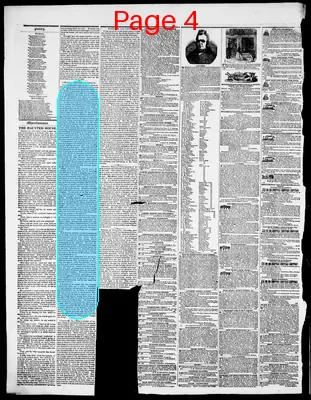
Republican Herald
Providence, Providence County, Rhode Island
What is this article about?
In 1736, Oxfordshire innkeeper Jonathan Bradford is discovered over the murdered body of guest Mr. Hayes with a bloody knife, convicted on strong circumstantial evidence, and executed despite his innocence claims. Eighteen months later, Hayes's footman confesses on his deathbed to the stabbing and robbery, revealing Bradford intended to rob but arrived after the murder.
Clipping

OCR Quality
Full Text
Jonathan Bradford kept an inn in Oxfordshire, on the London road to Oxford, in the year 1736. He bore an unexceptionable character. Mr. Hayes, a gentleman of fortune, being on his way to Oxford, on a visit to a relation, put up at Bradford's; he there joined company with two gentlemen, with whom he supped, and in conversation unguardedly mentioned that he had then about him a large sum of money. In due time they retired to their respective chambers; the gentlemen to a two-bedded room, leaving, as is customary with many, a candle burning in the chimney-corner. Some hours after they were in bed, one of the gentlemen being awake, thought he heard deep groans in the adjoining chamber, and this being repeated, he softly awakened his friend. They listened together, the groans increasing as of one dying, they both instantly arose and proceeded silently to the door of the next chamber, from whence they heard the groans: and the door being ajar, saw a light in the room; they entered, but it was impossible to paint their consternation, on perceiving a person weltering in his blood in the bed, and a man standing over him, with a dark lanthorn in one hand and a knife in the other. The man seemed as petrified as themselves, but his terror carried with it all the terror of guilt! The gentleman soon discovered the person was the stranger with whom they had that night supped, and that the man who was standing over him was their host. They seized Bradford, disarmed him of his knife, and charged him with being the murderer; he assumed by this time the air of innocence, positively denied the crime, and asserted that he came there with the same humane intentions as themselves; for that, hearing a noise, which was succeeded by groaning, he got out of bed, struck a light, armed himself with a knife for his defence, and had but that moment entered the room before them.
These assertions were of little avail; he was kept in close custody till the morning, and then taken before a neighboring justice of the peace. Bradford still denied the murder, but nevertheless, with such an apparent indication of guilt, that the justice hesitated not to make use of this extraordinary expression, on writing out his mittimus, 'Mr. Bradford, either you or myself committed this murder.'
This extraordinary affair was the conversation of the whole county. Bradford was tried and condemned over and over again, in every company. In the midst of all this predetermination came on the assizes at Oxford; Bradford was brought to trial, he pleaded not guilty. Nothing could be more strong than the evidence of the two gentlemen; they testified to the finding Mr. Hayes murdered in his bed; Bradford at the side of the body with a light and a knife; that knife and the hand which held it bloody: that on their entering the room he betrayed all the signs of a guilty man, and that a few moments preceding, they heard the groans of the deceased.
Bradford's defence on his trial was the same as before the gentlemen; he had heard a noise; he suspected some villany transacting; he struck a light; he snatched a knife (the only weapon near him) to defend himself; and the terrors he discovered, were merely the terrors of humanity, the natural effects of innocence as well as guilt, on beholding such a horrid scene.
This defence, however, could be considered but as weak, contrasted with several powerful circumstances against him. Never was circumstantial evidence there so strong: There was little need left of comment from the judge in summing up the evidence. No room appeared for extenuation! And the jury brought in the prisoner guilty, even without going out of the box, Bradford was executed shortly after, still declaring he was not the murderer, nor privy to the murder of Mr. Hayes; but he died disbelieved by all.
Yet were those assertions not untrue! The murder was actually committed by Mr. Hayes's footman, who, immediately on stabbing his master, rifled his breeches of his money, gold watch and snuff-box, and escaped to his own room; which could have been, from the above circumstances, scarcely two seconds before Bradford's entering the unfortunate man's chamber. The world owes this knowledge to a remorse of conscience in the footman (eighteen months after the execution of Bradford) on a bed of sickness; it was death-bed repentance, and by that death the law lost its victim.
It is much to be wished that this account could close here, but it cannot, Bradford, though innocent, and not privy to the murder, was nevertheless, the murderer in design.— He, had heard, as well as the footman, what Mr. Hayes had declared at supper, as to his having a large sum of money about him, and he went to the chamber with the same diabolical intention as the servant, He was struck with amazement!—he could not believe his senses! and in turning back the bed-clothes, to assure himself of the fact, he in his agitation dropped his knife on the bleeding body, by which both his hand and the knife became bloody, These circumstances Bradford acknowledged to the clergyman who attended him after his sentence.—Theory of Presumptive Proof.
What sub-type of article is it?
What themes does it cover?
What keywords are associated?
What entities or persons were involved?
Where did it happen?
Story Details
Key Persons
Location
Oxfordshire, On The London Road To Oxford
Event Date
1736
Story Details
Innkeeper Jonathan Bradford intends to rob guest Mr. Hayes after hearing of his money, but arrives to find Hayes already stabbed by his footman, who flees. Bradford, in shock, drops his knife on the body, getting blood on it. Two gentlemen discover him over the corpse, leading to his arrest, trial, conviction on circumstantial evidence, and execution. The footman confesses on his deathbed eighteen months later.