Thank you for visiting SNEWPapers!
Sign up free
Literary
February 6, 1872
The Bloomfield Times
New Bloomfield, Perry County, Pennsylvania
What is this article about?
Sailor Bob Small, fearing a shark dooms him during a voyage home to New Hampshire, confides in shipmate Jack. After the shark's demise, Bob vanishes, presumed drowned. Jack visits Bob's family to deliver news and a gift, discovering Bob alive and well, having staged his disappearance for a surprise reunion.
Merged-components note: These three components form a single continuous literary story titled 'THE SAILOR'S STORY' that spans multiple blocks on page 2, as indicated by the sequential reading order and narrative flow.
Clipping
OCR Quality
98%
Excellent
Full Text
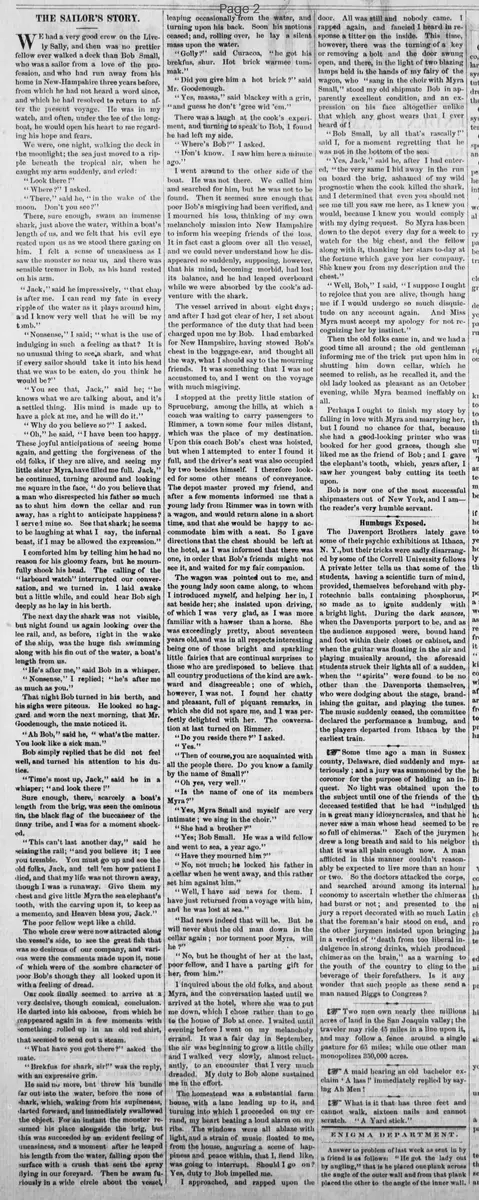
THE SAILOR'S STORY.
He had a very good crew on the Lovely Sally, and there was no prettier fellow ever walked a deck than Bob Small, who was a sailor from a love of the profession, and who had run away from his home in New-Hampshire three years before, from which he had not heard a word since, and which he had resolved to return to after the present voyage. He was in my watch, and often, under the lee of the long-boat, he would open his heart to me regarding his hope and fears.
We were, one night, walking the deck in the moonlight; the sea just moved to a ripple beneath the tropical air, when he caught my arm suddenly, and cried:
"Look there!"
"Where?" I asked.
"There," said he, "in the wake of the moon. Don't you see?"
There, sure enough, swam an immense shark, just above the water, within a boat's length of us, and we felt that his evil eye rested upon us as we stood there gazing on him. I felt a sense of uneasiness as I saw the monster so near us, and there was sensible tremor in Bob, as his hand rested on his arm.
"Jack," said he impressively, "that chap is after me. I can read my fate in every ripple of the water as it plays around him, and I know very well that he will be my tomb."
"Nonsense," I said; "what is the use of indulging in such a feeling as that? It is no unusual thing to see a shark, and what if every sailor should take it into his head that he was to be eaten, do you think he would be?"
"You see that, Jack," said he; "he knows what we are talking about, and it's a settled thing. His mind is made up to have a pick at me, and he will do it."
"Why do you believe so?" I asked.
"Oh," he said, "I have been too happy. These joyful anticipations of seeing home again, and getting the forgiveness of the old folks, if they are alive, and seeing my little sister Myra, have filled me full, Jack," he continued, turning around and looking me square in the face, "do you believe that a man who disrespected his father so much as to shut him down the cellar and run away, has a right to anticipate happiness? I served mine so. See that shark; he seems to be laughing at what I say, the infernal beast, if I may be allowed the expression."
I comforted him by telling him he had no reason for his gloomy fears, but he mournfully shook his head. The calling of the "larboard watch" interrupted our conversation, and we turned in. I laid awake but a little while, and could hear Bob sigh deeply as he lay in his berth.
The next day the shark was not visible, but night found us again looking over the lee rail, and, as before, right in the wake of the ship, was the huge fish swimming along with his fin out of the water, a boat's length from us.
"He's after me," said Bob in a whisper.
"Nonsense," I replied; "he's after me as much as you."
That night Bob turned in his berth, and his sighs were piteous. He looked so haggard and worn the next morning, that Mr. Goodenough, the mate, noticed it.
"Ah Bob," said he, "what's the matter. You look like a sick man."
Bob simply replied that he did not feel well, and turned his attention to his duties.
"Time's most up, Jack," said he in a whisper; "and look there!"
Sure enough, there, scarcely a boat's length from the brig, was seen the ominous fin, the black flag of the buccaneer of the finny tribe, and I was for a moment shocked.
"This can't last another day," said he seizing the rail; "and you believe it; I see you tremble. You must go up and see the old folks, Jack, and tell 'em how patient I died, and that my life was not thrown away, though I was a runaway. Give them my chest and give little Myra the sea elephant's tooth, with the carving upon it, to keep as a memento, and Heaven bless you, Jack."
The poor fellow wept like a child.
The whole crew were now attracted along the vessel's side, to see the great fish that was so desirous of our company, and various were the comments made upon it, none of which were of the sombre character of poor Bob's though they all looked upon it with a feeling of dread.
Our cook finally seemed to arrive at a very decisive, though comical, conclusion. He darted into his caboose, from which he reappeared again in a few moments with something rolled up in an old red shirt, that seemed to send out a steam.
"What have you got there?" asked the mate.
"Breakfast for shark, sir!" was the reply, with an expressive grin.
He said no more, but threw his bundle far out into the water, before the nose of shark, which, waking from his supineness, darted forward, and immediately swallowed the object. For an instant the monster resumed his place alongside the brig, but this was succeeded by an evident feeling of uneasiness, and a moment after he leaped his length from the water, falling upon the surface with a crush that sent the spray flying in our foreyard. Then he swam furiously in a wide circle about the vessel
leaping occasionally from the water, and turning upon his back. Soon his motions ceased; and, rolling over, he lay a silent mass upon the water.
"Golly?" said Curacoa, "he got his breakfast, shur. Hot brick warmee tum-mak."
"Did you give him a hot brick?" said Mr. Goodenough.
"Yes, massa," said blackey with a grin, "and guess he don't 'gree wid 'em."
There was a laugh at the cook's experiment, and turning to speak to Bob, I found he had left my side.
"Where's Bob?" I asked.
"Don't know. I saw him here a minute ago."
I went around to the other side of the boat. He was not there. We called him and searched for him, but he was not to be found. Then it seemed sure enough that poor Bob's misgiving had been verified, and I mourned his loss, thinking of my own melancholy mission into New Hampshire to inform his weeping friends of the loss. It in fact cast a gloom over all the vessel, and we could never understand how he disappeared so suddenly, supposing, however, that his mind, becoming morbid, had lost its balance, and he had leaped overboard while we were absorbed by the cook's adventure with the shark.
The vessel arrived in about eight days; and after I had got clear of her, I set about the performance of the duty that had been charged upon me by Bob. I had embarked for New Hampshire, having stowed Bob's chest in the baggage-car, and thought all the way, what I should say to the mourning friends. It was something that I was not accustomed to, and I went on the voyage with much misgiving.
I stopped at the pretty little station of Spruceburg, among the hills, at which a coach was waiting to carry passengers to Rimmer, a town some four miles distant, which was the place of my destination. Upon this coach Bob's chest was hoisted, but when I attempted to enter I found it full, and the driver's seat was also occupied by two besides himself. I therefore looked for some other means of conveyance.
The depot master proved my friend, and after a few moments informed me that a young lady from Rimmer was in town with a wagon, and would return alone in a short time, and that she would be happy to accommodate him with a seat. So I gave directions that the chest should be left at the hotel, as I was informed that there was one, in order that Bob's friends might not see it, and waited for my fair companion.
The wagon was pointed out to me, and the young lady soon came along, to whom I introduced myself, and helping her in, I sat beside her; she insisted upon driving, of which I was very glad, as I was more familiar with a hawser than a horse. She was exceedingly pretty, about seventeen years old, and was in all respects interesting being one of those bright and sparkling little fairies that are continual surprises to those who are predisposed to believe that all country productions of the kind are awkward and disagreeable; one of which, however, I was not. I found her chatty and pleasant, full of piquant remarks, in which she did not spare me, and I was perfectly delighted with her. The conversation at last turned on Rimmer.
"Do you reside there?" I asked.
"Yes."
"Then of course, you are acquainted with all the people there. Do you know a family by the name of Small?"
"Oh yes, very well."
"Is the name of one of its members Myra?"
"Yes, Myra Small and myself are very intimate; we sing in the choir."
"She had a brother?"
"Yes; Bob Small. He was a wild fellow and went to sea, a year ago."
"Have they mourned him?"
"No, not much; he locked his father in a cellar when he went away, and this rather set him against him."
"Well, I have sad news for them. I have just returned from a voyage with him, and he was lost at sea."
"Bad news indeed that will be. But he will never shut the old man down in the cellar again; nor torment poor Myra, will he?"
"No, but he thought of her at the last, poor fellow, and I have a parting gift for her, from him."
I inquired about the old folks, and about Myra, and the conversation lasted until we arrived at the hotel, where she was to put me down, which I chose rather than to go to the house of Bob at once. I waited until evening before I went on my melancholy errand. It was a fair day in September, the air was beginning to grow a little chilly and I walked very slowly, almost reluctantly, to an encounter that I very much dreaded. My duty to Bob alone sustained me in the effort.
The homestead was a substantial farm house, with a lane leading up to it, and turning into which I proceeded on my errand, my heart beating a loud alarm on my ribs. The windows were all ablaze with light, and a strain of music floated to me, from the house, auguring a scene of happiness and peace within, that I, fiend like, was going to interrupt. Should I go on? Yes, duty to Bob impelled me.
I approached, and rapped upon the
door. All was still and nobody came. I rapped again, and fancied I heard in response a titter on the inside. This time, however, there was the turning of a key or removing a bolt and the door swung open, and there, in the light of two blazing lamps held in the hands of my fairy of the wagon, who "sang in the choir with Myra Small," stood my old shipmate Bob in apparently excellent condition, and an expression on his face altogether unlike that which any ghost wears that I ever heard of!
"Bob Small, by all that's rascally!" said I, for a moment regretting that he was not in the bottom of the sea.
"Yes, Jack," said he, after I had entered, "the very same I hid away in the run on board the brig, ashamed of my wild prognostic when the cook killed the shark, and I determined that even you should not see me till you saw me here, as I knew you would, because I know you would comply with my dying request. So Myra has been down to the depot every day for a week to watch for the big chest, and the fellow along with it, thanking her stars to-day at the fortune which gave you her company. She knew you from my description and the chest."
"Well, Bob," I said, "I suppose I ought to rejoice that you are alive, though hang me if I would undergo so much disquietude on any account again. And Miss Myra must accept my apology for not recognizing her by instinct."
Then the old folks came in, and we had a good time all around; the old gentleman informing me of the trick put upon him in shutting him down cellar, which he seemed to relish, as he recalled it, and the old lady looked as pleasant as an October evening, while Myra beamed ineffably on all.
Perhaps I ought to finish my story by falling in love with Myra and marrying her, but I found no chance for that, because she had a good-looking printer who was booked for her good graces, though she liked me as the friend of Bob; and I gave the elephant's tooth, which, years after, I saw her youngest baby cutting its teeth upon.
Bob is now one of the most successful shipmasters out of New York, and I am the reader's very humble servant.
He had a very good crew on the Lovely Sally, and there was no prettier fellow ever walked a deck than Bob Small, who was a sailor from a love of the profession, and who had run away from his home in New-Hampshire three years before, from which he had not heard a word since, and which he had resolved to return to after the present voyage. He was in my watch, and often, under the lee of the long-boat, he would open his heart to me regarding his hope and fears.
We were, one night, walking the deck in the moonlight; the sea just moved to a ripple beneath the tropical air, when he caught my arm suddenly, and cried:
"Look there!"
"Where?" I asked.
"There," said he, "in the wake of the moon. Don't you see?"
There, sure enough, swam an immense shark, just above the water, within a boat's length of us, and we felt that his evil eye rested upon us as we stood there gazing on him. I felt a sense of uneasiness as I saw the monster so near us, and there was sensible tremor in Bob, as his hand rested on his arm.
"Jack," said he impressively, "that chap is after me. I can read my fate in every ripple of the water as it plays around him, and I know very well that he will be my tomb."
"Nonsense," I said; "what is the use of indulging in such a feeling as that? It is no unusual thing to see a shark, and what if every sailor should take it into his head that he was to be eaten, do you think he would be?"
"You see that, Jack," said he; "he knows what we are talking about, and it's a settled thing. His mind is made up to have a pick at me, and he will do it."
"Why do you believe so?" I asked.
"Oh," he said, "I have been too happy. These joyful anticipations of seeing home again, and getting the forgiveness of the old folks, if they are alive, and seeing my little sister Myra, have filled me full, Jack," he continued, turning around and looking me square in the face, "do you believe that a man who disrespected his father so much as to shut him down the cellar and run away, has a right to anticipate happiness? I served mine so. See that shark; he seems to be laughing at what I say, the infernal beast, if I may be allowed the expression."
I comforted him by telling him he had no reason for his gloomy fears, but he mournfully shook his head. The calling of the "larboard watch" interrupted our conversation, and we turned in. I laid awake but a little while, and could hear Bob sigh deeply as he lay in his berth.
The next day the shark was not visible, but night found us again looking over the lee rail, and, as before, right in the wake of the ship, was the huge fish swimming along with his fin out of the water, a boat's length from us.
"He's after me," said Bob in a whisper.
"Nonsense," I replied; "he's after me as much as you."
That night Bob turned in his berth, and his sighs were piteous. He looked so haggard and worn the next morning, that Mr. Goodenough, the mate, noticed it.
"Ah Bob," said he, "what's the matter. You look like a sick man."
Bob simply replied that he did not feel well, and turned his attention to his duties.
"Time's most up, Jack," said he in a whisper; "and look there!"
Sure enough, there, scarcely a boat's length from the brig, was seen the ominous fin, the black flag of the buccaneer of the finny tribe, and I was for a moment shocked.
"This can't last another day," said he seizing the rail; "and you believe it; I see you tremble. You must go up and see the old folks, Jack, and tell 'em how patient I died, and that my life was not thrown away, though I was a runaway. Give them my chest and give little Myra the sea elephant's tooth, with the carving upon it, to keep as a memento, and Heaven bless you, Jack."
The poor fellow wept like a child.
The whole crew were now attracted along the vessel's side, to see the great fish that was so desirous of our company, and various were the comments made upon it, none of which were of the sombre character of poor Bob's though they all looked upon it with a feeling of dread.
Our cook finally seemed to arrive at a very decisive, though comical, conclusion. He darted into his caboose, from which he reappeared again in a few moments with something rolled up in an old red shirt, that seemed to send out a steam.
"What have you got there?" asked the mate.
"Breakfast for shark, sir!" was the reply, with an expressive grin.
He said no more, but threw his bundle far out into the water, before the nose of shark, which, waking from his supineness, darted forward, and immediately swallowed the object. For an instant the monster resumed his place alongside the brig, but this was succeeded by an evident feeling of uneasiness, and a moment after he leaped his length from the water, falling upon the surface with a crush that sent the spray flying in our foreyard. Then he swam furiously in a wide circle about the vessel
leaping occasionally from the water, and turning upon his back. Soon his motions ceased; and, rolling over, he lay a silent mass upon the water.
"Golly?" said Curacoa, "he got his breakfast, shur. Hot brick warmee tum-mak."
"Did you give him a hot brick?" said Mr. Goodenough.
"Yes, massa," said blackey with a grin, "and guess he don't 'gree wid 'em."
There was a laugh at the cook's experiment, and turning to speak to Bob, I found he had left my side.
"Where's Bob?" I asked.
"Don't know. I saw him here a minute ago."
I went around to the other side of the boat. He was not there. We called him and searched for him, but he was not to be found. Then it seemed sure enough that poor Bob's misgiving had been verified, and I mourned his loss, thinking of my own melancholy mission into New Hampshire to inform his weeping friends of the loss. It in fact cast a gloom over all the vessel, and we could never understand how he disappeared so suddenly, supposing, however, that his mind, becoming morbid, had lost its balance, and he had leaped overboard while we were absorbed by the cook's adventure with the shark.
The vessel arrived in about eight days; and after I had got clear of her, I set about the performance of the duty that had been charged upon me by Bob. I had embarked for New Hampshire, having stowed Bob's chest in the baggage-car, and thought all the way, what I should say to the mourning friends. It was something that I was not accustomed to, and I went on the voyage with much misgiving.
I stopped at the pretty little station of Spruceburg, among the hills, at which a coach was waiting to carry passengers to Rimmer, a town some four miles distant, which was the place of my destination. Upon this coach Bob's chest was hoisted, but when I attempted to enter I found it full, and the driver's seat was also occupied by two besides himself. I therefore looked for some other means of conveyance.
The depot master proved my friend, and after a few moments informed me that a young lady from Rimmer was in town with a wagon, and would return alone in a short time, and that she would be happy to accommodate him with a seat. So I gave directions that the chest should be left at the hotel, as I was informed that there was one, in order that Bob's friends might not see it, and waited for my fair companion.
The wagon was pointed out to me, and the young lady soon came along, to whom I introduced myself, and helping her in, I sat beside her; she insisted upon driving, of which I was very glad, as I was more familiar with a hawser than a horse. She was exceedingly pretty, about seventeen years old, and was in all respects interesting being one of those bright and sparkling little fairies that are continual surprises to those who are predisposed to believe that all country productions of the kind are awkward and disagreeable; one of which, however, I was not. I found her chatty and pleasant, full of piquant remarks, in which she did not spare me, and I was perfectly delighted with her. The conversation at last turned on Rimmer.
"Do you reside there?" I asked.
"Yes."
"Then of course, you are acquainted with all the people there. Do you know a family by the name of Small?"
"Oh yes, very well."
"Is the name of one of its members Myra?"
"Yes, Myra Small and myself are very intimate; we sing in the choir."
"She had a brother?"
"Yes; Bob Small. He was a wild fellow and went to sea, a year ago."
"Have they mourned him?"
"No, not much; he locked his father in a cellar when he went away, and this rather set him against him."
"Well, I have sad news for them. I have just returned from a voyage with him, and he was lost at sea."
"Bad news indeed that will be. But he will never shut the old man down in the cellar again; nor torment poor Myra, will he?"
"No, but he thought of her at the last, poor fellow, and I have a parting gift for her, from him."
I inquired about the old folks, and about Myra, and the conversation lasted until we arrived at the hotel, where she was to put me down, which I chose rather than to go to the house of Bob at once. I waited until evening before I went on my melancholy errand. It was a fair day in September, the air was beginning to grow a little chilly and I walked very slowly, almost reluctantly, to an encounter that I very much dreaded. My duty to Bob alone sustained me in the effort.
The homestead was a substantial farm house, with a lane leading up to it, and turning into which I proceeded on my errand, my heart beating a loud alarm on my ribs. The windows were all ablaze with light, and a strain of music floated to me, from the house, auguring a scene of happiness and peace within, that I, fiend like, was going to interrupt. Should I go on? Yes, duty to Bob impelled me.
I approached, and rapped upon the
door. All was still and nobody came. I rapped again, and fancied I heard in response a titter on the inside. This time, however, there was the turning of a key or removing a bolt and the door swung open, and there, in the light of two blazing lamps held in the hands of my fairy of the wagon, who "sang in the choir with Myra Small," stood my old shipmate Bob in apparently excellent condition, and an expression on his face altogether unlike that which any ghost wears that I ever heard of!
"Bob Small, by all that's rascally!" said I, for a moment regretting that he was not in the bottom of the sea.
"Yes, Jack," said he, after I had entered, "the very same I hid away in the run on board the brig, ashamed of my wild prognostic when the cook killed the shark, and I determined that even you should not see me till you saw me here, as I knew you would, because I know you would comply with my dying request. So Myra has been down to the depot every day for a week to watch for the big chest, and the fellow along with it, thanking her stars to-day at the fortune which gave you her company. She knew you from my description and the chest."
"Well, Bob," I said, "I suppose I ought to rejoice that you are alive, though hang me if I would undergo so much disquietude on any account again. And Miss Myra must accept my apology for not recognizing her by instinct."
Then the old folks came in, and we had a good time all around; the old gentleman informing me of the trick put upon him in shutting him down cellar, which he seemed to relish, as he recalled it, and the old lady looked as pleasant as an October evening, while Myra beamed ineffably on all.
Perhaps I ought to finish my story by falling in love with Myra and marrying her, but I found no chance for that, because she had a good-looking printer who was booked for her good graces, though she liked me as the friend of Bob; and I gave the elephant's tooth, which, years after, I saw her youngest baby cutting its teeth upon.
Bob is now one of the most successful shipmasters out of New York, and I am the reader's very humble servant.
What sub-type of article is it?
Prose Fiction
What themes does it cover?
Moral Virtue
Friendship
What keywords are associated?
Sailor Story
Shark Superstition
Runaway Sailor
Family Reunion
Homecoming
Sea Voyage
Forgiveness
Literary Details
Title
The Sailor's Story.
Key Lines
"Jack," Said He Impressively, "That Chap Is After Me. I Can Read My Fate In Every Ripple Of The Water As It Plays Around Him, And I Know Very Well That He Will Be My Tomb."
"Oh," He Said, "I Have Been Too Happy. These Joyful Anticipations Of Seeing Home Again, And Getting The Forgiveness Of The Old Folks, If They Are Alive, And Seeing My Little Sister Myra, Have Filled Me Full, Jack,"
"Breakfast For Shark, Sir!" Was The Reply, With An Expressive Grin.
"Bob Small, By All That's Rascally!" Said I, For A Moment Regretting That He Was Not In The Bottom Of The Sea.
Bob Is Now One Of The Most Successful Shipmasters Out Of New York, And I Am The Reader's Very Humble Servant.