Thank you for visiting SNEWPapers!
Sign up free
Lynchburg Virginian
Lynchburg, Virginia
What is this article about?
Official letter from U.S. Acting Secretary of State to Georgia slave owner Robert Collins, affirming President Fillmore's intent to enforce the Fugitive Slave Law amid Boston opposition, but requiring proof of obstruction before federal action. Dated Nov. 9, 1850.
Clipping
OCR Quality
Full Text
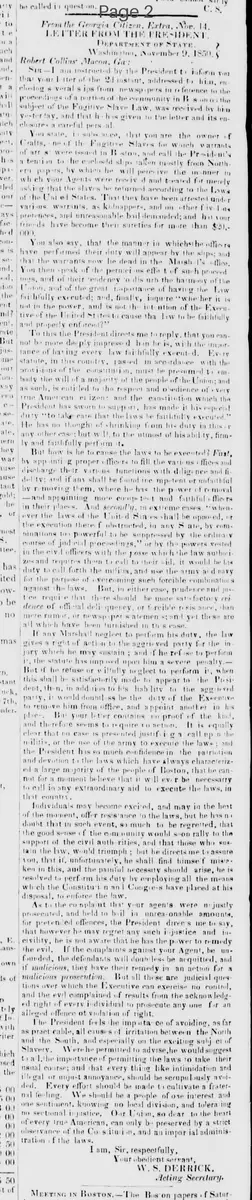
LETTER FROM THE PRESIDENT.
Department of State.
Washington, November 9, 1850.
Robert Collins, Macon, Ga.:
Sir—I am instructed by the President to inform you that your letter of the 2d instant, addressed to him, enclosing several slips from newspapers in reference to the proceedings of a portion of the community in Boston on the subject of the Fugitive Slave Law, was received by him yesterday, and that he has given to the letter and its enclosures a careful perusal.
You state, in substance, that you are the owner of Crafts, the fugitive slaves for whom warrants of arrest were issued in Boston, and call the President's attention to the enclosed slips taken mostly from Northern papers, by which he will perceive the manner in which your Agents were received and treated for merely asking that the slaves be returned according to the Laws of the United States. That they have been arrested under various warrants, as kidnappers, and on other frivolous pretences, and unreasonable bail demanded; and that your friends have become their sureties for more than $20,000.
You also say, that the manner in which the officers have performed their duty will appear by the slips; and that the warrants now lie dead in the Marshal's office.
You then speak of the pernicious effect of such proceedings, and of their tendency to disturb the harmony of the Union, and of the great importance of having the Law faithfully executed; and, finally, inquire "whether it is not in the power, and is not the intention of the Executive of the United States to cause the law to be faithfully and properly enforced?"
To this the President directs me to reply, that you cannot be more deeply impressed than he is, with the importance of having every law faithfully executed. Every statute, in this country, passed in accordance with the provisions of the constitution, must be presumed to embody the will of a majority of the people of the Union; and as such, is entitled to the respect and obedience of every true American citizen: and the constitution which the President has sworn to support, has made it his especial duty "to take care that the laws be faithfully executed."
He has no thoughts of shrinking from his duty in this, or any other case; but will, to the utmost of his ability, firmly and faithfully perform it.
But how is he to cause the laws to be executed? First, by appointing proper officers to fill the various offices and discharge their various functions with diligence and fidelity: and if any shall be found incompetent or unfaithful by removing them, where he has the power of removal—and appointing more competent and faithful officers in their places. And secondly, in extreme cases "when, whenever the laws of the United States shall be opposed, or the execution thereof obstructed, in any State, by combinations too powerful to be suppressed by the ordinary course of judicial proceedings," or by the powers vested in the civil officers with the posse which the law authorizes and requires them to call to their aid, it would be his duty to call forth the militia, and use the army and navy for the purpose of overcoming such forcible combinations against the laws. But, in either case, prudence and justice require that there should be more satisfactory evidence of official delinquency, or forcible resistance, than mere rumor, or newspaper statements; and yet these are all which have been furnished in this case.
If any Marshal shall neglect to perform his duty, the law gives a right of action to the aggrieved party for the injury which he may sustain; and if he refuse to perform it, the statute has imposed upon him a severe penalty. But if he refuse or willfully neglect to perform it, when this shall be satisfactorily made to appear to the President, then, in addition to his liability to the aggrieved party, it would doubtless be the duty of the Executive to remove him from office, and appoint another in his place. But your letter contains no proof of the kind, and therefore seems to require no action. It is equally clear that no case is presented justifying a call upon the militia, or the use of the army to execute the laws: and the President has so much confidence in the patriotism and devotion to the laws which have always characterized a large majority of the people of Boston, that he cannot for a moment believe that it will ever be necessary to call in any extraordinary aid to execute the laws, in that quarter.
Individuals may become excited, and may in the heat of the moment, offer resistance to the laws, but he has no doubt that in such event, so much to be regretted, that the good sense of the community would soon rally to the support of the civil authorities, and that those who sustain the law, would triumph; but he directs me to assure you, that if, unfortunately, he shall find himself mistaken in this, and the painful necessity should arise, he is resolved to perform his duty by employing all the means which the Constitution and Congress have placed at his disposal, to enforce the law.
As to the complaint that your agents were unjustly prosecuted, and held to bail in unreasonable amounts, for pretended offences, the President directs me to say, that however he may regret any such injustice and incivility, he is not aware that he has the power to remedy the evil. If the complaints against your Agents, be unfounded, the defendants will doubtless be acquitted, and if malicious, they have their remedy in an action for a malicious prosecution. But all these are judicial questions over which the Executive can exercise no control, and the evil complained of results from the acknowledged right of every individual to prosecute any one for an alleged offence or violation of right.
The President feels the importance of avoiding, as far as practicable, all causes of irritation between the North and the South, and especially on the exciting subject of Slavery. Were he permitted to advise, he would suggest to all, the importance of permitting the laws to take their usual course; and that every thing like intimidation and illegal or unjust annoyance, should be scrupulously avoided. Every effort should be made to cultivate a fraternal feeling. We should be a people of one interest and one sentiment, knowing no local division, and tolerating no sectional injustice. Our Union, so dear to the heart of every true American, can only be preserved by a strict observance of the Constitution, and an impartial administration of the laws.
I am, Sir, respectfully,
Your obedient servant,
W. S. DERRICK,
Acting Secretary.
What sub-type of article is it?
What themes does it cover?
What keywords are associated?
What entities or persons were involved?
Where did it happen?
Story Details
Key Persons
Location
Boston, Washington
Event Date
November 9, 1850
Story Details
Acting Secretary Derrick conveys the President's response to Robert Collins, owner of fugitive slaves Crafts, regarding resistance in Boston to enforcing the Fugitive Slave Law. The President affirms commitment to faithful execution of laws but notes lack of evidence for federal intervention, expressing confidence in local authorities and urging harmony between North and South.