Thank you for visiting SNEWPapers!
Sign up free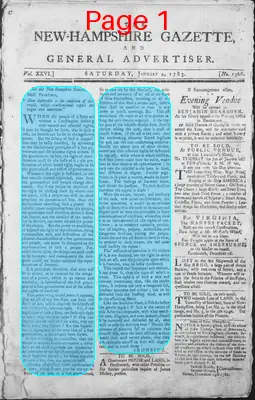
Letter to Editor
January 4, 1783
The New Hampshire Gazette And General Advertiser
Portsmouth, Exeter, Rockingham County, New Hampshire
What is this article about?
An anonymous letter signed 'IRONSIDE' argues against a New-Hampshire act requiring an oath for voting eligibility, asserting it violates fundamental rights of representation, free government principles, and freedom of conscience, potentially allowing minorities to control majorities.
Clipping
OCR Quality
95%
Excellent
Full Text
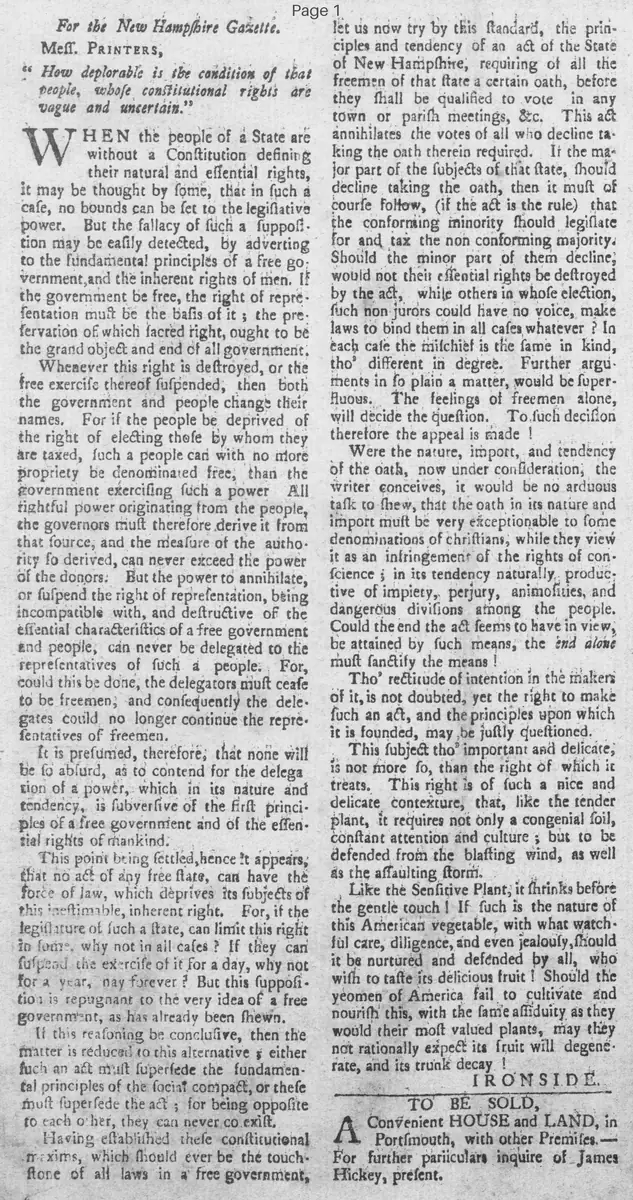
For the New-Hampshire Gazette.
Mess. Printers,
How deplorable is the condition of that People, whose constitutional rights are vague and uncertain.
WHEN the people of a State are without a Constitution defining their natural and essential rights, it may be thought by some, that in such a case, no bounds can be set to the legislative power. But the fallacy of such a supposition may be easily detected, by adverting to the fundamental principles of a free government, and the inherent rights of men. If the government be free, the right of representation must be the basis of it; the preservation of which sacred right, ought to be the grand object and end of all government. Whenever this right is destroyed, or the free exercise thereof suspended; then both the government and people change their names. For if the people be deprived of the right of electing those by whom they are taxed, such a people can with no more propriety be denominated free, than the government exercising such a power. All rightful power originating from the people, the governors must therefore derive it from that source; and the measure of the authority so derived, can never exceed the power of the donors: But the power to annihilate, or suspend the right of representation, being incompatible with, and destructive of the essential characteristics of a free government and people, can never be delegated to the representatives of such a people. For, could this be done, the delegators must cease to be freemen, and consequently the delegates could no longer continue the representatives of freemen.
It is presumed, therefore, that none will be so absurd, as to contend for the delegation of a power, which in its nature and tendency, is subversive of the first principles of a free government and of the essential rights of mankind.
This point being settled, hence it appears, that no act of any free state, can have the force of law, which deprives its subjects of this inestimable, inherent right. For, if the legislature of such a state, can limit this right in some, why not in all cases? If they can suspend the exercise of it for a day, why not for a year, nay forever? But this supposition is repugnant to the very idea of a free government, as has already been shewn.
If this reasoning be conclusive, then the matter is reduced to this alternative; either such an act must supersede the fundamental principles of the social compact, or these must supersede the act; for being opposite to each other, they can never co-exist.
Having established these constitutional maxims, which should ever be the touchstone of all laws in a free government, let us now try by this standard, the principles and tendency of an act of the State of New-Hampshire, requiring of all the freemen of that state a certain oath, before they shall be qualified to vote in any town or parish meetings, &c. This act annihilates the votes of all who decline taking the oath therein required. If the major part of the subjects of that state, should decline taking the oath, then it must of course follow, (if the act is the rule) that the conforming minority should legislate for and tax the non-conforming majority. Should the minor part of them decline? would not their essential rights be destroyed by the act, while others in whose election, such non-jurors could have no voice, make laws to bind them in all cases whatever? In each case the mischief is the same in kind, tho' different in degree. Further arguments on so plain a matter, would be superfluous. The feelings of freemen alone, will decide the question. To such decision therefore the appeal is made!
Were the nature, import, and tendency of the oath, now under consideration, the writer conceives, it would be no arduous task to shew, that the oath in its nature and import must be very exceptionable to some denominations of christians, while they view it as an infringement of the rights of conscience; in its tendency naturally productive of impiety, perjury, animosities, and dangerous divisions among the people. Could the end the Act seems to have in view, be attained by such means, the end alone must sanctify the means!
Tho' rectitude of intention in the maker of it, is not doubted, yet the right to make such an act, and the principles upon which it is founded, may be justly questioned.
This subject tho' important and delicate; is not more so, than the right of which it treats. This right is of such a nice and delicate contexture, that, like the tender plant, it requires not only a congenial soil, constant attention and culture; but to be defended from the blustering wind, as well as the assailing storm. Like the Sensitive Plant, it shrinks before the gentle touch! If such is the nature of this American vegetable, with what watchful care, diligence, and even jealousy, should it be nurtured and defended by all, who wish to taste its delicious fruit! Should the yeomen of America fail to cultivate and nourish this, with the same assiduity as they would their most valued plants, may they not rationally expect its fruit will degenerate, and its trunk decay!
IRONSIDE.
Mess. Printers,
How deplorable is the condition of that People, whose constitutional rights are vague and uncertain.
WHEN the people of a State are without a Constitution defining their natural and essential rights, it may be thought by some, that in such a case, no bounds can be set to the legislative power. But the fallacy of such a supposition may be easily detected, by adverting to the fundamental principles of a free government, and the inherent rights of men. If the government be free, the right of representation must be the basis of it; the preservation of which sacred right, ought to be the grand object and end of all government. Whenever this right is destroyed, or the free exercise thereof suspended; then both the government and people change their names. For if the people be deprived of the right of electing those by whom they are taxed, such a people can with no more propriety be denominated free, than the government exercising such a power. All rightful power originating from the people, the governors must therefore derive it from that source; and the measure of the authority so derived, can never exceed the power of the donors: But the power to annihilate, or suspend the right of representation, being incompatible with, and destructive of the essential characteristics of a free government and people, can never be delegated to the representatives of such a people. For, could this be done, the delegators must cease to be freemen, and consequently the delegates could no longer continue the representatives of freemen.
It is presumed, therefore, that none will be so absurd, as to contend for the delegation of a power, which in its nature and tendency, is subversive of the first principles of a free government and of the essential rights of mankind.
This point being settled, hence it appears, that no act of any free state, can have the force of law, which deprives its subjects of this inestimable, inherent right. For, if the legislature of such a state, can limit this right in some, why not in all cases? If they can suspend the exercise of it for a day, why not for a year, nay forever? But this supposition is repugnant to the very idea of a free government, as has already been shewn.
If this reasoning be conclusive, then the matter is reduced to this alternative; either such an act must supersede the fundamental principles of the social compact, or these must supersede the act; for being opposite to each other, they can never co-exist.
Having established these constitutional maxims, which should ever be the touchstone of all laws in a free government, let us now try by this standard, the principles and tendency of an act of the State of New-Hampshire, requiring of all the freemen of that state a certain oath, before they shall be qualified to vote in any town or parish meetings, &c. This act annihilates the votes of all who decline taking the oath therein required. If the major part of the subjects of that state, should decline taking the oath, then it must of course follow, (if the act is the rule) that the conforming minority should legislate for and tax the non-conforming majority. Should the minor part of them decline? would not their essential rights be destroyed by the act, while others in whose election, such non-jurors could have no voice, make laws to bind them in all cases whatever? In each case the mischief is the same in kind, tho' different in degree. Further arguments on so plain a matter, would be superfluous. The feelings of freemen alone, will decide the question. To such decision therefore the appeal is made!
Were the nature, import, and tendency of the oath, now under consideration, the writer conceives, it would be no arduous task to shew, that the oath in its nature and import must be very exceptionable to some denominations of christians, while they view it as an infringement of the rights of conscience; in its tendency naturally productive of impiety, perjury, animosities, and dangerous divisions among the people. Could the end the Act seems to have in view, be attained by such means, the end alone must sanctify the means!
Tho' rectitude of intention in the maker of it, is not doubted, yet the right to make such an act, and the principles upon which it is founded, may be justly questioned.
This subject tho' important and delicate; is not more so, than the right of which it treats. This right is of such a nice and delicate contexture, that, like the tender plant, it requires not only a congenial soil, constant attention and culture; but to be defended from the blustering wind, as well as the assailing storm. Like the Sensitive Plant, it shrinks before the gentle touch! If such is the nature of this American vegetable, with what watchful care, diligence, and even jealousy, should it be nurtured and defended by all, who wish to taste its delicious fruit! Should the yeomen of America fail to cultivate and nourish this, with the same assiduity as they would their most valued plants, may they not rationally expect its fruit will degenerate, and its trunk decay!
IRONSIDE.
What sub-type of article is it?
Persuasive
Political
Philosophical
What themes does it cover?
Constitutional Rights
Politics
Religion
What keywords are associated?
Constitutional Rights
Voting Oath
New Hampshire Act
Representation
Free Government
Conscience Infringement
Oath Requirement
What entities or persons were involved?
Ironside
Mess. Printers
Letter to Editor Details
Author
Ironside
Recipient
Mess. Printers
Main Argument
an act requiring an oath for voting in new-hampshire violates the fundamental right of representation in a free government, as it can disenfranchise majorities or minorities, and infringes on rights of conscience, making it unconstitutional.
Notable Details
Appeal To Feelings Of Freemen
Metaphor Of The Sensitive Plant For Rights
Reference To Social Compact And Inherent Rights