Thank you for visiting SNEWPapers!
Sign up free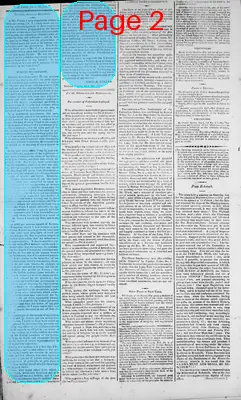
Letter to Editor
May 29, 1811
The Rhode Island Republican
Newport, Newport County, Rhode Island
What is this article about?
In 1811, Amos B. Fuller, a former Federalist merchant and New York assemblyman from Madison County, publicly recants his Federalist affiliation, denouncing party tactics and affirming support for the Republican administration's just handling of national affairs, including the Chesapeake incident. (248 characters)
Clipping
OCR Quality
95%
Excellent
Full Text
A Fuller for a Shelley.
From the American Watchman.
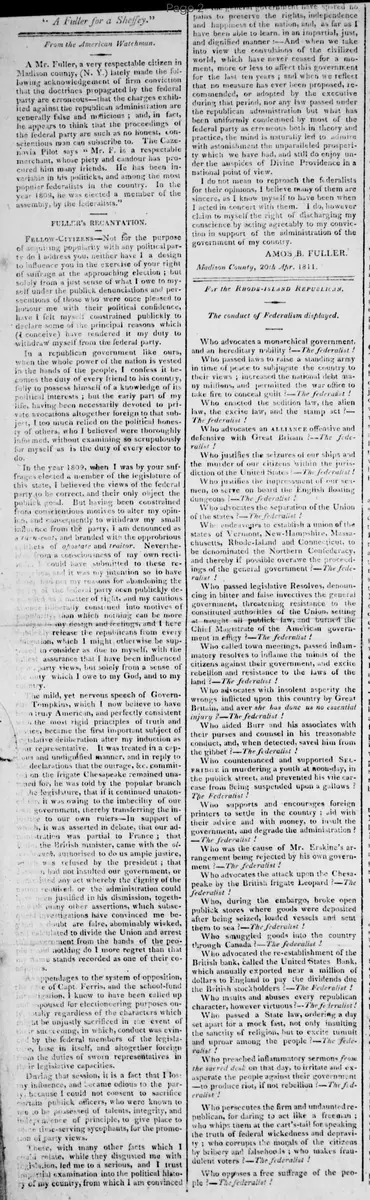
A Mr. Fuller, a very respectable citizen in Madison county, (N. Y.) lately made the following acknowledgement of firm conviction that the doctrines propagated by the federal party are erroneous--that the charges exhibited against the republican administration are generally false and malicious; and, in fact, he appears to think that the proceedings of the federal party are such as no honest, conscientious man can subscribe to. The Cazenovia Pilot says "Mr. F. is a respectable merchant, whose piety and candour has procured him many friends. He has been invariable in his politics, and among the most popular federalists in the country. In the year 1809, he was elected a member of the assembly, by the federalists."
FULLER'S RECANTATION.
Fellow-Citizens--Not for the purpose of acquiring popularity with any political party do I address you, neither have I a design to influence you in the exercise of your right of suffrage at the approaching election; but solely from a just sense of what I owe to myself under the publick denunciations and persecutions of those who were once pleased to honour me with their political confidence, have I felt myself constrained publickly to declare some of the principal reasons which (I conceive) have rendered it my duty to withdraw myself from the federal party.
In a republican government like ours, when the whole power of the nation is vested in the hands of the people, I confess it becomes the duty of every friend to his country, fully to possess himself of a knowledge of its political interests; but the early part of my life, having been necessarily devoted to private avocations altogether foreign to that subject, I too much relied on the political honesty of others, who I believed were thoroughly informed, without examining so scrupulously for myself as is the duty of every elector to do.
In the year 1809, when I was by your suffrages elected a member of the legislature of this state, I believed the views of the federal party to be correct, and their only object the publick good. But having been constrained from conscientious motives to alter my opinion, and consequently to withdraw my small influence from the party, I am denounced as a turn-coat, and branded with the opprobrious epithets of apostate and traitor. Nevertheless, from a consciousness of my own rectitude, I could have submitted to these reflections, and it was my intention so to have done, had not my reasons for abandoning the old federal party been publicly demanded as a matter of right, and my cautious reluctance construed into motives of popularity, than which nothing can be more erroneous in my design and feelings, and I hereby release the republicans from every obligation, which I might, otherwise be supposed to consider as due to myself, with the best assurance that I have been influenced by no party views, but solely from a sense of duty which I owe to my God, and to my country.
The mild, yet nervous speech of Governor Tompkins, which I now believe to have been truly American, and perfectly consistent with the most rigid principles of truth and justice, became the first important subject of legislative deliberation after my induction as a representative. It was treated in a captious and undignified manner, and in reply to declarations that the outrage, &c. committed on the frigate Chesapeake remained unavenged, he was told by the popular branch of the legislature, that if it continued unatoned for it was owing to the imbecility of our national government, thereby transferring the censure to our own rulers--In support of which, it was asserted in debate, that our administration was partial to France; that the British minister, came with the olive branch, authorised to do us ample justice, was refused by the president; that Britain had not insulted our government, or committed any act whereby the dignity of the nation required or the administration could been justified in his dismission, together with many other assertions, which subsequent investigations have convinced me beyond doubt are false, abominably wicked, calculated to divide the Union and wrest government from the hands of the people--and nothing do I more regret than that my name stands recorded as one of their co-adjutors.
Appendages to the system of opposition, the case of Capt. Ferris, and the school-fund litigation, I know to have been called up and espoused for electioneering purposes only regardless of the characters which might be unjustly sacrificed in the event of their succeeding, in which, conduct was evinced by the federal members of the legislature, base in itself, and altogether foreign from the duties of sworn representatives in their legislative capacities.
During that session, it is a fact that I lost my influence, and became odious to the party, because I could not consent to sacrifice certain publick officers, who were known to be possessed of talents, integrity, and independence of principle, to give place to more time-serving sycophants, for the promotion of party views.
These, with many other facts which I could relate, while they disgusted me with legislation, led me to a serious, and I trust impartial examination into the political history of my country, from which I am convinced
government have spared no pains to preserve the rights, independence and happiness of the nation, and, as far as I have been able to learn, in an impartial, just, and dignified manner :--And when we take into view the convulsions of the civilized world, which have never ceased for a moment, more or less to affect this government for the last ten years; and when we reflect that no measure has ever been proposed, recommended, or adopted by the executive during that period, nor any law passed under the republican administration but what has been uniformly condemned by most of the federal party as erroneous both in theory and practice, the mind is naturally led to admire with astonishment the unparalleled prosperity which we have had, and still do enjoy under the auspices of Divine Providence in a national point of view.
I do not mean to reproach the federalists for their opinions, I believe many of them are sincere, as I know myself to have been when I acted in concert with them. I do, however claim to myself the right of discharging my conscience by acting agreeably to my conviction in support of the administration of the government of my country.
AMOS B. FULLER.
Madison County, 20th April 1811.
From the American Watchman.
A Mr. Fuller, a very respectable citizen in Madison county, (N. Y.) lately made the following acknowledgement of firm conviction that the doctrines propagated by the federal party are erroneous--that the charges exhibited against the republican administration are generally false and malicious; and, in fact, he appears to think that the proceedings of the federal party are such as no honest, conscientious man can subscribe to. The Cazenovia Pilot says "Mr. F. is a respectable merchant, whose piety and candour has procured him many friends. He has been invariable in his politics, and among the most popular federalists in the country. In the year 1809, he was elected a member of the assembly, by the federalists."
FULLER'S RECANTATION.
Fellow-Citizens--Not for the purpose of acquiring popularity with any political party do I address you, neither have I a design to influence you in the exercise of your right of suffrage at the approaching election; but solely from a just sense of what I owe to myself under the publick denunciations and persecutions of those who were once pleased to honour me with their political confidence, have I felt myself constrained publickly to declare some of the principal reasons which (I conceive) have rendered it my duty to withdraw myself from the federal party.
In a republican government like ours, when the whole power of the nation is vested in the hands of the people, I confess it becomes the duty of every friend to his country, fully to possess himself of a knowledge of its political interests; but the early part of my life, having been necessarily devoted to private avocations altogether foreign to that subject, I too much relied on the political honesty of others, who I believed were thoroughly informed, without examining so scrupulously for myself as is the duty of every elector to do.
In the year 1809, when I was by your suffrages elected a member of the legislature of this state, I believed the views of the federal party to be correct, and their only object the publick good. But having been constrained from conscientious motives to alter my opinion, and consequently to withdraw my small influence from the party, I am denounced as a turn-coat, and branded with the opprobrious epithets of apostate and traitor. Nevertheless, from a consciousness of my own rectitude, I could have submitted to these reflections, and it was my intention so to have done, had not my reasons for abandoning the old federal party been publicly demanded as a matter of right, and my cautious reluctance construed into motives of popularity, than which nothing can be more erroneous in my design and feelings, and I hereby release the republicans from every obligation, which I might, otherwise be supposed to consider as due to myself, with the best assurance that I have been influenced by no party views, but solely from a sense of duty which I owe to my God, and to my country.
The mild, yet nervous speech of Governor Tompkins, which I now believe to have been truly American, and perfectly consistent with the most rigid principles of truth and justice, became the first important subject of legislative deliberation after my induction as a representative. It was treated in a captious and undignified manner, and in reply to declarations that the outrage, &c. committed on the frigate Chesapeake remained unavenged, he was told by the popular branch of the legislature, that if it continued unatoned for it was owing to the imbecility of our national government, thereby transferring the censure to our own rulers--In support of which, it was asserted in debate, that our administration was partial to France; that the British minister, came with the olive branch, authorised to do us ample justice, was refused by the president; that Britain had not insulted our government, or committed any act whereby the dignity of the nation required or the administration could been justified in his dismission, together with many other assertions, which subsequent investigations have convinced me beyond doubt are false, abominably wicked, calculated to divide the Union and wrest government from the hands of the people--and nothing do I more regret than that my name stands recorded as one of their co-adjutors.
Appendages to the system of opposition, the case of Capt. Ferris, and the school-fund litigation, I know to have been called up and espoused for electioneering purposes only regardless of the characters which might be unjustly sacrificed in the event of their succeeding, in which, conduct was evinced by the federal members of the legislature, base in itself, and altogether foreign from the duties of sworn representatives in their legislative capacities.
During that session, it is a fact that I lost my influence, and became odious to the party, because I could not consent to sacrifice certain publick officers, who were known to be possessed of talents, integrity, and independence of principle, to give place to more time-serving sycophants, for the promotion of party views.
These, with many other facts which I could relate, while they disgusted me with legislation, led me to a serious, and I trust impartial examination into the political history of my country, from which I am convinced
government have spared no pains to preserve the rights, independence and happiness of the nation, and, as far as I have been able to learn, in an impartial, just, and dignified manner :--And when we take into view the convulsions of the civilized world, which have never ceased for a moment, more or less to affect this government for the last ten years; and when we reflect that no measure has ever been proposed, recommended, or adopted by the executive during that period, nor any law passed under the republican administration but what has been uniformly condemned by most of the federal party as erroneous both in theory and practice, the mind is naturally led to admire with astonishment the unparalleled prosperity which we have had, and still do enjoy under the auspices of Divine Providence in a national point of view.
I do not mean to reproach the federalists for their opinions, I believe many of them are sincere, as I know myself to have been when I acted in concert with them. I do, however claim to myself the right of discharging my conscience by acting agreeably to my conviction in support of the administration of the government of my country.
AMOS B. FULLER.
Madison County, 20th April 1811.
What sub-type of article is it?
Political
Persuasive
Reflective
What themes does it cover?
Politics
Military War
What keywords are associated?
Federal Recantation
Republican Administration
Chesapeake Incident
Political Conversion
Madison County
Tompkins Speech
What entities or persons were involved?
Amos B. Fuller
Fellow Citizens
Letter to Editor Details
Author
Amos B. Fuller
Recipient
Fellow Citizens
Main Argument
the writer withdraws from the federal party due to conscientious conviction that its doctrines are erroneous, its charges against the republican administration are false and malicious, and the administration has justly preserved national rights amid global convulsions.
Notable Details
References Governor Tompkins' Speech
Chesapeake Frigate Outrage
Capt. Ferris Case
School Fund Litigation