Thank you for visiting SNEWPapers!
Sign up free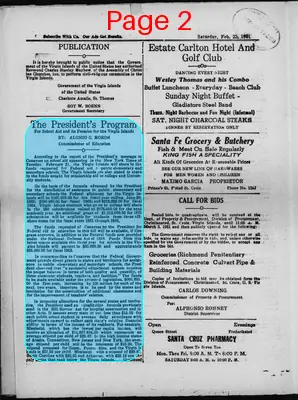
Story
February 25, 1961
The West End News
Frederiksted, Saint Croix County, Virgin Islands
What is this article about?
Alonzo G. Moron explains President Kennedy's proposed federal aid to public schools and scholarships, detailing allocations for the Virgin Islands: $167,575 for FY1962, increasing to $212,882 by FY1964, plus scholarships totaling over $1.4 million through 1966, in addition to existing NDEA funds.
Clipping
OCR Quality
98%
Excellent
Full Text
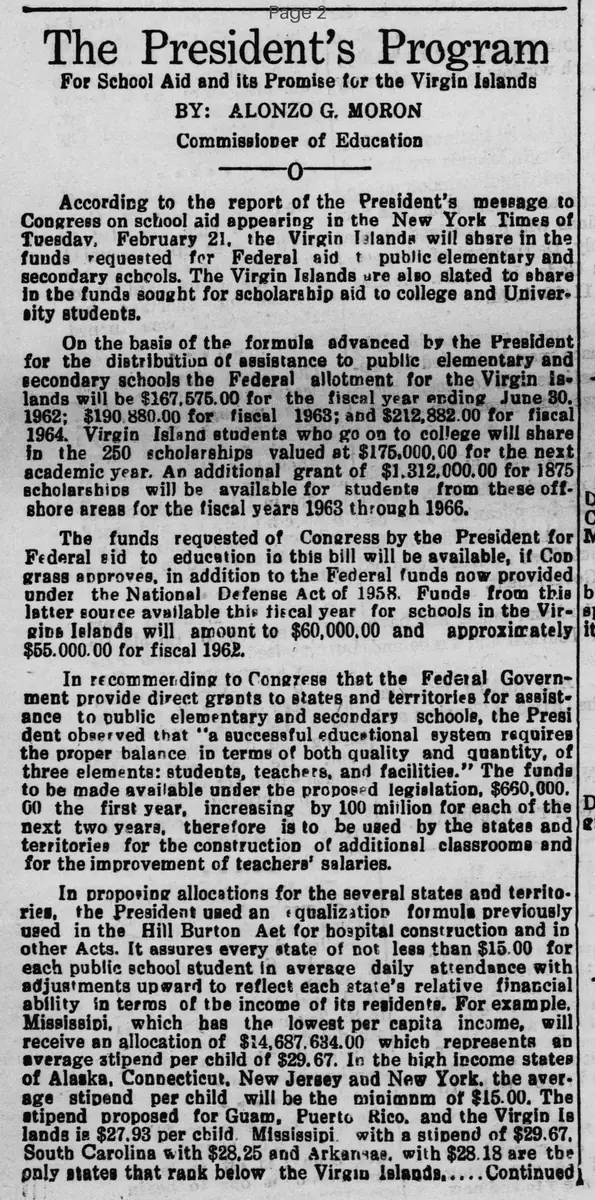
The President's Program
For School Aid and its Promise for the Virgin Islands
BY: ALONZO G. MORON
Commissioner of Education
According to the report of the President's message to Congress on school aid appearing in the New York Times of Tuesday, February 21, the Virgin Islands will share in the funds requested for Federal aid to public elementary and secondary schools. The Virgin Islands are also slated to share in the funds sought for scholarship aid to college and university students.
On the basis of the formula advanced by the President for the distribution of assistance to public elementary and secondary schools the Federal allotment for the Virgin Islands will be $167,575.00 for the fiscal year ending June 30, 1962; $190,880.00 for fiscal 1963; and $212,882.00 for fiscal 1964. Virgin Island students who go on to college will share in the 250 scholarships valued at $175,000.00 for the next academic year. An additional grant of $1,312,000.00 for 1875 scholarships will be available for students from these off-shore areas for the fiscal years 1963 through 1966.
The funds requested of Congress by the President for Federal aid to education in this bill will be available, if Congress approves, in addition to the Federal funds now provided under the National Defense Act of 1958. Funds from this latter source available this fiscal year for schools in the Virgin Islands will amount to $60,000.00 and approximately $55,000.00 for fiscal 1962.
In recommending to Congress that the Federal Government provide direct grants to states and territories for assistance to public elementary and secondary schools, the President observed that "a successful educational system requires the proper balance in terms of both quality and quantity, of three elements: students, teachers, and facilities." The funds to be made available under the proposed legislation, $650,000.00 the first year, increasing by 100 million for each of the next two years, therefore is to be used by the states and territories for the construction of additional classrooms and for the improvement of teachers' salaries.
In proposing allocations for the several states and territories, the President used an equalization formula previously used in the Hill Burton Act for hospital construction and in other Acts. It assures every state of not less than $15.00 for each public school student in average daily attendance with adjustments upward to reflect each state's relative financial ability in terms of the income of its residents. For example, Mississippi, which has the lowest per capita income, will receive an allocation of $14,687,634.00 which represents an average stipend per child of $29.67. In the high income states of Alaska, Connecticut, New Jersey and New York, the average stipend per child will be the minimum of $15.00. The stipend proposed for Guam, Puerto Rico, and the Virgin Islands is $27.93 per child. Mississippi, with a stipend of $29.67, South Carolina with $28.25 and Arkansas, with $28.18 are the only states that rank below the Virgin Islands.....Continued
For School Aid and its Promise for the Virgin Islands
BY: ALONZO G. MORON
Commissioner of Education
According to the report of the President's message to Congress on school aid appearing in the New York Times of Tuesday, February 21, the Virgin Islands will share in the funds requested for Federal aid to public elementary and secondary schools. The Virgin Islands are also slated to share in the funds sought for scholarship aid to college and university students.
On the basis of the formula advanced by the President for the distribution of assistance to public elementary and secondary schools the Federal allotment for the Virgin Islands will be $167,575.00 for the fiscal year ending June 30, 1962; $190,880.00 for fiscal 1963; and $212,882.00 for fiscal 1964. Virgin Island students who go on to college will share in the 250 scholarships valued at $175,000.00 for the next academic year. An additional grant of $1,312,000.00 for 1875 scholarships will be available for students from these off-shore areas for the fiscal years 1963 through 1966.
The funds requested of Congress by the President for Federal aid to education in this bill will be available, if Congress approves, in addition to the Federal funds now provided under the National Defense Act of 1958. Funds from this latter source available this fiscal year for schools in the Virgin Islands will amount to $60,000.00 and approximately $55,000.00 for fiscal 1962.
In recommending to Congress that the Federal Government provide direct grants to states and territories for assistance to public elementary and secondary schools, the President observed that "a successful educational system requires the proper balance in terms of both quality and quantity, of three elements: students, teachers, and facilities." The funds to be made available under the proposed legislation, $650,000.00 the first year, increasing by 100 million for each of the next two years, therefore is to be used by the states and territories for the construction of additional classrooms and for the improvement of teachers' salaries.
In proposing allocations for the several states and territories, the President used an equalization formula previously used in the Hill Burton Act for hospital construction and in other Acts. It assures every state of not less than $15.00 for each public school student in average daily attendance with adjustments upward to reflect each state's relative financial ability in terms of the income of its residents. For example, Mississippi, which has the lowest per capita income, will receive an allocation of $14,687,634.00 which represents an average stipend per child of $29.67. In the high income states of Alaska, Connecticut, New Jersey and New York, the average stipend per child will be the minimum of $15.00. The stipend proposed for Guam, Puerto Rico, and the Virgin Islands is $27.93 per child. Mississippi, with a stipend of $29.67, South Carolina with $28.25 and Arkansas, with $28.18 are the only states that rank below the Virgin Islands.....Continued
What sub-type of article is it?
Historical Event
What themes does it cover?
Triumph
What keywords are associated?
Federal Aid
School Funding
Virgin Islands Education
Scholarships
Presidential Proposal
What entities or persons were involved?
Alonzo G. Moron
The President
Where did it happen?
Virgin Islands
Story Details
Key Persons
Alonzo G. Moron
The President
Location
Virgin Islands
Event Date
Tuesday, February 21
Story Details
President proposes federal aid to education via direct grants to states and territories for school construction and teacher salaries using an equalization formula; Virgin Islands to receive specified allotments and share in scholarships, in addition to NDEA funds.