Thank you for visiting SNEWPapers!
Sign up free
Alexandria Daily Gazette, Commercial & Political
Alexandria, Virginia
What is this article about?
James M'Clure, a U.S. citizen from South Carolina, was imprisoned in France as a British prisoner of war after U.S. Minister General Armstrong refused protection, doubting his citizenship despite evidence of birth in the U.S. and father's naturalization. (214 characters)
Merged-components note: Textual continuation of the narrative about Mr. James M'Clure's case and General Armstrong's refusal of protection; the story flows directly from one component to the next.
Clipping
OCR Quality
Full Text
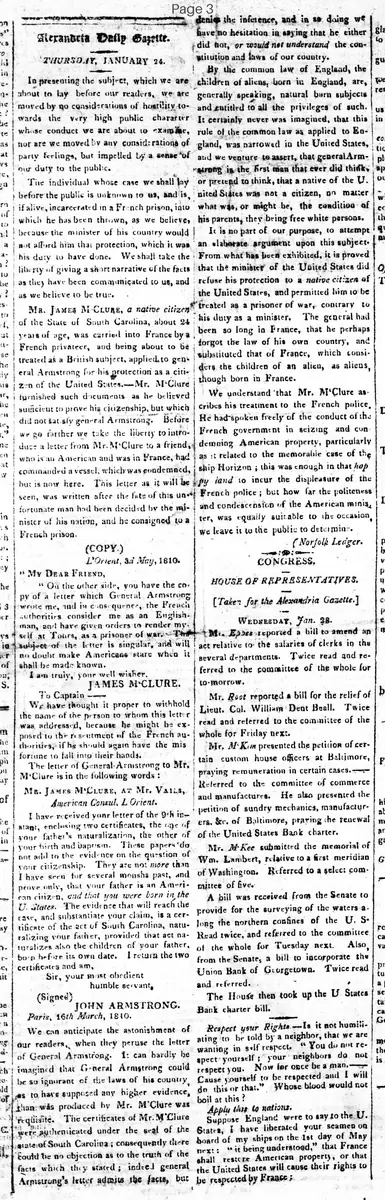
The individual whose case we shall lay before the public is unknown to us, and is, if alive, incarcerated in a French prison, into which he has been thrown, as we believe because the minister of his country would not afford him that protection, which it was his duty to have done. We shall take the liberty of giving a short narrative of the facts as they have been communicated to us, and as we believe to be true.
MR. JAMES M'CLURE, a native citizen of the State of South Carolina, about 24 years of age, was carried into France by a French privateer, and being about to be treated as a British subject, applied to general Armstrong for his protection as a citizen of the United States.--Mr. M'Clure furnished such documents as he believed sufficient to prove his citizenship, but which did not satisfy general Armstrong. Before we go farther we take the liberty to introduce a letter from Mr. M'Clure to a friend, who is an American and was in France. had commanded a vessel, which was condemned, but is now here. This letter as it will be seen, was written after the fate of this unfortunate man had been decided by the minister of his nation, and he consigned to a French prison.
(COPY.)
L'Orient, 2d May, 1810.
"My Dear Friend,
On the other side, you have the copy of a letter which General Armstrong wrote me, and in consequence, the French authorities consider me as an Englishman, and have given orders to render myself at Tours, as a prisoner of war. The subject of the letter is singular, and will no doubt make Americans stare when it shall be made known.
I am truly, your well wisher.
JAMES M'CLURE.
To Captain --
We have thought it proper to withhold the name of the person to whom this letter was addressed, because he might be exposed to the resentment of the French authorities, if he should again have the misfortune to fall into their hands.
The letter of General Armstrong to Mr. M'Clure is in the following words :
MR. JAMES M'CLURE, AT Mr. VAILS, American Consul, L'Orient.
I have received your letter of the 9th instant, enclosing two certificates, the one of your father's naturalization, the other of your birth and baptism. These papers do not add to the evidence on the question of your citizenship. They are not more than I have seen for several months past, and prove only, that your father is an American citizen, and that you were born in the U. States. The evidence that will reach the case, and substantiate your claim, is a certificate of the act of South Carolina, naturalizing your father, provided that act naturalizes also the children of your father, born before its own date. I return the two certificates and am,
Sir, your most obedient humble servant,
(Signed)
JOHN ARMSTRONG.
Paris, 16th March, 1810.
We can anticipate the astonishment of our readers, when they peruse the letter of General Armstrong. It can hardly be imagined that General Armstrong could be so ignorant of the laws of his country as to have supposed any higher evidence, than was produced by Mr. M'Clure was requisite. The certificates of Mr. M'Clure were authenticated under the seal of the state of South Carolina; consequently there could be no objection as to the truth of the facts which they stated; indeed general Armstrong's letter admits the acts, but denies the evidence, and in so doing we have no hesitation in saying that he either did not, or would not understand the constitution and laws of our country.
By the common law of England, the children of aliens, born in England, are, generally speaking, natural born subjects and entitled to all the privileges of such. It certainly never was imagined, that this rule of the common law as applied to England, was narrowed in the United States, and we venture to assert, that general Armstrong is the first man that ever did think, or pretend to think, that a native of the United States was not a citizen, no matter what was, or might be, the condition of his parents, they being free white persons.
It is no part of our purpose, to attempt an elaborate argument upon this subject. From what has been exhibited, it is proved that the minister of the United States did refuse his protection to a native citizen of the United States, and permitted him to be treated as a prisoner of war, contrary to his duty as a minister. The general had been so long in France, that he perhaps forgot the law of his own country, and substituted that of France, which considers the children of an alien, as aliens, though born in France.
We understand that Mr. M'Clure ascribes his treatment to the French police. He had spoken freely of the conduct of the French government in seizing and condemning American property, particularly as it related to the memorable case of the ship Horizon; this was enough in that happy land to incur the displeasure of the French police; but how as the politeness and condescension of the American minister, was equally suitable to the occasion we leave it to the public to determine.
Norfolk Ledger.
What sub-type of article is it?
What themes does it cover?
What keywords are associated?
What entities or persons were involved?
Where did it happen?
Story Details
Key Persons
Location
France, L'orient, Paris, Tours
Event Date
1810
Story Details
James M'Clure, a 24-year-old native of South Carolina, was captured by a French privateer and faced treatment as a British subject. He sought protection from U.S. Minister General Armstrong, providing certificates of his birth and father's naturalization, but Armstrong deemed them insufficient, leading to M'Clure's imprisonment as a prisoner of war in France.