Thank you for visiting SNEWPapers!
Sign up free
Literary
February 6, 1767
The New Hampshire Gazette And Historical Chronicle
Portsmouth, Greenland, Rockingham County, New Hampshire
What is this article about?
An elderly man from Gloucestershire writes to the London Magazine editor, contrasting his late friend Mr. Holland's frugal merchant life in London (died 1750, leaving £10,700) with his sons' ruinous extravagance. Visiting son Jack, he criticizes modern luxuries like coaches, assemblies, and lavish dinners for driving up provision prices, urging return to simplicity.
Clipping
OCR Quality
95%
Excellent
Full Text
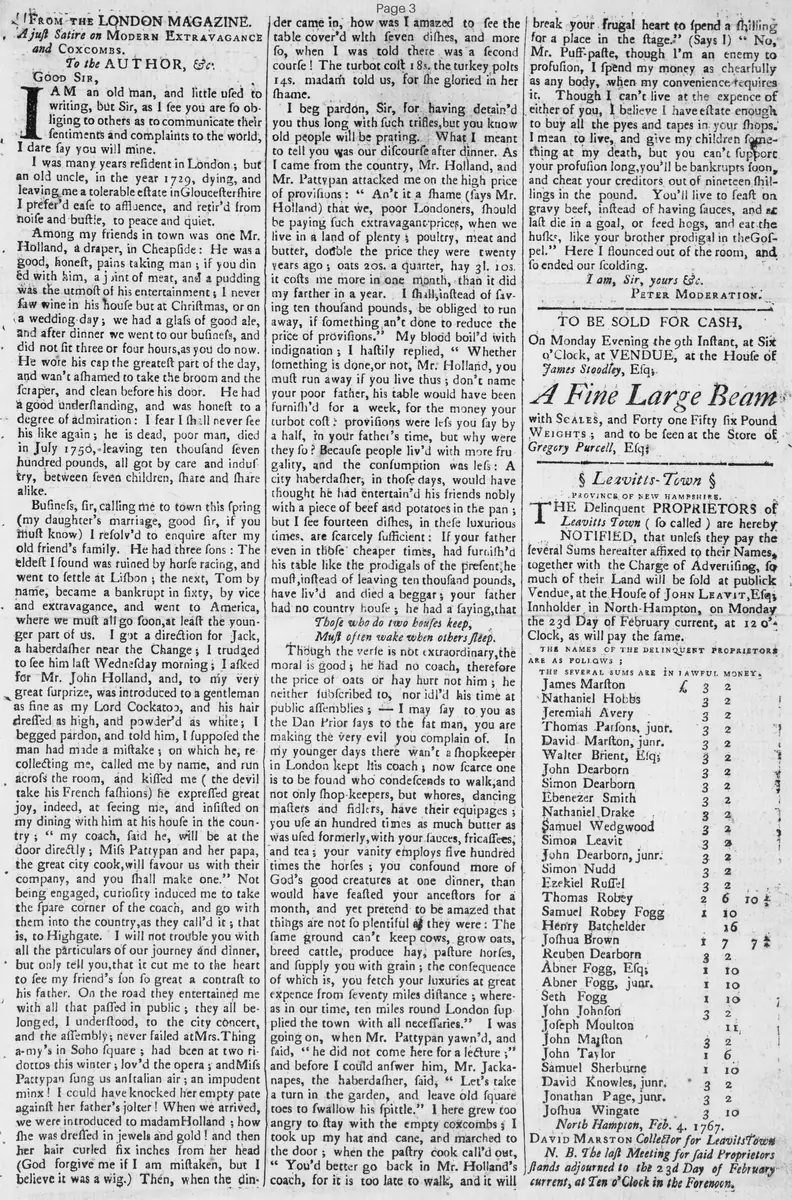
FROM THE LONDON MAGAZINE.
A just Satire on Modern Extravagance and Coxcombs,
To the AUTHOR. &c.
GOOD SIR,
A Man old man, and little used to writing, but Sir, as I see you are so obliging to others as to communicate their sentiments and complaints to the world, I dare say you will mine.
I was many years resident in London; but an old uncle, in the year 1729, dying, and leaving me a tolerable estate in Gloucestershire I prefer'd ease to affluence, and retir'd from noise and bustle, to peace and quiet.
Among my friends in town was one Mr. Holland, a draper, in Cheapside: He was a good, honest, pains-taking man; if you din'd with him, a joint of meat, and a pudding was the utmost of his entertainment; I never saw wine in his house but at Christmas, or on a wedding-day; we had a glass of good ale, and after dinner we went to our business, and did not sit three or four hours, as you do now.
He wore his cap the greatest part of the day, and wan't ashamed to take the broom and the scraper, and clean before his door. He had a good understanding, and was honest to a degree of admiration: I fear I shall never see his like again; he is dead, poor man, died in July 1750, leaving ten thousand seven hundred pounds, all got by care and industry, between seven children, share and share alike.
Business, Sir, calling me to town this spring (my daughter's marriage, good Sir, if you must know) I resolv'd to enquire after my old friend's family. He had three sons: The eldest I found was ruined by horse racing, and went to settle at Lisbon: the next, Tom by name, became a bankrupt in sixty, by vice and extravagance, and went to America, where we must all go soon, at least the younger part of us. I got a direction for Jack, a haberdasher near the Change; I trudged to see him last Wednesday morning; I asked for Mr. John Holland, and, to my very great surprize, was introduced to a gentleman as fine as my Lord Cockatoo, and his hair dressed as high, and powder'd as white; I begged pardon, and told him, I supposed the man had made a mistake; on which he, recollecting me, called me by name, and run across the room, and kissed me (the devil take his French fashions) he expressed great joy, indeed, at seeing me, and insisted on my dining with him at his house in the country; "my coach, said he, will be at the door directly: Mis Pattypan and her papa, the great city cook, will favour us with their company, and you shall make one." Not being engaged; curiosity induced me to take the spare corner of the coach, and go with them into the country, as they call'd it; that is, to Highgate. I will not trouble you with all the particulars of our journey and dinner, but only tell you, that it cut me to the heart to see my friend's son so great a contrast to his father. On the road they entertained me with all that passed in public; they all belonged, I understood, to the city concert, and the assembly; never failed at Mrs. Thing-a-my's in Soho Square; had been at two ridottos this winter; lov'd the opera; and Miss Pattypan sung us an Italian air; an impudent minx! I could have knocked her empty pate against her father's jolter! When we arrived, we were introduced to madam Holland: how she was dressed in jewels and gold! and then her hair curled six inches from her head (God forgive me if I am mistaken, but I believe it was a wig.) Then, when the dinner came in, how was I amazed to see the table cover'd with seven dishes, and more so, when I was told there was a second course! The turbot cost 18s. the turkey poults 14s. madam told us, for she gloried in her shame.
I beg pardon, Sir, for having detain'd you thus long with such trifles, but you know old people will be prating. What I meant to tell you was our discourse after dinner. As I came from the country, Mr. Holland, and Mr. Pattypan attacked me on the high price of provisions: "An't it a shame (says Mr. Holland) that we, poor Londoners, should be paying such extravagant prices, when we live in a land of plenty; poultry, meat and butter, double the price they were twenty years ago; oats 20s. a quarter, hay 3l. 10s. it costs me more in one month, than it did my father in a year. I shall, instead of having ten thousand pounds, be obliged to run away, if something an't done to reduce the price of provisions." My blood boil'd with indignation; I hastily replied, "Whether something is done, or not, Mr. Holland, you must run away if you live thus; don't name your poor father, his table would have been furnish'd for a week, for the money your turbot cost: provisions were less you say by a half, in your father's time, but why were they so? Because people liv'd with more frugality, and the consumption was less: A city haberdasher, in those days, would have thought he had entertain'd his friends nobly with a piece of beef and potatoes in the pan; but I see fourteen dishes, in these luxurious times, are scarcely sufficient: If your father even in those cheaper times, had furnish'd his table like the prodigals of the present, he must, instead of leaving ten thousand pounds, have liv'd and died a beggar; your father had no country house; he had a saying,
Those who do two houses keep;
Must often wake when others sleep.
Though the verse is not extraordinary, the moral is good; he had no coach, therefore the price of oats or hay hurt not him; he neither subscribed to, nor idl'd his time at public assemblies; — I may say to you as the Dan Prior says to the fat man, you are making the very evil you complain of. In my younger days there wan't a shopkeeper in London kept his coach: now scarce one is to be found who condescends to walk, and not only shop-keepers, but whores, dancing masters and fiddlers, have their equipages: you use an hundred times as much butter as was used formerly, with your sauces, fricassees; and tea; your vanity employs five hundred times the horses; you confound more of God's good creatures at one dinner, than would have feasted your ancestors for a month, and yet pretend to be amazed that things are not so plentiful as they were: The same ground can't keep cows, grow oats, breed cattle, produce hay, pasture horses, and supply you with grain; the consequence of which is, you fetch your luxuries at great expence from seventy miles distance; whereas in our time, ten miles round London supplied the town with all necessaries." I was going on, when Mr. Pattypan yawn'd, and said, "he did not come here for a lecture;" and before I could answer him, Mr. Jackanapes, the haberdasher, said, "Let's take a turn in the garden, and leave old square toes to wallow his spittle." I here grew too angry to stay with the empty coxcombs; I took up my hat and cane, and marched to the door; when the pastry cook call'd out, "You'd better go back in Mr. Holland's coach, for it is too late to walk, and it will break your frugal heart to spend a shilling for a place in the stage." (Says I) "No, Mr. Puff-pate, though I'm an enemy to profusion, I spend my money as cheerfully as any body, when my convenience requires it. Though I can't live at the expence of either of you, I believe I have estate enough to buy all the pies and tapes in your shops. I mean to live, and give my children something at my death, but you can't support your profusion long, you'll be bankrupts soon, and cheat your creditors out of nineteen shillings in the pound.
You'll live to feast on gravy beef, instead of having sauces, and at last die in a goal, or feed hogs, and eat the husks, like your brother prodigal in the Gospel." Here I flounced out of the room, and so ended our scolding.
2
I am, Sir, yours &c.
PETER MODERATION
A just Satire on Modern Extravagance and Coxcombs,
To the AUTHOR. &c.
GOOD SIR,
A Man old man, and little used to writing, but Sir, as I see you are so obliging to others as to communicate their sentiments and complaints to the world, I dare say you will mine.
I was many years resident in London; but an old uncle, in the year 1729, dying, and leaving me a tolerable estate in Gloucestershire I prefer'd ease to affluence, and retir'd from noise and bustle, to peace and quiet.
Among my friends in town was one Mr. Holland, a draper, in Cheapside: He was a good, honest, pains-taking man; if you din'd with him, a joint of meat, and a pudding was the utmost of his entertainment; I never saw wine in his house but at Christmas, or on a wedding-day; we had a glass of good ale, and after dinner we went to our business, and did not sit three or four hours, as you do now.
He wore his cap the greatest part of the day, and wan't ashamed to take the broom and the scraper, and clean before his door. He had a good understanding, and was honest to a degree of admiration: I fear I shall never see his like again; he is dead, poor man, died in July 1750, leaving ten thousand seven hundred pounds, all got by care and industry, between seven children, share and share alike.
Business, Sir, calling me to town this spring (my daughter's marriage, good Sir, if you must know) I resolv'd to enquire after my old friend's family. He had three sons: The eldest I found was ruined by horse racing, and went to settle at Lisbon: the next, Tom by name, became a bankrupt in sixty, by vice and extravagance, and went to America, where we must all go soon, at least the younger part of us. I got a direction for Jack, a haberdasher near the Change; I trudged to see him last Wednesday morning; I asked for Mr. John Holland, and, to my very great surprize, was introduced to a gentleman as fine as my Lord Cockatoo, and his hair dressed as high, and powder'd as white; I begged pardon, and told him, I supposed the man had made a mistake; on which he, recollecting me, called me by name, and run across the room, and kissed me (the devil take his French fashions) he expressed great joy, indeed, at seeing me, and insisted on my dining with him at his house in the country; "my coach, said he, will be at the door directly: Mis Pattypan and her papa, the great city cook, will favour us with their company, and you shall make one." Not being engaged; curiosity induced me to take the spare corner of the coach, and go with them into the country, as they call'd it; that is, to Highgate. I will not trouble you with all the particulars of our journey and dinner, but only tell you, that it cut me to the heart to see my friend's son so great a contrast to his father. On the road they entertained me with all that passed in public; they all belonged, I understood, to the city concert, and the assembly; never failed at Mrs. Thing-a-my's in Soho Square; had been at two ridottos this winter; lov'd the opera; and Miss Pattypan sung us an Italian air; an impudent minx! I could have knocked her empty pate against her father's jolter! When we arrived, we were introduced to madam Holland: how she was dressed in jewels and gold! and then her hair curled six inches from her head (God forgive me if I am mistaken, but I believe it was a wig.) Then, when the dinner came in, how was I amazed to see the table cover'd with seven dishes, and more so, when I was told there was a second course! The turbot cost 18s. the turkey poults 14s. madam told us, for she gloried in her shame.
I beg pardon, Sir, for having detain'd you thus long with such trifles, but you know old people will be prating. What I meant to tell you was our discourse after dinner. As I came from the country, Mr. Holland, and Mr. Pattypan attacked me on the high price of provisions: "An't it a shame (says Mr. Holland) that we, poor Londoners, should be paying such extravagant prices, when we live in a land of plenty; poultry, meat and butter, double the price they were twenty years ago; oats 20s. a quarter, hay 3l. 10s. it costs me more in one month, than it did my father in a year. I shall, instead of having ten thousand pounds, be obliged to run away, if something an't done to reduce the price of provisions." My blood boil'd with indignation; I hastily replied, "Whether something is done, or not, Mr. Holland, you must run away if you live thus; don't name your poor father, his table would have been furnish'd for a week, for the money your turbot cost: provisions were less you say by a half, in your father's time, but why were they so? Because people liv'd with more frugality, and the consumption was less: A city haberdasher, in those days, would have thought he had entertain'd his friends nobly with a piece of beef and potatoes in the pan; but I see fourteen dishes, in these luxurious times, are scarcely sufficient: If your father even in those cheaper times, had furnish'd his table like the prodigals of the present, he must, instead of leaving ten thousand pounds, have liv'd and died a beggar; your father had no country house; he had a saying,
Those who do two houses keep;
Must often wake when others sleep.
Though the verse is not extraordinary, the moral is good; he had no coach, therefore the price of oats or hay hurt not him; he neither subscribed to, nor idl'd his time at public assemblies; — I may say to you as the Dan Prior says to the fat man, you are making the very evil you complain of. In my younger days there wan't a shopkeeper in London kept his coach: now scarce one is to be found who condescends to walk, and not only shop-keepers, but whores, dancing masters and fiddlers, have their equipages: you use an hundred times as much butter as was used formerly, with your sauces, fricassees; and tea; your vanity employs five hundred times the horses; you confound more of God's good creatures at one dinner, than would have feasted your ancestors for a month, and yet pretend to be amazed that things are not so plentiful as they were: The same ground can't keep cows, grow oats, breed cattle, produce hay, pasture horses, and supply you with grain; the consequence of which is, you fetch your luxuries at great expence from seventy miles distance; whereas in our time, ten miles round London supplied the town with all necessaries." I was going on, when Mr. Pattypan yawn'd, and said, "he did not come here for a lecture;" and before I could answer him, Mr. Jackanapes, the haberdasher, said, "Let's take a turn in the garden, and leave old square toes to wallow his spittle." I here grew too angry to stay with the empty coxcombs; I took up my hat and cane, and marched to the door; when the pastry cook call'd out, "You'd better go back in Mr. Holland's coach, for it is too late to walk, and it will break your frugal heart to spend a shilling for a place in the stage." (Says I) "No, Mr. Puff-pate, though I'm an enemy to profusion, I spend my money as cheerfully as any body, when my convenience requires it. Though I can't live at the expence of either of you, I believe I have estate enough to buy all the pies and tapes in your shops. I mean to live, and give my children something at my death, but you can't support your profusion long, you'll be bankrupts soon, and cheat your creditors out of nineteen shillings in the pound.
You'll live to feast on gravy beef, instead of having sauces, and at last die in a goal, or feed hogs, and eat the husks, like your brother prodigal in the Gospel." Here I flounced out of the room, and so ended our scolding.
2
I am, Sir, yours &c.
PETER MODERATION
What sub-type of article is it?
Satire
Epistolary
Essay
What themes does it cover?
Moral Virtue
Social Manners
Commerce Trade
What keywords are associated?
Extravagance
Frugality
London Merchants
High Prices
Satire
Coxcombs
Provisions
Bankruptcy
What entities or persons were involved?
Peter Moderation
Literary Details
Title
A Just Satire On Modern Extravagance And Coxcombs
Author
Peter Moderation
Subject
Contrast Between Frugal Past And Extravagant Present Among London Merchants
Form / Style
Satirical Letter In Prose
Key Lines
Those Who Do Two Houses Keep;
Must Often Wake When Others Sleep.
Provisions Were Less You Say By A Half, In Your Father's Time, But Why Were They So? Because People Liv'd With More Frugality, And The Consumption Was Less
You Are Making The Very Evil You Complain Of