Thank you for visiting SNEWPapers!
Sign up free
Atlanta Daily World
Atlanta, Fulton County, Georgia
What is this article about?
The NAACP argued its 28th case, Watts v. Indiana, before the US Supreme Court in Washington, appealing a murder conviction on grounds of systematic exclusion of Black people from grand juries in Marion County, Indiana, and a coerced confession. Decision pending.
Clipping
OCR Quality
Full Text
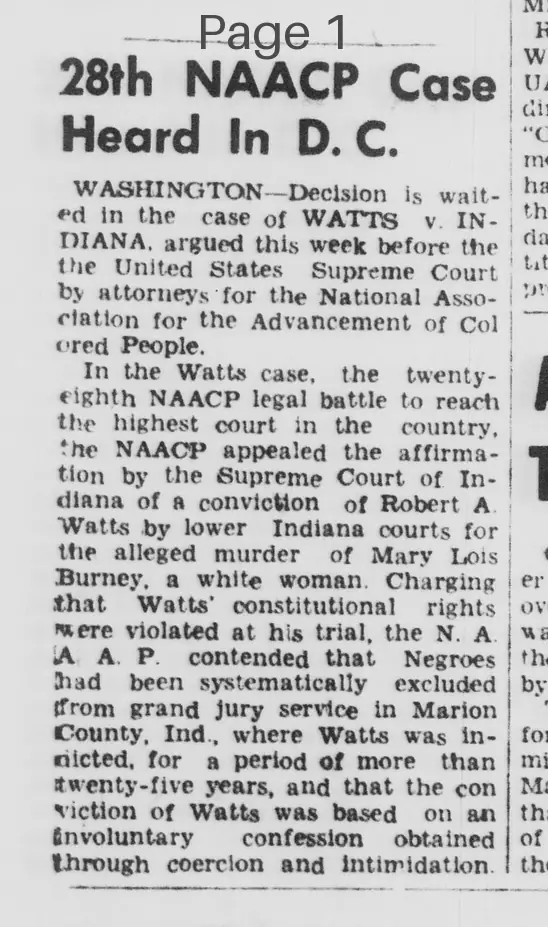
WASHINGTON - Decision is waited in the case of WATTS v. INDIANA, argued this week before the United States Supreme Court by attorneys for the National Association for the Advancement of Colored People.
In the Watts case, the twenty-eighth NAACP legal battle to reach the highest court in the country, the NAACP appealed the affirmation by the Supreme Court of Indiana of a conviction of Robert A. Watts by lower Indiana courts for the alleged murder of Mary Lois Burney, a white woman. Charging that Watts' constitutional rights were violated at his trial, the N.A.A.C.P. contended that Negroes had been systematically excluded from grand jury service in Marion County, Ind., where Watts was indicted, for a period of more than twenty-five years, and that the conviction of Watts was based on an involuntary confession obtained through coercion and intimidation.
What sub-type of article is it?
What keywords are associated?
What entities or persons were involved?
Where did it happen?
Domestic News Details
Primary Location
Washington
Event Date
This Week
Key Persons
Outcome
conviction of robert a. watts for the alleged murder of mary lois burney affirmed by supreme court of indiana; decision awaited from united states supreme court
Event Details
The National Association for the Advancement of Colored People appealed the affirmation by the Supreme Court of Indiana of a conviction of Robert A. Watts by lower Indiana courts for the alleged murder of Mary Lois Burney. The NAACP charged that Watts' constitutional rights were violated at his trial, contending that Negroes had been systematically excluded from grand jury service in Marion County, Ind., for more than twenty-five years, and that the conviction was based on an involuntary confession obtained through coercion and intimidation.