Thank you for visiting SNEWPapers!
Sign up free
Story
December 11, 1872
Daily Kennebec Journal
Augusta, Kennebec County, Maine
What is this article about?
Article argues that anthracite coal ashes have value as manure due to containing lime, magnesia, and other elements. Cites analyses by chemists like Prof. Norton and experiments showing superior crop yields compared to dung.
Clipping
OCR Quality
95%
Excellent
Full Text
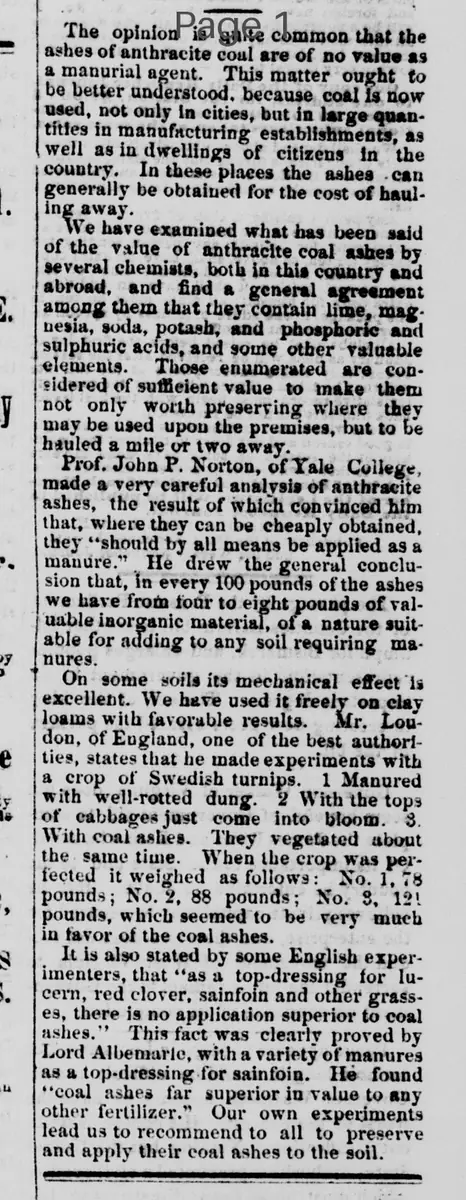
The opinion is quite common that the ashes of anthracite coal are of no value as a manurial agent. This matter ought to be better understood, because coal is now used, not only in cities, but in large quantities in manufacturing establishments, as well as in dwellings of citizens in the country. In these places the ashes can generally be obtained for the cost of hauling away.
We have examined what has been said of the value of anthracite coal ashes by several chemists, both in this country and abroad, and find a general agreement among them that they contain lime, magnesia, soda, potash, and phosphoric and sulphuric acids, and some other valuable elements. Those enumerated are considered of sufficient value to make them not only worth preserving where they may be used upon the premises, but to be hauled a mile or two away.
Prof. John P. Norton, of Yale College, made a very careful analysis of anthracite ashes. The result of which convinced him that, where they can be cheaply obtained, they "should by all means be applied as a manure." He drew the general conclusion that, in every 100 pounds of the ashes we have from four to eight pounds of valuable inorganic material, of a nature suitable for adding to any soil requiring manures.
On some soils its mechanical effect is excellent. We have used it freely on clay loams with favorable results. Mr. London, of England, one of the best authorities, states that he made experiments with a crop of Swedish turnips. 1 Manured with well-rotted dung. 2 With the tops of cabbages just come into bloom. 3. With coal ashes. They vegetated about the same time. When the crop was perfected it weighed as follows: No. 1. 78 pounds; No.2. 88 pounds; No. 3. 121 pounds, which seemed to be very much in favor of the coal ashes.
It is also stated by some English experimenters, that "as a top-dressing for lucern, red clover, sainfoin and other grasses, there is no application superior to coal ashes." This fact was clearly proved by Lord Albemarle, with a variety of manures as a top-dressing for sainfoin. He found "coal ashes far superior in value to any other fertilizer." Our own experiments lead us to recommend to all to preserve and apply their coal ashes to the soil.
We have examined what has been said of the value of anthracite coal ashes by several chemists, both in this country and abroad, and find a general agreement among them that they contain lime, magnesia, soda, potash, and phosphoric and sulphuric acids, and some other valuable elements. Those enumerated are considered of sufficient value to make them not only worth preserving where they may be used upon the premises, but to be hauled a mile or two away.
Prof. John P. Norton, of Yale College, made a very careful analysis of anthracite ashes. The result of which convinced him that, where they can be cheaply obtained, they "should by all means be applied as a manure." He drew the general conclusion that, in every 100 pounds of the ashes we have from four to eight pounds of valuable inorganic material, of a nature suitable for adding to any soil requiring manures.
On some soils its mechanical effect is excellent. We have used it freely on clay loams with favorable results. Mr. London, of England, one of the best authorities, states that he made experiments with a crop of Swedish turnips. 1 Manured with well-rotted dung. 2 With the tops of cabbages just come into bloom. 3. With coal ashes. They vegetated about the same time. When the crop was perfected it weighed as follows: No. 1. 78 pounds; No.2. 88 pounds; No. 3. 121 pounds, which seemed to be very much in favor of the coal ashes.
It is also stated by some English experimenters, that "as a top-dressing for lucern, red clover, sainfoin and other grasses, there is no application superior to coal ashes." This fact was clearly proved by Lord Albemarle, with a variety of manures as a top-dressing for sainfoin. He found "coal ashes far superior in value to any other fertilizer." Our own experiments lead us to recommend to all to preserve and apply their coal ashes to the soil.
What sub-type of article is it?
Agricultural Advice
Scientific Analysis
What keywords are associated?
Anthracite Coal Ashes
Manure Value
Crop Experiments
Fertilizer
Soil Improvement
What entities or persons were involved?
Prof. John P. Norton
Mr. London
Lord Albemarle
Story Details
Key Persons
Prof. John P. Norton
Mr. London
Lord Albemarle
Story Details
Discusses chemical composition of anthracite coal ashes beneficial for soil, cites analyses and experiments showing better crop yields than traditional manures, recommends their use as fertilizer.