Thank you for visiting SNEWPapers!
Sign up free
Alexandria Daily Advertiser
Alexandria, Virginia
What is this article about?
Vice Admiral Collingwood reports the British naval victory at Trafalgar on October 21, 1805, where Lord Nelson was killed. The British fleet of 27 ships defeated the combined French-Spanish fleet of 33, capturing 19 enemy ships of the line. Follow-up dispatches detail losses of prizes due to storms and Nelson's final moments.
Merged-components note: These components form a continuous detailed report on the Battle of Trafalgar and its aftermath, split across pages due to OCR parsing.
Clippings
1 of 2
OCR Quality
Full Text
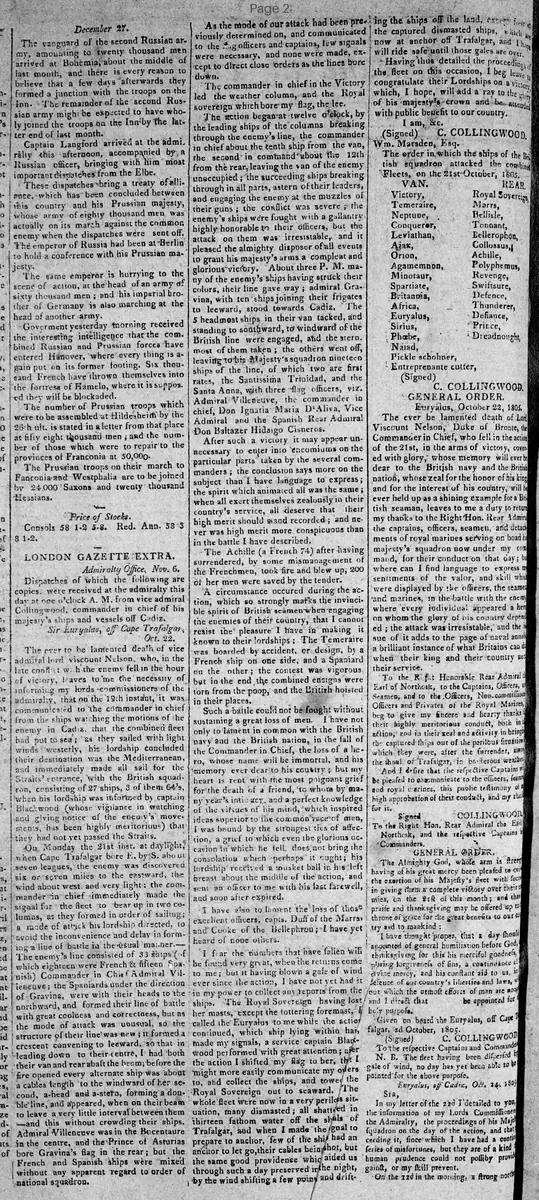
Admiralty Office. Nov. 6.
Dispatches, of which the following are copies, were received at the admiralty this day at one o'clock A. M. from vice admiral Collingwood, commander in chief of his majesty's ships and vessels off Cadiz.
Sir Euryalus, off Cape Trafalgar,
Oct. 22.
The ever to be lamented death of vice admiral lord viscount Nelson, who, in the late conflict with the enemy fell in the hour of victory, leaves to me the necessity of informing my lords commissioners of the admiralty, that on the 19th instant, it was communicated to the commander in chief from the ships watching the motions of the enemy in Cadiz, that the combined fleet had put to sea; as they sailed with light winds westerly, his lordship concluded their destination was the Mediterranean, and immediately made all sail for the Straits' entrance, with the British squadron, consisting of 27 ships, 3 of them 64's. when his lordship was informed by captain Blackwood (whose vigilance in watching and giving notice of the enemy's movements, has been highly meritorious) that they had not yet passed the Straits.
On Monday the 21st inst. at daylight, when Cape Trafalgar bore E. by S. about seven leagues, the enemy was discovered six or seven miles to the eastward, the wind about west. and very light : the commander in chief immediately made the signal for the fleet to bear up in two columns, as they formed in order of sailing: a mode of attack his lordship directed, to avoid the inconvenience and delay in forming a line of battle in the usual manner.
The enemy's line consisted of 33 ships of which eighteen were French & fifteen Spanish Commander in Chief Admiral Villeneuve; the Spaniards under the direction of Gravina, were with their heads to the northward, and formed their line of battle with great coolness and correctness, but as the mode of attack was unusual, so the structure of their line was new ; it formed a crescent converging to leeward, so that in leading down to their centre, I had both their van and rear abaft the beam; before the fire opened every alternate ship was about a cables length to the windward of her second, a-head and a-stern, forming a double line, and appeared, when on their beam to leave a very little interval between them and this without crowding their ships.
Admiral Villeneuve was in the Bucentaure in the centre, and the Prince of Asturias bore Gravina's flag in the rear; but the French and Spanish ships were mixed without any apparent regard to order of national squadron.
As the mode of our attack had been previously determined on, and communicated to the flag officers and captains, few signals were necessary, and none were made, except to direct close orders as the lines bore down.
The commander in chief in the Victory led the weather column, and the Royal Sovereign which bore my flag, the lee.
The action began at twelve o'clock, by the leading ships of the columns breaking through the enemy's line, the commander in chief about the tenth ship from the van, the second in command about the 12th from the rear, leaving the van of the enemy unoccupied ; the succeeding ships breaking through in all parts, astern of their leaders, and engaging the enemy at the muzzles of their guns ; the conflict was severe ; the enemy's ships were fought with a gallantry highly honorable to their officers, but the attack on them was irresistable, and it pleased the almighty disposer of all events to grant his majesty's arms a compleat and glorious victory. About three P. M. many of the enemy's ships having struck their colors, their line gave way ; admiral Gravina, with ten ships joining their frigates to leeward, stood towards Cadiz. The 5 headmost ships in their van tacked, and standing to southward, to windward of the British line were engaged, and the sternmost of them taken ; the others went off, leaving to his Majesty's squadron nineteen ships of the line, of which two are first rates, the Santissima Trinidad, and the Santa Anna, with three flag officers, viz. Admiral Villeneuve, the commander in chief, Don Ignatio Maria D'Aliva, Vice Admiral and the Spanish Rear Admiral Don Baltazer Hidalgo Cisneros.
After such a victory it may appear unnecessary to enter into encomiums on the particular parts taken by the several commanders ; the conclusion says more on the subject than I have language to express; the spirit which animated all was the same ; when all exert themselves zealously in their country's service, all deserve that their high merit should stand recorded; and never was high merit more conspicuous than in the battle I have described.
The Achille (a French 74) after having surrendered, by some mismanagement of the Frenchmen, took fire and blew up, 200 of her men were saved by the tender.
A circumstance occurred during the action, which so strongly marks the invincible spirit of British seamen when engaging the enemies of their country, that I cannot resist the pleasure I have in making it known to their lordships : The Temeraire was boarded by accident, or design, by a French ship on one side; and a Spaniard on the other; the contest was vigorous. but in the end the combined ensigns were torn from the poop, and the British hoisted in their places.
Such a battle could not be fought without sustaining a great loss of men. I have not only to lament in common with the British navy and the British nation, in the fall of the Commander in Chief, the loss of a hero, whose name will be immortal, and his memory ever dear to his country; but my heart is rent with the most poignant grief for the death of a friend, to whom by many year's intimacy, and a perfect knowledge of the virtues of his mind, which inspired ideas superior to the common race of men, I was bound by the strongest ties of affection, a grief to which even the glorious occasion in which he fell. does not bring the consolation which perhaps it ought; his lordship received a musket ball in his left breast about the middle of the action, and sent an officer to me with his last farewell, and soon after expired.
I have also to lament the loss of those excellent officers, capts. Duff of the Mars and Cooke of the Bellerophon; I have yet heard of none others.
I fear the numbers that have fallen will be found very great, when the returns come to me; but it having blown a gale of wind ever since the action, I have not yet had it in my power to collect any reports from the ships. The Royal Sovereign having lost her masts, except the tottering foremast, I called the Euryalus to me while the action continued, which ship lying within hail, made my signals, a service captain Blackwood performed with great attention; after the action I shifted my flag to her, that I might more easily communicate my orders to, and collect the ships, and towe the Royal Sovereign out to seaward. The whole fleet were now in a very perilous situation, many dismasted; all shattered in thirteen fathom water off the shoals of Trafalgar, and when I made the signal to prepare to anchor, few of the ships had an anchor to let go, their cables being shot, but the same good providence which aided us through such a day preserved in the night, by the wind shifting a few points and drifting the ships off the land, except four of the captured dismasted ships, which are now at anchor off Trafalgar, and I hope will ride safe until those gales are over.
Having thus detailed the proceedings of the fleet on this occasion, I beg leave to congratulate their Lordships on a victory, which I hope will add a ray to the glory of his majesty's crown and be attended with public benefit to our country.
I am, &c.
(Signed) C. COLLINGWOOD.
Wm. Marsden, Esq.
The order in which the ships of the British squadron attacked the combined Fleets, on the 21st October, 1805.
VAN. REAR.
Victory, Royal Sovereign
Temeraire, Mars,
Neptune, Bellisle,
Conqueror, Tonnant,
Leviathan, Bellerophon,
Ajax, Colossus,
Orion, Achille,
Agamemnon, Polyphemus,
Minotaur, Revenge,
Spartiate, Swiftsure,
Britannia, Defence,
Africa, Thunderer,
Euryalus, Defiance,
Sirius, Prince,
Phoebe, Dreadnought
Naiad,
Pickle schooner,
Entreprenante cutter,
(Signed)
C. COLLINGWOOD.
GENERAL ORDER.
Euryalus, October 22, 1805.
The ever be lamented death of Lord Viscount Nelson, Duke of Bronte, the Commander in Chief, who fell in the action of the 21st, in the arms of victory, covered with glory, whose memory will ever be dear to the British navy and the British nation, whose zeal for the honor of his king and for the interest of his country, will be ever held up as a shining example for a British seaman, leaves to me a duty to return my thanks to the Right Hon. Rear Admiral the Earl of Northesk, to the captains, officers, seamen, and detachments of royal marines serving on board his majesty's squadron now under my command, for their conduct on that day ; but where can I find language to express my sentiments of the valor, and skill which were displayed by the officers, the seamen and marines, in the battle with the enemy where every individual appeared a hero on whom the glory of his country depended ; the attack was irresistable, and the issue of it adds to the page of naval annals a brilliant instance of what Britons can do when their king and their country call them to their service.
To the Right Honorable Rear Admiral the Earl of Northesk, to the Captains, Officers, and Seamen; and to the Officers, Non-commissioned Officers and Privates of the Royal Marines, beg to give my sincere and hearty thanks for their highly meritorious conduct, both in action, and in their zeal and activity in bringing the captured ships out of the perilous situation which they were, after the surrender, among the shoals of Trafalgar, in boisterous weather.
And I desire that the respective Captains will be pleased to communicate to the officers, seamen and royal marines, this public testimony of high approbation of their conduct, and my thanks for it.
Signed
COLLINGWOOD.
To the Right Hon. Rear Admiral the Earl Northesk, and the respective Captains and Commanders.
GENERAL ORDER.
The Almighty God, whose arm is strong, having of his great mercy been pleased to crown the exertions of his Majesty's fleet with success in giving them a complete victory over their enemies, on the 21st of this month: and that praise and thanksgiving may be offered up to his throne of grace for the great benefits to our country and to mankind :
I have thought proper, that a day should be appointed of general humiliation before God, thanksgiving for this his merciful goodness, praying forgiveness of sins, a continuance of divine mercy, and his constant aid to us, in defence of our country's liberties and laws, without which the utmost efforts of man are now vain and I direct that be appointed for holy purpose.
Given on board the Euryalus, off Cape Trafalgar, 22d October, 1805.
(Signed)
C. COLLINGWOOD
To the respective Captains and Commanders
N. B. The fleet having been dispersed by a gale of wind, no day has yet been able to be appointed for the above purpose.
Euryalus, off Cadiz, Oct. 24. 1805.
SIR,
In my letter of the 22d I detailed to you the information of my Lords Commissioners of the Admiralty, the proceedings of his Majesty's squadron on the day of the action, and that preceding it, since which I have had a continued series of misfortunes, but they are of a kind which human prudence could not possibly provide against, or I still prevent.
On the 23d in the morning, a strong northerly gale with squally weather, which however did not prevent the activity of the officers and seamen in taking hold of many of the prizes (thirteen or fourteen) and towing them off to the westward, where I ordered them to rendezvous round the Royal Sovereign, in tow by the Neptune; but on the 23d the gale increased, and the sea ran so high, that many of them broke the tow rope, and drifted far to leeward, before they were got hold of again, and some of them taking advantage in the dark and boisterous night, got before the wind and have perhaps drifted upon the shore and sunk; on the afternoon of that day the remnant of the combined fleet, ten sail of ships, who had not been much engaged, stood up to leeward of my shattered and straggled charge, as if meaning to attack them, which obliged me to collect a force out of the least injured ships, and form to leeward for their defence: all this retarded the progress of the hulks, and the weather continuing, determined me to destroy all the leeward most that could be cleared of the men considering that keeping possession of the ships was a matter of little consequence compared with the falling again into the hands of the enemy; but even this was an arduous task in the high sea which was running. - a considerable extent; I entrusted it to skilful officers, who would spare no pains to execute what was possible. The Captains of the Prince and Neptune cleared the Trinidad and sunk her. Captains Hope, Bayntun, and Malcolm, who joined the fleet this moment from Gibraltar, had the charge of destroying four others. The Revenge was almost entirely beat in; and such tow. The Santa Anna, I have no doubt, is sunk, doubtful sunk astern of the Swiftsure while in tow. I hope their Lordships will approve of what I (having only in consideration the destruction of the enemy's fleet) having thought a measure of absolute necessity. Vice Admiral Don Aliva is dead, Whenever I have taken Admiral Villeneuve into this ship; the temper of the weather will permit, and I can spare a frigate (for there were only four in the action with the fleet, Euryalus, Sirius, Phoebe, and Naiad; the Melpomene joined the 22d, and Eurydice and Scout the 23d,) I shall collect the flag officers, and send them to England, with their flags, (if they do not all go to the bottom) to be at his Majesty's feet. There were four thousand troops embarked under the command of general Contamin, who was taken with Admiral Villeneuve in the Bucentaure: I am, Sir, &c. (Signed) C. COLLINGWOOD. We are enabled to add the following particulars respecting the departed Hero; (Lord Nelson) When His Lordship found that by his skilful manoeuvres, he had placed the enemy in such a situation that they could not avoid an engagement, he displayed the utmost animation, and his usual confidence of victory; he said to captain Hardy, and the other officers who surrounded him on the quarter deck "Now they cannot escape us; I think we shall at least make sure of twenty of them. I shall probably lose a leg, but that will be purchasing the victory cheaply." About two hours before the close of the action, his Lordship received a wound in his shoulder from a musket ball, which was fired from the tops of the Santissima Trinidad, with which ship he was closely engaged. The ball penetrated his breast, and he instantly fell, he was immediately carried below, and the surgeons pronounced the wound to be mortal.--His Lordship lived about an hour, during the whole of which time he remained perfectly collected, and displayed the same heroic magnanimity in his death, that had marked his conduct in every action of his glorious life. A few minutes before he expired he ordered captain Hardy to be called to him; when the captain came, he asked how many of the enemy's ships had struck ; the captain replied that as nearly as he could ascertain, fifteen sail of the line had struck their colours. His Lordship then, with that fervent piety, which has strongly marked his character as skill and courage, returned thanks to the Almighty; then turning to captain Hardy, he said "I know I am dying, I could have wished to survive to breath my last upon British ground, but the will of God be done." In a few moments he expired !!
What sub-type of article is it?
What keywords are associated?
What entities or persons were involved?
Where did it happen?
Foreign News Details
Primary Location
Off Cape Trafalgar
Event Date
21st October 1805
Key Persons
Outcome
british victory with 19 enemy ships of the line captured including santissima trinidad and santa anna; three enemy flag officers captured: admiral villeneuve, don ignatio maria d'aliva, don baltazer hidalgo cisneros; lord nelson killed by musket ball; captains duff and cooke killed; achille blew up after surrender, 200 saved; many british losses expected; subsequent storms caused loss of several prizes which were destroyed to prevent recapture; vice admiral don aliva dead; 4000 french troops captured under general contamin
Event Details
British squadron of 27 ships under Nelson engaged combined French-Spanish fleet of 33 ships under Villeneuve off Cape Trafalgar on October 21, 1805. Fleet bore up in two columns to break enemy's line; action began at noon; by 3 PM many enemy ships struck colors; Gravina with 10 ships retreated to Cadiz; 5 van ships tacked and engaged, one taken; Nelson mortally wounded mid-action; Collingwood took command; post-action gales dispersed fleet and led to destruction of several prizes; general orders issued thanking officers and appointing thanksgiving day