Thank you for visiting SNEWPapers!
Sign up free
Literary Cadet And Rhode Island Statesman
Providence, Providence County, Rhode Island
What is this article about?
Daniel Webster visits his native New Hampshire and addresses the faculty and students of Dartmouth College in Hanover, expressing gratitude for his education, emphasizing the importance of instruction in religion, morals, and knowledge, and urging students to value time and duty.
Clipping
OCR Quality
Full Text
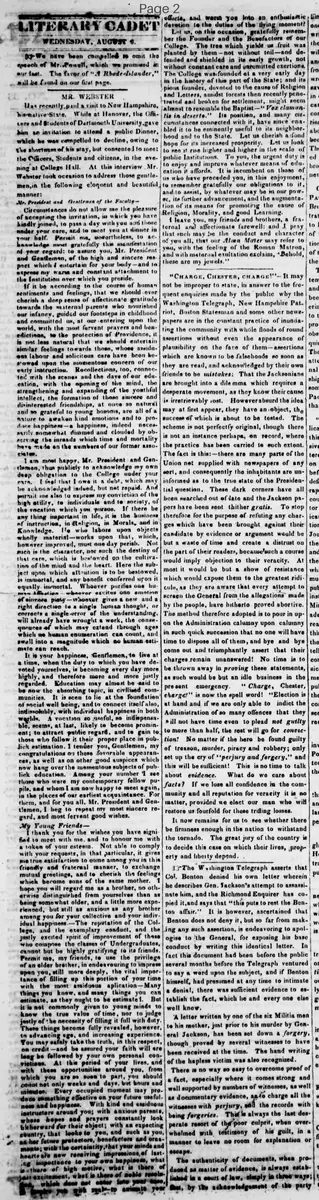
Has recently paid a visit to New Hampshire, his native State. While at Hanover, the Officers and Students of Dartmouth University, gave him an invitation to attend a public Dinner, which he was compelled to decline, owing to the shortness of his stay, but consented to meet the Officers, Students and citizens, in the evening at College Hall. At this interview Mr. Webster took occasion to address those gentlemen, in the following eloquent and beautiful manner:
Mr. President and Gentlemen of the Faculty—
Circumstances do not allow me the pleasure of accepting the invitation, in which you have kindly joined, to pass a day with you and those under your care, and to meet you at dinner in your hall. Permit me, nevertheless, to acknowledge most gratefully this manifestation of your regard: to assure you, Mr. President and Gentlemen, of the high and sincere respect which I entertain for your body—and to express my warm and constant attachment to the Institution over which you preside.
If it be according to the course of human sentiments and feelings, that we should cherish a deep sense of affectionate gratitude towards the maternal parents who nourished our infancy, guided our footsteps in childhood and committed us, at our entering upon the world, with the most fervent prayers and benedictions, the protection of Providence, it is not less natural that we should entertain similar feelings towards those, whose assiduous labour and solicitous care have been bestowed upon the momentous concern of our early instruction. Recollections, too, connected with the scenes and the days of our education, with the opening of the mind, the strengthening and expanding of the youthful intellect, the formation of those sincere and disinterested friendships, at once so natural and so grateful to young bosoms, are all of a nature to awaken kind emotions and to produce happiness—a happiness, indeed necessarily somewhat dimmed and clouded by observing the inroads which time and mortality here make on the numbers of our former association.
I am most happy, Mr. President and Gentlemen, thus publicly to acknowledge my own deep obligation to the College under your care. I feel that I owe it a debt, which may be acknowledged indeed, but never repaid. And permit me also to express my conviction of the high utility, to individuals and to society, of the vocation which you pursue. If there be any thing important in life, it is the business of instruction, in Religion, in Morals, and in Knowledge. He who labors upon objects wholly material—works upon that, which, however improved, must one day perish. Not much is the character, nor such the destiny of that care, which is bestowed on the cultivation of the mind and the heart. Here the subject upon which attention is to be bestowed, is immortal, and any benefit conferred upon it equally immortal. Whoever purifies one human affection—whoever excites one emotion of sincere piety—whoever gives a new and a right direction to a single human thought, or corrects a single error of the understanding will already have wrought a work, the consequences of which may extend through ages which no human enumeration can count, and swell into a magnitude which no human estimate can reach.
It is your happiness, Gentlemen, to live at a time, when the duty to which you have devoted yourselves, is becoming every day more highly, and therefore more and more justly regarded. Education may almost be said to be now the absorbing topic, in civilized communities. It is seen to lie at the foundation of social well being, and to connect itself also, indissolubly, with individual happiness in both worlds. A vocation so useful, so indispensable, seems, at last, likely to become prominent; to attract public regard, and to gain to those who follow it their proper place in public estimation. I tender you, Gentlemen, my congratulations on those favorable appearances, as well as on other good auspices which now hang over the momentous subjects of public education. Among your number I see those who were my contemporary fellow pupils, and whom I am now happy to meet again, in the places of our earliest acquaintance. For them, and for you all, Mr. President and Gentlemen, I beg to repeat my most sincere regard, and most fervent good wishes.
My Young Friends—
I thank you for the wishes you have signified to meet with me, and to honour me with token of your esteem. Not able to comply with your requests, in that particular, it gives me true satisfaction to come among you in this friendly and fraternal manner, to exchange mutual greetings, and to cherish the feelings which become sons of the same mother. I hope you will regard me as a brother, no otherwise distinguished from yourselves than as being somewhat older, and a little more experienced, but still as anxious as any brother among you for your collective and your individual happiness.—The reputation of the College, and the exemplary conduct, and the justly excited spirit of improvement of those who compose the classes of Undergraduates, cannot but be highly gratifying to its friends.
Permit me, my friends, to use the privilege of an elder brother, in endeavouring to impress upon you, still more deeply, the vital importance of filling up this portion of your time with the most assiduous application—Many things you know, and many things you can estimate, as they ought to be estimated. But it is not commonly given to young minds to know the true value of time, nor to judge justly of the necessity of filling it full with duty. These things become fully revealed, however, in advancing age, and increasing experience. You may safely take the truth, in this respect, on credit—and be assured your faith will ere long be followed by your own personal convictions. At this period of your lives, and with these opportunities around you, from which you are ere soon to part, you should count not only weeks and days, but hours and minutes. Every occupied moment may produce something effective on your future usefulness and happiness. With kind and assiduous instructors around you; with anxious parents, whose hopes and prayers constantly look hitherward for their object; with an expecting country, that looks to you, and such as you, as her future protectors, benefactors and ornaments; with the certainty, that your minds and hearts are now receiving impressions of lasting importance to your own happiness, what stronger of high motive—what is there of noble resolve—which should not fire, and warm you into an enthusiastic devotion to the duties of the living moment?
Let us, on this occasion, gratefully remember the Founder and the Benefactors of our College. The tree which yields us fruit was planted by them—not without toil—and defended and shielded in its early growth, not without constant care and unremitted exertions. The College was founded at a very early day in the history of this part of the State; and its pious founder, devoted to the cause of Religion and letters, amidst forests then recently penetrated and broken for settlement, might seem almost to resemble the Baptist—"Vox clamantis in deserto." Its position, and many circumstances connected with it, have since enabled it to be eminently useful to its neighborhood and to the State. Let us cherish a fond hope for its increased prosperity. Let us look to see it rise higher and higher in the scale of public Institutions. To you, the urgent duty is to enjoy and improve whatever means of education it affords. It is incumbent on those of us who have preceded you, in this enjoyment, to remember gratefully our obligations to it, and to assist, by whatever may be in our power, its further advancement, and the augmentation of its means for promoting the cause of Religion, Morality, and good Learning.
I leave you, my friends and brothers, a fraternal and affectionate farewell: and I pray that such may be the conduct and character of you all, that our Alma Mater may refer to you, with the feeling of the Roman Matron, and with maternal exultation exclaim, "Behold, these are my jewels."
What sub-type of article is it?
What themes does it cover?
What keywords are associated?
What entities or persons were involved?
Where did it happen?
Story Details
Key Persons
Location
Hanover, New Hampshire, Dartmouth University
Event Date
Recently
Story Details
Mr. Webster visits Dartmouth, declines dinner but addresses faculty and students, expressing gratitude to the college as a maternal institution, praising the immortality of education's impact, congratulating educators on education's rising importance, advising students on diligent study and time's value, and honoring the college's founder.