Thank you for visiting SNEWPapers!
Sign up free
Alexandria Gazette & Daily Advertiser
Alexandria, Virginia
What is this article about?
In 1821, during the Missouri legislature's session, a bill assenting to Congress's condition for state admission passed the House with a controversial preamble that may hinder presidential proclamation. Proposed constitutional amendments, including electing judges every six years, threaten judicial independence and the state's foundational document.
Merged-components note: The text in the second component is a direct continuation of the Missouri statehood and constitutional news article from the first component, forming a single coherent domestic news piece.
Clippings
1 of 2
OCR Quality
Full Text
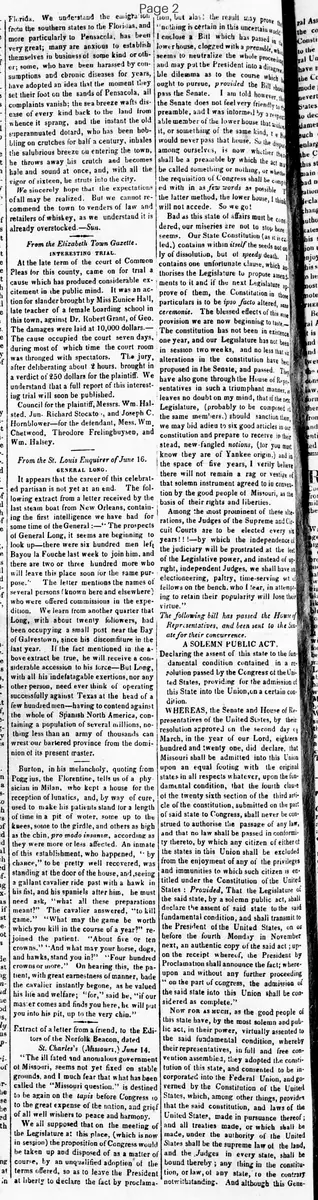
We all supposed that on the meeting of the Legislature at this place, (which is now in session) the proposition of Congress would be taken up and disposed of as a matter of course, by an unqualified adoption of the terms offered, so as to leave the President at liberty to declare the fact by proclamation-- But alas! the result may prove thy "nothing is certain in this uncertain world"
I enclose a Bill which has passed in the lower house, clogged with a preamble, which seems to neutralize the whole proceeding and may put the President into a disagreeable dilemma as to the course which he ought to pursue, provided the Bill pass the Senate.
I am told however, the Senate does not feel very friendly to the preamble, and I was informed by a respectable member of the lower house that without it, or something of the same kind, the Bill would never pass that house So the dispute among ourselves, is now whether there shall be a preamble by which the act may be called something or nothing, or whether the requisition of Congress shall be complied with in as few words as possible The latter method, the lower house, I think will not accede. So we go!
Bad as this state of affairs must be considered, our miseries are not to stop here seems. Our State Constitution (as It is called.) contains within itself the seeds not only of dissolution, but of speedy death. It contains one unfortunate clause, which authorises the Legislature to propose amendments to it and if the next Legislature approve of them, the Constitution in those particulars is to be ipso facto altered, sans ceremonie.
The blessed effects of this wise provision we are now beginning to taste.-- The constitution has not been in existence one year, and our Legislature has not been in session two weeks, and no less than six alterations in the constitution have been proposed in the Senate, and passed. They have also gone through the House of Representatives in such a triumphant manner, as leaves no doubt on my mind, that if the next Legislature, (probably to be composed of the same members.) should sanction them, we may bid adieu to six good articles in our constitution and prepare to receive in their stead, new-fangled notions, (for you must know they are of Yankee origin,) and in the space of five years, I verily believe there will not remain a rag or vestige of that solemn instrument agreed to in convention by the good people of Missouri, as the basis of their rights and liberties.
Among the most prominent of these alterations, the Judges of the Supreme and Circuit Courts are to be elected every six years!!! by which the independence of the judiciary will be prostrated at the feet of the Legislative power, and instead of upright, independent Judges, we shall have an electioneering, paltry, time-serving set of fellows on the bench, who I fear, in attempting to retain their popularity will lose their virtue.
The following bill has passed the House of Representatives, and been sent to the Senate for their concurrence.
A SOLEMN PUBLIC ACT
Declaring the assent of this state to the fundamental condition contained in a resolution passed by the Congress of the United States, providing for the admission of this State into the Union, on a certain condition.
WHEREAS, the Senate and House of Representatives of the United States, by their resolution approved on the second day of March, in the year of our Lord, eighteen hundred and twenty one, did declare, that Missouri shall be admitted into this Union upon an equal footing with the original states in all respects whatever, upon the fundamental condition, that the fourth clause of the twenty sixth section of the third article of the constitution, submitted on the part of said state to Congress, shall never be construed to authorise the passage of any law, and that no law shall be passed in conformity thereto, by which any citizen of either of the states in this Union shall be excluded from the enjoyment of any of the privileges and immunities to which such citizen is entitled under the Constitution of the United States : Provided, That the Legislature of the said state, by a solemn public act, shall declare the assent of said state to the said fundamental condition, and shall transmit to the President of the United States, on or before the fourth Monday in November next, an authentic copy of the said act; upon the receipt whereof, the President by Proclamation shall announce the fact; whereupon and without any further proceeding on the part of congress, the admission of the said state into this Union shall be considered as complete.
Now therefore as much, as the good people of this state have, by the most solemn and public act, in their power, virtually assented to the said fundamental condition, whereby their representatives, in full and free convention assembled, they adopted the constitution of this state, and consented to be incorporated into the Federal Union, and governed by the Constitution of the United States, which, among other things, provides that the said constitution, and laws of the United States, made in pursuance thereof; and all treaties made, or which shall be made, under the authority of the United States shall be the supreme law of the land, and the Judges in every state, shall be bound thereby; any thing in the constitution, or law, of any state, to the contrary notwithstanding. And although this General Assembly do most solemnly declare that the congress of the United States have no Constitutional power to annex any condition to the admission of this state into the Federal Union, and that this General Assembly have no power to change the operation of the Constitution of this state, except in the mode prescribed by the constitution itself. Nevertheless, as the Congress of the United States have desired this General Assembly to declare the assent of this state to said fundamental condition, and for as much as such declaration, will neither restrain nor enlarge, limit nor extend the operation of the Constitution of the United States, or of this state; but the said constitutions will remain in all respects, as if the said resolution had never passed, and the desired declaration was never made; and because such declaration will not divest any power, or change the duties of any of the constitutional authorities of this state, or of the United States, nor impair the rights of the people of this state, or impose any additional obligation upon them, but may promote an earlier enjoyment of their vested federal rights. And this state being moreover determined to give to her sister states, and to the world, the most unequivocal proof of her desire to promote the peace and harmony of the Union—
THEREFORE,
Be it enacted and declared, by the General Assembly of the state of Missouri, and it is hereby solemnly and publicly enacted and declared, That this state has assented and does assent, that the fourth clause of the twenty sixth section of the third article of the constitution of this state, shall never be construed to authorize the passage of any law, and that no law shall be passed in conformity thereto, by which any citizen, either of the United States, shall be excluded from the enjoyment of any of the privileges and immunities, to which such citizens are entitled, under the constitution of the United States."
What sub-type of article is it?
What keywords are associated?
Where did it happen?
Domestic News Details
Primary Location
Missouri
Event Date
1821
Outcome
bill passed house with preamble; pending senate approval; six constitutional amendments proposed, including electing judges every six years.
Event Details
The Missouri legislature in session debates and passes a bill in the House assenting to Congress's March 2, 1821 resolution for state admission, but includes a preamble declaring Congress's lack of power to impose conditions. Proposed amendments to the state constitution, recently adopted, include changes to judicial elections that undermine independence.