Thank you for visiting SNEWPapers!
Sign up free
Editorial
February 18, 1815
Norfolk Gazette And Publick Ledger
Norfolk, Virginia
What is this article about?
The editorial reflects on recent European intelligence following positive news, highlighting the beneficial effect of published U.S.-British commissioner correspondence at Ghent on English public opinion towards peace. It anticipates U.S. government ratification of the treaty, contrasting with Jefferson's prior rejection.
Clipping
OCR Quality
98%
Excellent
Full Text
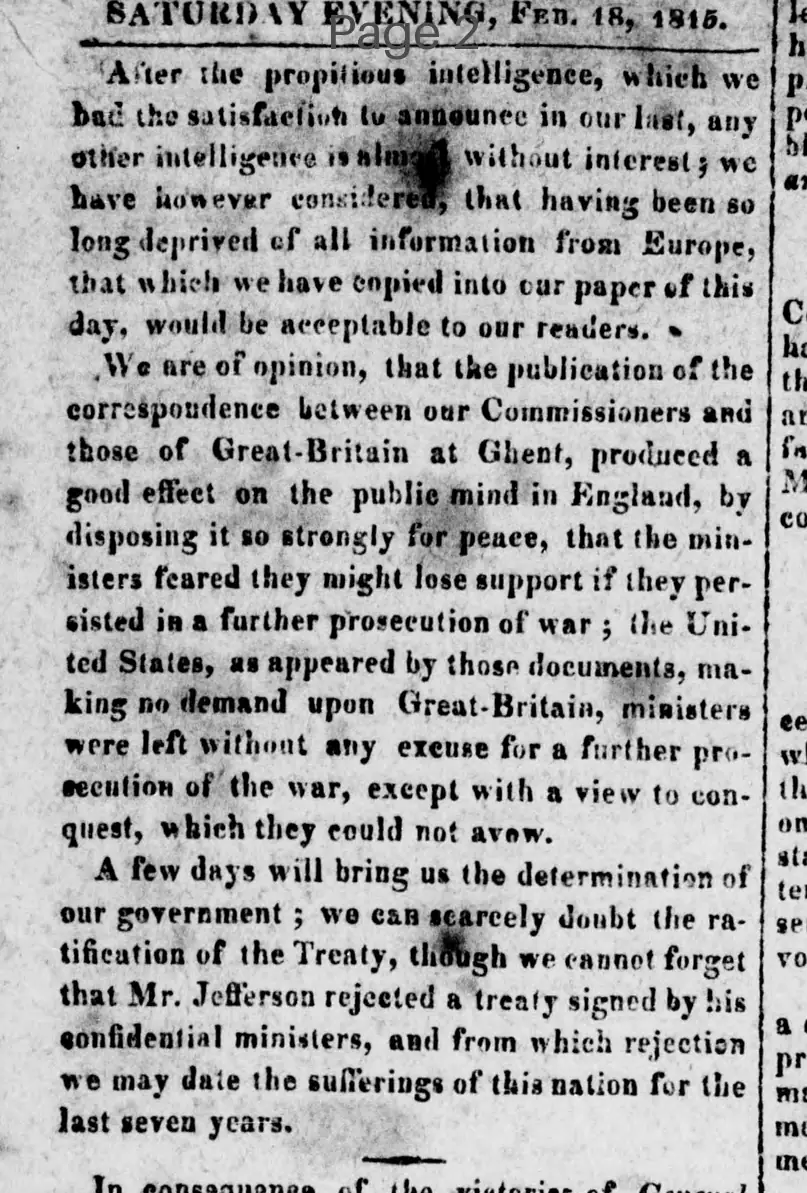
After the propitious intelligence, which we had the satisfaction to announce in our last, any other intelligence is almost without interest; we have however considered, that having been so long deprived of all information from Europe, that which we have copied into our paper of this day, would be acceptable to our readers.
We are of opinion, that the publication of the correspondence between our Commissioners and those of Great-Britain at Ghent, produced a good effect on the public mind in England, by disposing it so strongly for peace, that the ministers feared they might lose support if they persisted in a further prosecution of war; the United States, as appeared by those documents, making no demand upon Great-Britain, ministers were left without any excuse for a further prosecution of the war, except with a view to conquest, which they could not avow.
A few days will bring us the determination of our government; we can scarcely doubt the ratification of the Treaty, though we cannot forget that Mr. Jefferson rejected a treaty signed by his confidential ministers, and from which rejection we may date the sufferings of this nation for the last seven years.
We are of opinion, that the publication of the correspondence between our Commissioners and those of Great-Britain at Ghent, produced a good effect on the public mind in England, by disposing it so strongly for peace, that the ministers feared they might lose support if they persisted in a further prosecution of war; the United States, as appeared by those documents, making no demand upon Great-Britain, ministers were left without any excuse for a further prosecution of the war, except with a view to conquest, which they could not avow.
A few days will bring us the determination of our government; we can scarcely doubt the ratification of the Treaty, though we cannot forget that Mr. Jefferson rejected a treaty signed by his confidential ministers, and from which rejection we may date the sufferings of this nation for the last seven years.
What sub-type of article is it?
War Or Peace
Foreign Affairs
What keywords are associated?
Ghent Correspondence
Treaty Ratification
Peace With Britain
Jefferson Rejection
War Prosecution
What entities or persons were involved?
Commissioners Of The United States
Commissioners Of Great Britain
Ministers Of Great Britain
Mr. Jefferson
Our Government
Editorial Details
Primary Topic
Impact Of Ghent Correspondence On Peace And Treaty Ratification
Stance / Tone
Optimistic About Peace And Ratification
Key Figures
Commissioners Of The United States
Commissioners Of Great Britain
Ministers Of Great Britain
Mr. Jefferson
Our Government
Key Arguments
Publication Of Correspondence Disposed English Public Mind Strongly For Peace
Ministers Feared Loss Of Support If Persisting In War
United States Made No Demands On Great Britain
No Excuse For War Except Conquest, Which Could Not Be Avowed
Anticipation Of Treaty Ratification By U.S. Government
Reference To Jefferson's Rejection Of Prior Treaty Leading To National Sufferings