Thank you for visiting SNEWPapers!
Sign up free
Editorial
January 1, 1794
Gazette Of The United States & Evening Advertiser
Philadelphia, Philadelphia County, Pennsylvania
What is this article about?
An anonymous writer argues against granting an act of incorporation to the Insurance Company of North America, claiming it is unnecessary, potentially harmful to merchants, and unlikely to succeed, drawing comparisons to London insurance firms.
Clipping
OCR Quality
95%
Excellent
Full Text
For the GAZETTE of the UNITED STATES.
THOUGHTS
On Insurance-Corporations, &c.
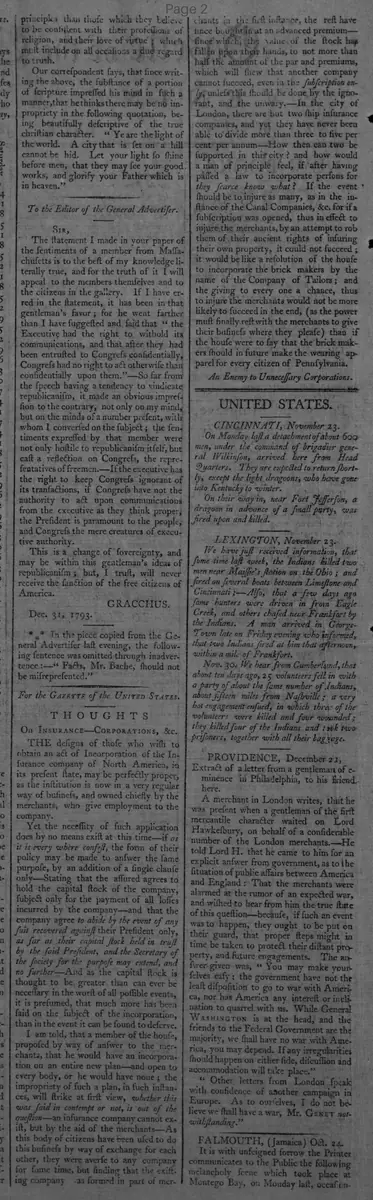
THE designs of those who wish to obtain an act of Incorporation of the Insurance company of North America, in its present state, may be perfectly proper, as the institution is now in a very regular way of business, and owned chiefly by the merchants, who give employment to the company.
Yet the necessity of such application does by no means exist at this time—if as it is every where confessed, the form of their policy may be made to answer the same purpose, by an addition of a single clause only—Stating that the assured agrees to hold the capital stock of the company, subject only for the payment of all losses incurred by the company—and that the company agree to abide by the event of any suit recovered against their President only, as far as their capital stock held in trust by the said President, and the Secretary of the society for the purpose may extend, and no further—And as the capital stock is thought to be, greater than can ever be necessary in the worst of all possible events, it is presumed, that much more has been said on the subject of the incorporation, than in the event it can be found to deserve.
I am told, that a member of the house, proposed by way of answer to the merchants, that he would have an incorporation on an entire new plan—and open to every body, or he would have none; the impropriety of such a plan, in such instances, will strike at first view, whether this was said in contempt or not, is out of the question—an insurance company cannot exist, but by the aid of the merchants. As this body of citizens have been used to do this business by way of exchange for each other, they were averse to any company for some time, but finding that the existing company was formed in part of merchants in the first instance, the rest have since bought in at an advanced premium—since which, the value of the stock has fallen upon their hands, to not more than half the amount of the par and premiums. which will shew that another company cannot succeed, even in the subscription only, unless this should be done by the ignorant, and the unwary.—In the city of London, there are but two ship insurance companies, and yet they have never been able to divide more than three to five per cent per annum—How then can two be supported in this city? and how would a man of principle feel, if after having passed a law to incorporate persons for they scarce know what? If the event should be to injure as many, as in the instance of the Canal Companies, &c. for if a subscription was opened, thus in effect to injure the merchants, by an attempt to rob them of their ancient rights of insuring their own property, it could not succeed; it would be like a resolution of the house to incorporate the brick makers by the name of the Company of Tailors; and the giving to every one a chance, thus to injure the merchants would not be more likely to succeed in the end, (as the power must finally rest with the merchants to give their business where they please) than if the house were to say that the brick makers should in future make the wearing apparel for every citizen of Pennsylvania.
An Enemy to Unnecessary Corporations.
THOUGHTS
On Insurance-Corporations, &c.
THE designs of those who wish to obtain an act of Incorporation of the Insurance company of North America, in its present state, may be perfectly proper, as the institution is now in a very regular way of business, and owned chiefly by the merchants, who give employment to the company.
Yet the necessity of such application does by no means exist at this time—if as it is every where confessed, the form of their policy may be made to answer the same purpose, by an addition of a single clause only—Stating that the assured agrees to hold the capital stock of the company, subject only for the payment of all losses incurred by the company—and that the company agree to abide by the event of any suit recovered against their President only, as far as their capital stock held in trust by the said President, and the Secretary of the society for the purpose may extend, and no further—And as the capital stock is thought to be, greater than can ever be necessary in the worst of all possible events, it is presumed, that much more has been said on the subject of the incorporation, than in the event it can be found to deserve.
I am told, that a member of the house, proposed by way of answer to the merchants, that he would have an incorporation on an entire new plan—and open to every body, or he would have none; the impropriety of such a plan, in such instances, will strike at first view, whether this was said in contempt or not, is out of the question—an insurance company cannot exist, but by the aid of the merchants. As this body of citizens have been used to do this business by way of exchange for each other, they were averse to any company for some time, but finding that the existing company was formed in part of merchants in the first instance, the rest have since bought in at an advanced premium—since which, the value of the stock has fallen upon their hands, to not more than half the amount of the par and premiums. which will shew that another company cannot succeed, even in the subscription only, unless this should be done by the ignorant, and the unwary.—In the city of London, there are but two ship insurance companies, and yet they have never been able to divide more than three to five per cent per annum—How then can two be supported in this city? and how would a man of principle feel, if after having passed a law to incorporate persons for they scarce know what? If the event should be to injure as many, as in the instance of the Canal Companies, &c. for if a subscription was opened, thus in effect to injure the merchants, by an attempt to rob them of their ancient rights of insuring their own property, it could not succeed; it would be like a resolution of the house to incorporate the brick makers by the name of the Company of Tailors; and the giving to every one a chance, thus to injure the merchants would not be more likely to succeed in the end, (as the power must finally rest with the merchants to give their business where they please) than if the house were to say that the brick makers should in future make the wearing apparel for every citizen of Pennsylvania.
An Enemy to Unnecessary Corporations.
What sub-type of article is it?
Economic Policy
Trade Or Commerce
What keywords are associated?
Insurance Corporation
Merchants
Incorporation Act
Capital Stock
Ship Insurance
What entities or persons were involved?
Insurance Company Of North America
Merchants
House
Canal Companies
Editorial Details
Primary Topic
Opposition To Incorporation Of Insurance Company Of North America
Stance / Tone
Critical Of Unnecessary Corporations
Key Figures
Insurance Company Of North America
Merchants
House
Canal Companies
Key Arguments
No Necessity For Incorporation As A Policy Clause Can Suffice
Incorporation Could Injure Merchants By Undermining Their Rights
Stock Value Has Fallen, Showing Risks
London Has Only Two Insurance Companies With Low Profits
Open Incorporation Plan Is Improper And Unlikely To Succeed