Thank you for visiting SNEWPapers!
Sign up free
National Gazette
Philadelphia, Philadelphia County, Pennsylvania
What is this article about?
In Charleston on August 9, citizens of the republican society, suspecting the British sloop Active of illegally arming in violation of neutrality, confronted Captain William Marshall and consignee Edward Penman. After affidavits denying intent, a committee demanded relanding of arms. Marshall refused, leading to citizens boarding and disarming the vessel without opposition, landing guns and stores.
Merged-components note: Continuation of the narrative about the incident with the sloop Active in Charleston; second part was mislabeled as foreign_news, but overall is a domestic story involving U.S. citizens enforcing neutrality.
Clippings
1 of 2
OCR Quality
Full Text
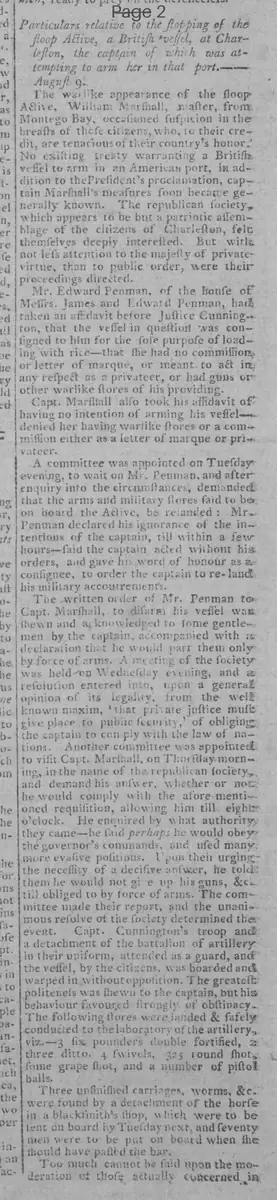
August 9.
The warlike appearance of the sloop Active, William Marshall, master, from Montego Bay, occasioned suspicion in the breasts of these citizens, who, to their credit, are tenacious of their country's honor. No existing treaty warranting a British vessel to arm in an American port, in addition to the President's proclamation, captain Marshall's measures soon became generally known. The republican society—which appears to be but a patriotic assembly of the citizens of Charleston, felt themselves deeply interested. But while not less attention to the majesty of private virtue, than to public order, were their proceedings directed.
Mr. Edward Penman, of the house of Messrs. James and Edward Penman, had taken an affidavit before Justice Cunningham, that the vessel in question—was consigned to him for the sole purpose of loading with rice—that she had no commission or letter of marque, or meant to act in any respect as a privateer, or had guns or other warlike stores of his providing.
Capt. Marshall also took his affidavit of having no intention of arming his vessel—denied her having warlike stores or a commission either as a letter of marque or privateer.
A committee was appointed on Tuesday evening, to wait on Mr. Penman, and after enquiry into the circumstances, demanded that the arms and military stores said to be on board the Active, be relanded: Mr. Penman declared his ignorance of the intentions of the captain, till within a few hours—said the captain acted without his orders, and gave his word of honour as a consignee, to order the captain to re-land his military accoutrements.
The written order of Mr. Penman to Capt. Marshall, to disarm his vessel was shown and acknowledged to some gentlemen by the captain, accompanied with a declaration that he would part them only by force of arms. A meeting of the society was held on Wednesday evening, and a resolution entered into, upon a general opinion of its legality, from the well known maxim, 'that private justice must give place to public security,' of obliging the captain to comply with the law of nations. Another committee was appointed to visit Capt. Marshall, on Thursday morning, in the name of the republican society, and demand his answer, whether or not he would comply with the aforementioned requisition, allowing him till eight o'clock. He enquired by what authority they came—he said perhaps he would obey the governor's commands, and used many more evasive positions. Upon their urging the necessity of a decisive answer, he told them he would not give up his guns, &c. til obliged to by force of arms. The committee made their report, and the unanimous resolve of the society determined the event. Capt. Cunningham's troop and a detachment of the battalion of artillery in their uniform, attended as a guard, and the vessel, by the citizens, was boarded and warped in without opposition. The greatest politeness was shewn to the captain, but his behaviour favoured strongly of obstinacy—
The following stores were landed & safely conducted to the laboratory of the artillery viz.—3 six pounders double fortified, 2 three ditto, 4 swivels, 325 round shot, some grape shot, and a number of pistol balls.
Three unfinished carriages, worms, &c. were found by a detachment of the horse in a blacksmith's shop, which were to be sent on board by Tuesday next, and seventy men were to be put on board when she should have passed the bar.
Too much cannot be said upon the moderation of those actually concerned in this business.
There is translation. After landing the stores.
The officers declared their readiness to stay by Capt. Marshall, if he thought himself in danger of insult or injury. The vessel they offered to replace in the stream; but as men were in pay, Capt. Marshall told them it was unnecessary—he would there take charge of her again, and they accordingly left her to his direction.
What sub-type of article is it?
What themes does it cover?
What keywords are associated?
What entities or persons were involved?
Where did it happen?
Story Details
Key Persons
Location
Charleston
Event Date
August 9
Story Details
Citizens in Charleston suspect British sloop Active of arming illegally; after denials via affidavits, committees demand relanding of arms from consignee and captain; captain refuses, leading to citizens boarding and disarming the vessel, landing guns and stores without force.