Thank you for visiting SNEWPapers!
Sign up free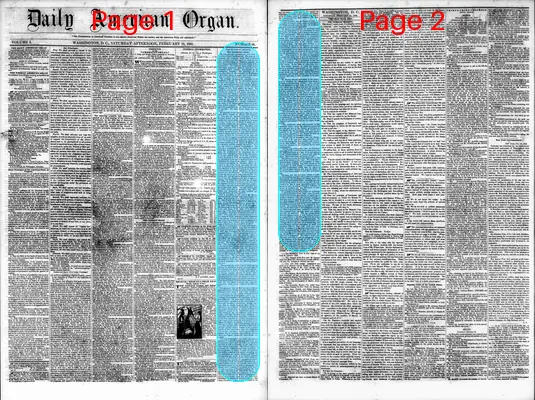
Daily American Organ
Washington, District Of Columbia
What is this article about?
Editorial critiques President Pierce's veto of the French Spoliation Claims bill, arguing that the 1800 convention with France relinquished US citizens' claims against France for property spoliations, refuting the President's historical interpretation using treaty details and Senator Clayton's arguments.
Merged-components note: Continuation of the Spoliation Claims story across pages, as indicated by the text flow and sequential reading order.
Clippings

1 of 2
OCR Quality
Full Text
From the American and Gazette.
The Spoliation Claims.
We have already expressed our views of the veto of the French Spoliation bill. The hope we entertained that Congress would have a sufficient sense of justice and self-respect to carry the measure, notwithstanding the Executive negative, has been disappointed by the vote in the House of Representatives. The claimants must submit to have their rights postponed again, as they have been repeatedly before; trusting, nevertheless, to the intelligence, integrity, and patriotism of the men who will be in the ascendant at Washington a short time hence, to grant them a debt righteously and clearly due by the government.
The message containing the objections of the President to the bill, we did not publish, because it was a very lengthy document, a very weak one in its facts and reasoning, and consisted, substantially, indeed, of the arguments of the late Silas Wright, of New York, against the claims. Nor should we now bestow a remark upon it, were it not that we desire to call public attention to a grave error into which the Executive has fallen respecting an essential historical fact involved in the issue. Mr. Pierce rests his opposition to the bill mainly on the allegation that the United States never did relinquish, for a valuable consideration, the claims of its citizens against France for spoliations of their property. The grounds on which he bases this proposition are set forth and argued in his message. We shall review them here but briefly.
He contends, in the first place, that the conditions of the treaties of alliance and commerce of 1778, and the consular convention of 1788 between France and the United States, "were tacitly, but unequivocally, recognised as no longer in force," by the new conditions of amity and intercourse, commercial and political, embraced in the convention signed at Paris, September 30th, 1800. And yet, while seeming to assert that the obligations of the preceding treaties, &c., had absolutely ceased by virtue of some other precedent cause or causes, prior to the ratification of the convention of 1800, the President, in the very sentence in which he appears to make this declaration, says that the stipulations of the last named treaty were "of course to be substituted in place of the previous conditions of the treaties of alliance, and of commerce, and the consular convention." Does not this involve a palpable contradiction? Can there be a substitution of one thing, for another thing that does not exist? If, as Mr. Pierce argues, the conditions of the convention, &c., of 1788, were "abrogated, either by the state of war, or by the political action of the two republics," before the treaty of 1800 was concluded, how can the provisions of the one be declared to have been substituted for those of the others? Again, in a subsequent paragraph, the President says- "Except in so far as the whole convention (of 1800) goes to establish the fact that the previous treaties were admitted on both sides to be at an end, none of the articles are directly material to the present question save the following." He then quotes the 2d and 5th articles of the convention of 1800. The former, after stating that the Ministers Plenipotentiary of the two parties are not able to agree respecting "the indemnities now fully due or claimed" under preceding treaties, &c., and that they will negotiate further on these subjects at a convenient time, expressly provides that until they have agreed upon these points, "the said treaties and convention shall have no operation," &c. What treaties and convention are here referred to? Those, obviously, of 1778 and 1788. And if, according to the view of Mr. Pierce, they were already null and void, where was the necessity of proceeding in a subsequent treaty, to wit: that of 1800, for a suspension of their operation? In the fifth article, moreover, wherein provision is made for the payment or prosecution of the debts contracted by one of the two nations with individuals of the other, or by the individuals of one with those of the other, it is distinctly stated that, "this clause shall not extend to indemnities claimed on account of captures and confiscations." Why make this exception in favor of the very claims of which settlement is now demanded by our citizens of their government, if, as it is alleged in the veto message, the laws or engagements under which they accrued were not in force or being at the date of the convention of 1800?
But the President goes on to argue that whether the claims now in dispute were valid and existent or not, at the period of negotiating the convention of 1800, that convention did not relinquish them as against France. This is the passage in the Executive argument upon this question, which, in our judgment, is most remarkable for its fallaciousness and for the disreputable reflection it manifestly casts upon the integrity of the Congress of that day. The history of the transaction is as follows: The convention of 1800 being submitted to the United States Senate, they consented to and recommended its ratification upon the insertion of a proviso expunging the second article thereof and stipulating that it should be in force for the term of eight years from the time of the exchange of ratifications. The convention, thus amended, was submitted to the First Consul, (Napoleon) it was ratified by him; he, however, accompanying his act of acceptance with the following declaratory note:
"The government of the United States having added in its ratification that the convention should be in force for the space of eight years, and having omitted the second article, the government of the French republic consents to accept, ratify, and confirm the above convention, with the addition importing that the convention shall be in force for the space of eight years, and with the retrenchment of the second article: Provided that by this retrenchment the two States renounce the respective pretensions which are the object of the said article."
The document thus ratified was then returned and re-submitted to the Senate of the United States, whereupon they resolved that "they considered the convention as fully ratified," and sent it back to the President for promulgation; and it was accordingly promulgated in the usual form, by President Jefferson. On these facts, which we have quoted almost literally from his own narrative of them, the President ventures the strange assertion, that in simply resolving that "they considered the convention as fully ratified," the Senate did, in fact, abstain from any express declaration of dissent or assent to the construction put by the First Consul on the retrenchment of the second article; and that, therefore, if any inference, beyond this, could be drawn from their resolution, it is that they regarded the proviso annexed by the First Consul to his declaration of acceptance as foreign to the subject, as nugatory, or as without consequence or effect; that notwithstanding this proviso, they considered the ratification as full; that if the new proviso made a change in the previous import of the convention, then the ratification was not full; and that in considering it a full ratification, they in substance deny that the proviso did in any respect change the tenor of the convention.
This may be thought a very artful and specious specimen of sophistical reasoning, and every man of sense and candor must see that it is eminently unsound, as well as unworthy of the high source from whence it proceeds. We will not pause now to expose the weakness of the logic, and falsity of the conclusions to which it leads the President. Contenting ourselves with simply remarking that the ratification of a treaty, without expressly dissenting from any article of it, whether originally inserted, or afterwards added by either of the contracting parties, includes the supplemental matter, in accordance with the familiar principle that silence implies consent; and that the vote by which the Senate passed its resolution of acceptance was greater than a majority of two-thirds of the body; we will quote here, as furnishing perhaps the best possible refutation of the views of Mr. Pierce, the following extract from the argument of Senator Clayton, of Delaware, on French Spoliations, delivered in the Senate, April 23d and 24th, 1853.
Asserting the doctrine of the law of nations, "that claims founded on a debt or an injury prior to the date of a treaty, are to be considered as existing debts or injuries, unless expressly or impliedly discharged by the treaty," Mr. Clayton proceeds:
"The convention of 1800, as finally ratified, contains no express relinquishment of the spoliation claims. Does it contain an implied relinquishment? I maintain that it does not. The second article, which was stricken out by the Senate, contained the only provision in the treaty which could by possibility be tortured into such a relinquishment. That article provided that the debts due by citizens and subjects of France to citizens and subjects of the United States, and vice versa, should be paid without any deduction or discount, notwithstanding the spoliations committed by France on American commerce. The French government insisted that the payment of these debts should be considered as an equivalent for the spoliations; and that, therefore, the American government should relinquish the claims of its citizens for the latter. The American negotiators rejected this proposition, and insisted that the spoliation claims should be paid in full, without any deduction or discount on account of the French debts. The French negotiators then proposed that the two governments should each pay the debts due by its own citizens to the citizens of the other, and that the spoliation claims should be relinquished. This was also rejected by the American negotiators. The French then proposed that the two governments should each pay one-half of the spoliation claims, and that the French debts should be paid in full. This was also rejected. The French then proposed that the spoliation claims should be paid in full, and that the French debts should be paid without any deduction or discount. This was also rejected by the American negotiators, who insisted that the French debts should be paid without any deduction or discount, and that the spoliation claims should be paid in full. The French negotiators then proposed that the spoliation claims should be paid in full, and that the French debts should be paid without any deduction or discount, but that the American government should relinquish all claim to indemnity for the spoliations. This was the last proposition made by the French, and it was rejected by the American negotiators. The second article, therefore, as it stood in the original draft of the convention, contained no relinquishment of the spoliation claims. It simply provided for the payment of the French debts without deduction or discount, and left the spoliation claims to be adjusted by future negotiation. When the Senate struck out this article, they left the spoliation claims exactly where they found them—still to be adjusted by future negotiation. The French government, in ratifying the convention with the article stricken out, accompanied their ratification with a declaration that by this retrenchment the two States renounce the respective pretensions which are the object of the said article. What were the pretensions which were the object of the said article? The pretensions of France were that the payment of the French debts should be considered as an equivalent for the spoliations, and that the American government should relinquish the spoliation claims. The pretensions of the United States were that the spoliation claims should be paid in full, without any deduction or discount on account of the French debts. By the retrenchment of the article, France renounced her pretension that the French debts should be considered as an equivalent for the spoliations, and the United States renounced their pretension that the spoliation claims should be paid without any deduction or discount on account of the French debts. But neither party renounced their pretensions to the payment of the spoliation claims in full. The Senate, in ratifying the convention with the article stricken out, did not renounce the pretension of the United States to the payment of the spoliation claims. On the contrary, they left that pretension exactly where it was before—still to be adjusted by future negotiation. The declaration of the French government, that by the retrenchment of the article the two States renounce the respective pretensions which are the object of the said article, cannot be tortured into a relinquishment of the spoliation claims. It simply means that France renounces her pretension that the French debts should be considered as an equivalent for the spoliations, and the United States renounce their pretension that the spoliation claims should be paid without any deduction or discount on account of the French debts. But the spoliation claims themselves are left untouched, and still to be adjusted by future negotiation."
undertaking it, remain entire, and are not abolished by the treaty, unless it be formally extended to the extinction of every claim whatever," Mr. Clayton proceeds thus:
"I infer, therefore, that the Senate of 1801, by expunging the second article, meant to extinguish the treaties and still retain the right of American citizens to indemnity for spoliations.
Mr. Murray was appointed to exchange with France the ratifications of the convention, as thus amended by the Senate, and to procure her assent to the amendments. The view I have presented of the object of our government, to extinguish treaties and retain indemnities by expunging the second article, is confirmed by Mr. Murray's letter of the 9th of June, 1801, to Mr. Lincoln, acting Secretary of State. He says, after alluding to a conversation he had held with Roederer, one of the French envoys, relative to the effect of expunging the second article on our claim to indemnity, 'I fear that they will press an article of formal abandonment (of indemnities) on our part—which I shall evade. Why evade it, if our object in expunging the article had really been to give up the indemnities? The French Ministers, however, did not permit him to evade it. They demanded of him the motives of interest which induced the suppression of the article. In his letter of 15th June, 1801, he does indeed endeavor to evade the inquiry, says he is absolutely uninstructed on the subject, but thinks that the object of the suppression of the second article was to prevent ulterior discordant negotiation, and virtually admits that the indemnities have been sold, or were intended to be extinguished.
"Mr. Murray was not authorized, by his instructions, to abandon the indemnities, as he states in his letter to the Secretary, of July 1, 1801; but the French Ministers, in their letter of the 3d of July, 1801, inform him, in effect, that they will not agree to the convention, unless it be expressly stipulated that the reciprocal pretensions which were the object of the second article (that is, treaties and indemnities) should be abandoned forever; and that an article to this effect must be signed by both parties. In his letter to them, of the 5th of July, he informs them that he has no authority to abandon indemnities. 'In his letters to Mr. Madison, of the 9th, 15th and 23d July, 1801, he informs him that the French will not ratify without an express release (and that, too, by an additional article of the convention) of indemnities as well as treaties.
"The convention was thus concluded, with the addition of an article importing 'that the convention shall be in force for eight years, and with the retrenchment of the second article, provided that, by this retrenchment, the two States renounce the respective pretensions which are the object of said article.'
"The convention being thus amended by this additional article, which was distinctly announced as a sine qua non by the French government, it was signed and ratified by the First Consul, and returned to the United States, and again submitted, as thus amended, to the Senate, for their advice and consent, by President Jefferson.
"On the 19th of December, 1801, the Senate, by a vote of 22 yeas to 4 nays, resolved, 'two-thirds concurring, that they consider this convention as fully ratified;' and they further resolved that it be returned to the President for the usual promulgation.'
"On the 21st of December, 1801, the President promulgated the convention in the usual form, with the additional article as a part of it, and enjoined on all persons faithfully to observe and fulfil the same, 'and every clause and article thereof.'"
The above is a true and clear statement of that part of the history of the case. We think that it demonstrates, as plainly as it is possible to represent or prove anything, that both parties to the convention of 1800 meant "to renounce the respective pretensions," which were the objects of the second article thereof, and that the Senate of the United States ratified it with that understanding.
We have now but one more remark to make. It will doubtless appear to every person of ordinary discernment, who considers the matter, that if the hypothesis of President Pierce respecting the ratification of the treaty of 1800, on our side, be well-founded in fact, it must necessarily convict the Senate of 1801, as well as President Jefferson, of an act of duplicity and bad faith fitted to cover them with deep and lasting odium.
It manifestly accuses them either of a deliberate purpose to practice a gross fraud upon the confidence of the French government, by appearing to accept a condition which they secretly rejected, or that they were too ignorant and stupid to perceive the import of their action in the premises. One or the other of these interpretations must be adopted, if President Pierce's view of the transaction is received. Is it possible that an imputation so injurious to the honor and to the intelligence of a Senate which comprised many gentlemen of pre-eminent personal virtue, learning, talent, and patriotism, can be deserved? Will the people believe that the highest branch of their National Council, at a period when it was distinguished for its exalted moral worth and enlightened statesmanship, was capable of perpetrating an infamous deception upon a foreign State, in the very act of sanctioning and authenticating a solemn convention of amity and commerce with it? That they could have been guilty, by means of a dishonest suppression of intention, of appropriating for their own government, while denying to that with which they were treating, the benefit of a stipulation supposed and designed to be reciprocal? The idea is utterly preposterous, and while it does an outrageous wrong to the character of the Senate of 1801, insults the nation it represented, and disgraces the elevated functionary who has made the aspersion; it serves to show to what desperate and evil expedients the mind may be driven in its effort to maintain erroneous opinions, to which it adheres from prejudice, interest, or even honest conviction of judgment.
What sub-type of article is it?
What themes does it cover?
What keywords are associated?
What entities or persons were involved?
Where did it happen?
Story Details
Key Persons
Location
Washington, Paris
Event Date
1800 09 30
Story Details
Editorial argues that President Pierce's veto of the French Spoliation Claims bill is based on erroneous historical interpretation; the 1800 convention relinquished US claims against France for spoliations, as evidenced by treaty negotiations, Senate actions, and Senator Clayton's 1853 speech.