Thank you for visiting SNEWPapers!
Sign up free
Story
April 9, 1904
The Topeka State Journal
Topeka, Shawnee County, Kansas
What is this article about?
Commentary on diminishing Easter parade finery in Topeka, evolving church dress norms favoring quiet attire, indifference to weather in social events, and musings on beauty's fleeting nature, critiquing myths around Ninon de l'Enclos' allure and emphasizing acceptance of one's appearance amid fashion's influence.
Clipping
OCR Quality
98%
Excellent
Full Text
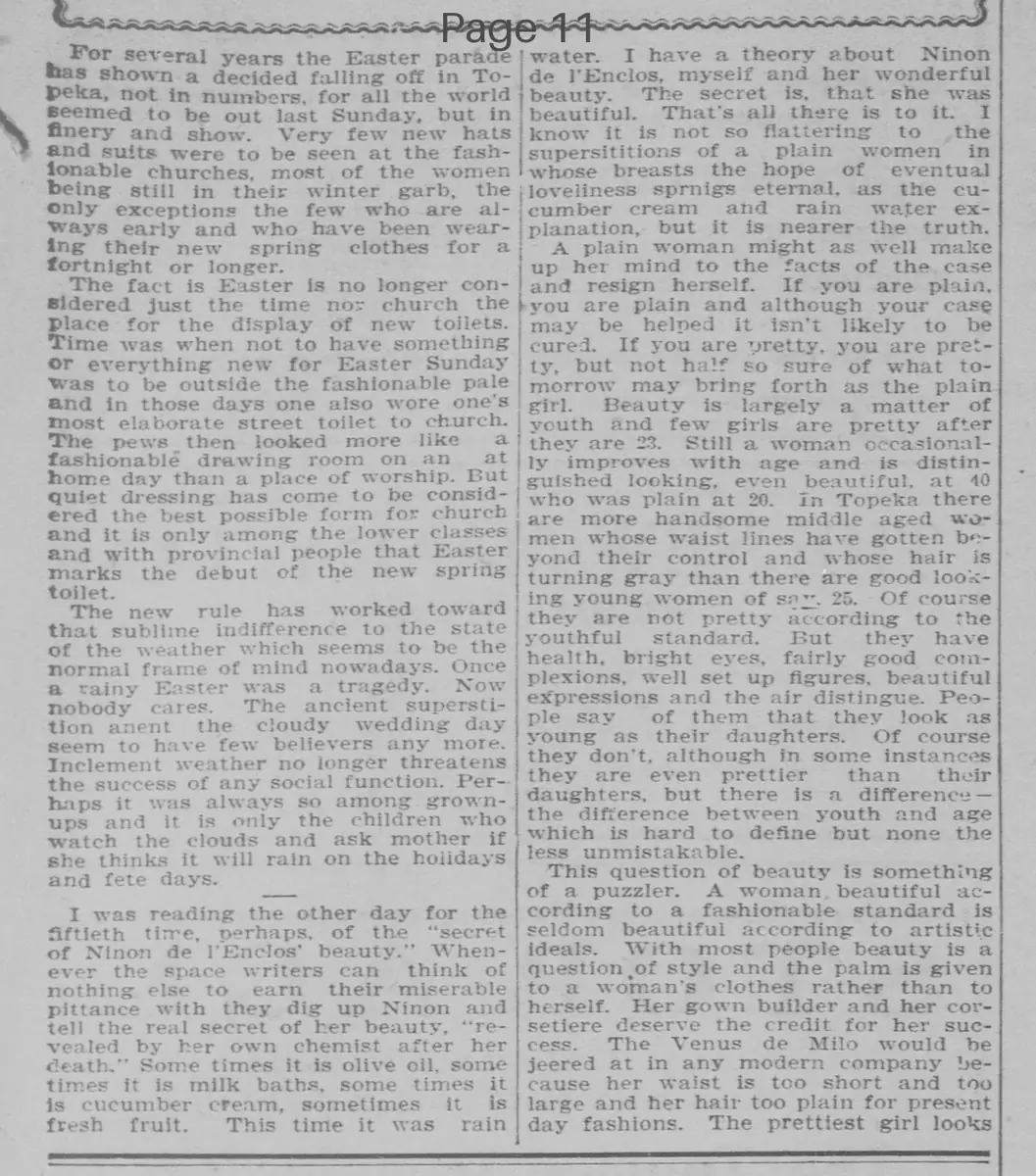
For several years the Easter parade has shown a decided falling off in Topeka, not in numbers, for all the world seemed to be out last Sunday, but in finery and show. Very few new hats and suits were to be seen at the fashionable churches, most of the women being still in their winter garb, the only exceptions the few who are always early and who have been wearing their new spring clothes for a fortnight or longer.
The fact is Easter is no longer considered just the time nor church the place for the display of new toilets. Time was when not to have something or everything new for Easter Sunday was to be outside the fashionable pale and in those days one also wore one's most elaborate street toilet to church. The pews then looked more like a fashionable drawing room on an at home day than a place of worship. But quiet dressing has come to be considered the best possible form for church and it is only among the lower classes and with provincial people that Easter marks the debut of the new spring toilet.
The new rule has worked toward that sublime indifference to the state of the weather which seems to be the normal frame of mind nowadays. Once a rainy Easter was a tragedy. Now nobody cares. The ancient superstition anent the cloudy wedding day seem to have few believers any more. Inclement weather no longer threatens the success of any social function. Perhaps it was always so among grown-ups and it is only the children who watch the clouds and ask mother if she thinks it will rain on the holidays and fete days.
I was reading the other day for the fiftieth time, perhaps, of the "secret of Ninon de l'Enclos' beauty." Whenever the space writers can think of nothing else to earn their miserable pittance with they dig up Ninon and tell the real secret of her beauty, "revealed by her own chemist after her death." Sometimes it is olive oil, some times it is milk baths, some times it is cucumber cream, sometimes it is fresh fruit. This time it was rain water. I have a theory about Ninon de l'Enclos, myself and her wonderful beauty. The secret is, that she was beautiful. That's all there is to it. I know it is not so flattering to the superstitions of a plain woman in whose breasts the hope of eventual loveliness springs eternal, as the cucumber cream and rain water explanation, but it is nearer the truth.
A plain woman might as well make up her mind to the facts of the case and resign herself. If you are plain, you are plain and although your case may be helped it isn't likely to be cured. If you are pretty, you are pretty, but not half so sure of what tomorrow may bring forth as the plain girl. Beauty is largely a matter of youth and few girls are pretty after they are 23. Still a woman occasionally improves with age and is distinguished looking, even beautiful, at 40 who was plain at 20. In Topeka there are more handsome middle aged women whose waist lines have gotten beyond their control and whose hair is turning gray than there are good looking young women of say 25. Of course they are not pretty according to the youthful standard. But they have health, bright eyes, fairly good complexions, well set up figures, beautiful expressions and the air distingue. People say of them that they look as young as their daughters. Of course they don't, although in some instances they are even prettier than their daughters, but there is a difference-the difference between youth and age which is hard to define but none the less unmistakable.
This question of beauty is something of a puzzler. A woman beautiful according to a fashionable standard is seldom beautiful according to artistic ideals. With most people beauty is a question of style and the palm is given to a woman's clothes rather than to herself. Her gown builder and her corsetiere deserve the credit for her success. The Venus de Milo would be jeered at in any modern company because her waist is too short and too large and her hair too plain for present day fashions. The prettiest girl looks plain to the modern eye unless she is modishly dressed and give a woman clothes and the knack of wearing them and she will create the illusion of beauty whether she has it or not.
The fact is Easter is no longer considered just the time nor church the place for the display of new toilets. Time was when not to have something or everything new for Easter Sunday was to be outside the fashionable pale and in those days one also wore one's most elaborate street toilet to church. The pews then looked more like a fashionable drawing room on an at home day than a place of worship. But quiet dressing has come to be considered the best possible form for church and it is only among the lower classes and with provincial people that Easter marks the debut of the new spring toilet.
The new rule has worked toward that sublime indifference to the state of the weather which seems to be the normal frame of mind nowadays. Once a rainy Easter was a tragedy. Now nobody cares. The ancient superstition anent the cloudy wedding day seem to have few believers any more. Inclement weather no longer threatens the success of any social function. Perhaps it was always so among grown-ups and it is only the children who watch the clouds and ask mother if she thinks it will rain on the holidays and fete days.
I was reading the other day for the fiftieth time, perhaps, of the "secret of Ninon de l'Enclos' beauty." Whenever the space writers can think of nothing else to earn their miserable pittance with they dig up Ninon and tell the real secret of her beauty, "revealed by her own chemist after her death." Sometimes it is olive oil, some times it is milk baths, some times it is cucumber cream, sometimes it is fresh fruit. This time it was rain water. I have a theory about Ninon de l'Enclos, myself and her wonderful beauty. The secret is, that she was beautiful. That's all there is to it. I know it is not so flattering to the superstitions of a plain woman in whose breasts the hope of eventual loveliness springs eternal, as the cucumber cream and rain water explanation, but it is nearer the truth.
A plain woman might as well make up her mind to the facts of the case and resign herself. If you are plain, you are plain and although your case may be helped it isn't likely to be cured. If you are pretty, you are pretty, but not half so sure of what tomorrow may bring forth as the plain girl. Beauty is largely a matter of youth and few girls are pretty after they are 23. Still a woman occasionally improves with age and is distinguished looking, even beautiful, at 40 who was plain at 20. In Topeka there are more handsome middle aged women whose waist lines have gotten beyond their control and whose hair is turning gray than there are good looking young women of say 25. Of course they are not pretty according to the youthful standard. But they have health, bright eyes, fairly good complexions, well set up figures, beautiful expressions and the air distingue. People say of them that they look as young as their daughters. Of course they don't, although in some instances they are even prettier than their daughters, but there is a difference-the difference between youth and age which is hard to define but none the less unmistakable.
This question of beauty is something of a puzzler. A woman beautiful according to a fashionable standard is seldom beautiful according to artistic ideals. With most people beauty is a question of style and the palm is given to a woman's clothes rather than to herself. Her gown builder and her corsetiere deserve the credit for her success. The Venus de Milo would be jeered at in any modern company because her waist is too short and too large and her hair too plain for present day fashions. The prettiest girl looks plain to the modern eye unless she is modishly dressed and give a woman clothes and the knack of wearing them and she will create the illusion of beauty whether she has it or not.
What sub-type of article is it?
Curiosity
What themes does it cover?
Social Manners
Moral Virtue
What keywords are associated?
Easter Parade
Fashion Trends
Beauty Secrets
Social Norms
Ninon De Lenclos
Topeka Women
Youth Beauty
What entities or persons were involved?
Ninon De L'enclos
Where did it happen?
Topeka
Story Details
Key Persons
Ninon De L'enclos
Location
Topeka
Story Details
Decline in Easter finery displays at Topeka churches reflects shifting norms toward subdued church attire; indifference to weather in social events; critique of beauty myths, asserting Ninon's beauty was innate, urging acceptance of plainness, noting fashion's role in perceived attractiveness over time.