Thank you for visiting SNEWPapers!
Sign up free
Herald Of The Valley
Fincastle, Botetourt County, Virginia
What is this article about?
Isaac Sharpless describes weevil habits in barns, their winter dormancy, summer activity, egg-laying in grain, and methods to destroy them like stacking grain outside, using decoy corn, or hemp layers to prevent ravages on stored grain.
Merged-components note: Continuation of article on weevils and methods to destroy them across pages 1 and 2.
Clippings
1 of 2
OCR Quality
Full Text
From the West Chester Republican.
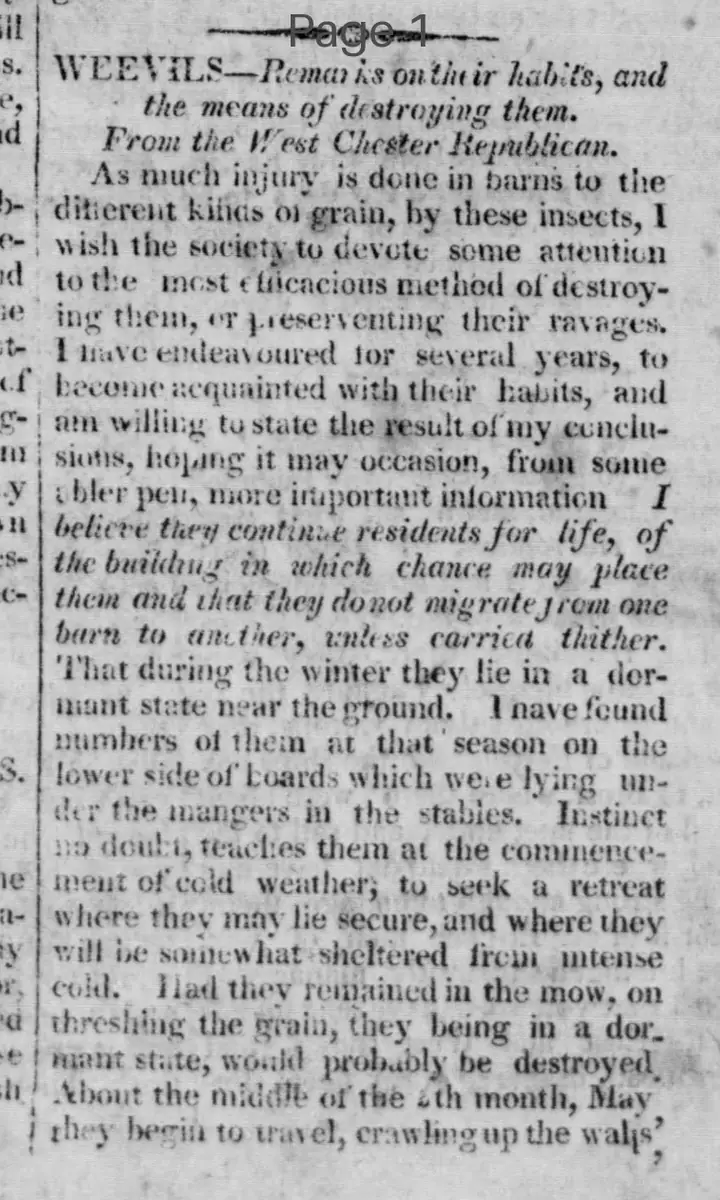
As much injury is done in barns to the different kinds of grain, by these insects, I wish the society to devote some attention to the most efficacious method of destroying them, or preventing their ravages.
I have endeavoured for several years, to become acquainted with their habits, and am willing to state the result of my conclusions, hoping it may occasion, from some abler pen, more important information. I believe they continue residents for life, of the building in which chance may place them and that they do not migrate from one barn to another. unless carried thither.
That during the winter they lie in a dormant state near the ground. I have found numbers of them at that season on the lower side of boards which were lying under the mangers in the stables. Instinct no doubt, teaches them at the commencement of cold weather; to seek a retreat where they may lie secure, and where they will be somewhat sheltered from intense cold. Had they remained in the mow, on threshing the grain, they being in a dormant state, would probably be destroyed about the middle of the 4th month, May they begin to travel, crawling up the walls and in every direction in search of food. If any grain be in the barn, they find it: and I have seen as many as eight or ten on one grain of Indian corn, the eye of which they at first consume. When wheat, rye, or barley, is brought into the barn, they penetrate the mow, and I apprehend, deposit their eggs in the grain, which serves for food for the young insects, till they arrive at nearly the size of the parents; probably the sweating and warmth of the mow, much assist in the depositing of the egg, and in bringing the insect to perfection. As a proof that the egg is deposited in the grain, it will be found, that if wheat be threshed some short time after harvest, in barns where weevils abound, when it will be very little eaten by them, and put into bags, and perhaps few of the insects then to be seen, that in a few weeks it will be very much eaten, and numbers of weevils in the bags.
Having thus briefly stated my opinion of their habits, I will suggest a few propositions for destroying them. The most efficacious mode, I apprehend, would be to stack the grain out for one or two years, and keep all kinds of it from laying in the barn, during the summer season, by this means they would be deprived of food and of a suitable place to deposit their young. Many of them may be destroyed by having no grain in the barn from the time they leave their winter retreat, till harvest: except about a double handful of Indian corn in a place, and in several different places. Numbers of them will go to these heaps for food, then about once in two days to riddle them in some clean place with a wheat riddle, the insects will fall through, which may be gathered up and thrown into the fire. Another method is to leave a little straw in the stables at this season, and before harvest gather it all up carefully, and draw it out into a field, many weevils will thus be taken out and will perish. It is said, though I have never experienced it, that they have a great antipathy to hemp, that a few layers of it, spread among the grain, at the time of putting it in the barn, will prevent their ravages.
No doubt, members of the society, and others are possessed of facts on this subject which would be highly interesting to those who are troubled with these insects about their barns. It is hoped they be induced, through the medium of the society or otherwise, to make them public, as it might be the means of saving many bushels of grain annually for the use of the community.
ISAAC SHARPLESS.
What sub-type of article is it?
What themes does it cover?
What keywords are associated?
What entities or persons were involved?
Where did it happen?
Story Details
Key Persons
Location
Barns
Story Details
Isaac Sharpless shares observations on weevil habits: winter dormancy near ground, spring activity seeking grain, egg deposition in stored grains like wheat and corn leading to infestation. Suggests prevention by stacking grain outside, using decoy corn to trap and burn weevils, straw removal, or hemp layers to deter them.