Thank you for visiting SNEWPapers!
Sign up free
The New Hampshire Gazette And General Advertiser
Portsmouth, Rockingham County, New Hampshire
What is this article about?
Reports from Paris detail French political unrest: Foreign Minister addresses Assembly on emigrant loans and armed marches; King's letters warn of Prussian invasion and express unity; Condorcet's radical motions applauded; King's defiance during riots; National Assembly unites parties in support of constitution on July 9, 1792.
Clipping
OCR Quality
Full Text
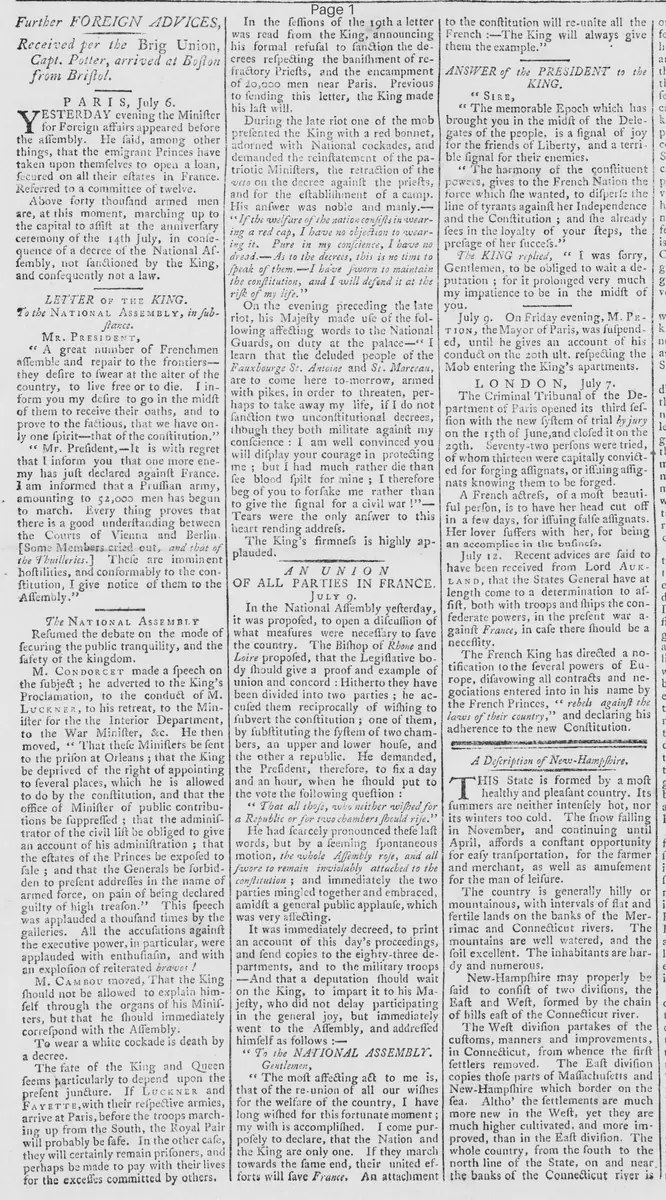
Received per the Brig Union,
Capt. Potter, arrived at Boston
from Bristol.
P A R I S, July 6.
YESTERDAY evening the Minister
for Foreign affairs appeared before
the assembly. He said, among other
things, that the emigrant Princes have
taken upon themselves to open a loan,
secured on all their estates in France.
Referred to a committee of twelve.
Above forty thousand armed men
are, at this moment, marching up to
the capital to assist at the anniversary
ceremony of the 14th July, in consequence
of a decree of the National Assembly,
not sanctioned by the King,
and consequently not a law.
LETTER OF THE KING.
To the NATIONAL ASSEMBLY, in substance.
Mr. President,
A great number of Frenchmen
assemble and repair to the frontiers--
they desire to swear at the altar of the
country, to live free or to die. I inform
you my desire to go in the midst
of them to receive their oaths, and to
prove to the factious, that we have only
one spirit--that of the constitution."
"Mr. President,--It is with regret
that I inform you that one more enemy
has just declared against France.
I am informed that a Prussian army,
amounting to 52,000 men has begun
to march. Every thing proves that
there is a good understanding between
the Courts of Vienna and Berlin.
[Some Members cried out, and "to the Tuilleries."] These are imminent
hostilities, and conformably to the constitution,
I give notice of them to the
Assembly."
The National Assembly
Resumed the debate on the mode of
securing the public tranquility, and the
safety of the kingdom.
M. Condorcet made a speech on
the subject; he adverted to the King's
Proclamation, to the conduct of M.
Luckner, to his retreat, to the Minister
for the Interior Department,
to the War Minister, &c. He then
moved, "That these Ministers be sent
to the prison at Orleans; that the King
be deprived of the right of appointing
to several places, which he is allowed
to do by the constitution, and that the
office of Minister of public contributions
be suppressed: that the administrator
of the civil list be obliged to give
an account of his administration; that
the estates of the Princes be exposed to
sale; and that the Generals be forbidden
to present addresses in the name of
armed force, on pain of being declared
guilty of high treason." This speech
was applauded a thousand times by the
galleries. All the accusations against
the executive power, in particular, were
applauded with enthusiasm, and with
an explosion of reiterated bravos!
M. Cambon moved, That the King
should not be allowed to explain himself
through the organs of his Ministers,
but that he should immediately
correspond with the Assembly:
To wear a white cockade is death by
a decree.
The fate of the King and Queen
seems particularly to depend upon the
present juncture. If Luckner and
Fayette, with their respective armies,
arrive at Paris, before the troops marching
up from the South, the Royal Pair
will probably be safe. In the other case,
they will certainly remain prisoners, and
perhaps be made to pay with their lives
for the excesses committed by others.
In the sessions of the 10th a letter
was read from the King, announcing
his formal refusal to sanction the decrees
respecting the banishment of refractory
Priests, and the encampment
of 20,000 men near Paris. Previous
to sending this letter, the King made
his last will.
During the late riot one of the mob
presented the King with a red bonnet,
adorned with National cockades, and
demanded the reinstatement of the patriotic
Ministers, the retraction of the
veto on the decree against the priests,
and for the establishment of a camp.
His answer was noble and manly.--
"If the welfare of the nation consists in wearing
a red cap, I have no objection to wearing
it. Pure in my conscience, I have no
dread.--As to the decrees, this is no time to
speak of them,--I have sworn to maintain
the constitution, and I will defend it at the
risk of my life."
On the evening preceding the late
riot, his Majesty made use of the following
affecting words to the National
Guards, on duty at the palace--"I
learn that the deluded people of the
Faubourg St. Antoine and St. Marceau,
are to come here to-morrow, armed
with pikes, in order to threaten, perhaps
to take away my life, if I do not
sanction two unconstitutional decrees,
though they both militate against my
conscience: I am well convinced you
will display your courage in protecting
me: but I had much rather die than
see blood spilt for mine: I therefore
beg of you to forsake me rather than
to give the signal for a civil war!"
Tears were the only answer to this
heart rending address.
The King's firmness is highly applauded.
AN UNION
OF ALL PARTIES IN FRANCE.
July 9.
In the National Assembly yesterday,
it was proposed, to open a discussion of
what measures were necessary to save
the country. The Bishop of Rhone and
Loire proposed, that the Legislative body
should give a proof and example of
union and concord: Hitherto they have
been divided into two parties; he accused
them reciprocally of wishing to
subvert the constitution; one of them,
by substituting the system of two chambers,
an upper and lower house, and
the other a republic. He demanded,
the President, therefore, to fix a day
and an hour, when he should put to
the vote the following question:
"That all those, who neither wished for
a Republic or for two chambers should rise."
He had scarcely pronounced these last
words, but by a seeming spontaneous
motion, the whole Assembly rose, and all
swore to remain inviolably attached to the
constitution; and immediately the two
parties mingled together and embraced,
amidst a general public applause, which
was very affecting.
It was immediately decreed, to print
an account of this day's proceedings,
and send copies to the eighty-three departments,
and to the military troops
And that a deputation should wait
on the King, to impart it to his Majesty,
who did not delay participating
in the general joy, but immediately
went to the Assembly, and addressed
himself as follows:
"To the NATIONAL ASSEMBLY.
Gentlemen,
"The most affecting act to me is,
that of the re-union of all our wishes
for the welfare of the country, I have
long wished for this fortunate moment;
my wish is accomplished. I come purposely
to declare, that the Nation and
the King are only one. If they march
towards the same end, their united efforts
will save France. An attachment
What sub-type of article is it?
What keywords are associated?
What entities or persons were involved?
Where did it happen?
Foreign News Details
Primary Location
Paris
Event Date
July 6 And July 9
Key Persons
Outcome
national assembly unites parties in support of constitution; king refuses to sanction decrees on priests and encampment; prussian army of 52,000 begins march against france; threats to king's life during riots
Event Details
Foreign Minister reports emigrant princes' loan and armed men marching to Paris for July 14 ceremony despite King's non-sanction. King's letters express desire for unity and warn of Prussian invasion with Vienna-Berlin accord. Assembly debates security; Condorcet proposes jailing ministers, depriving King of appointments, selling princes' estates. Cambon moves for direct King-Assembly communication. King's noble responses during riot and to guards. On July 9, Bishop proposes vote against republic or two chambers; entire Assembly rises in unity, embraces, decrees distribution of account, King addresses in joy of reunion.