Thank you for visiting SNEWPapers!
Sign up free
Story
December 14, 1844
The Daily Madisonian
Washington, District Of Columbia
What is this article about?
Andrew Jackson, ex-President, joyfully declares the Republic will last forever upon Polk's 1844 election win over Clay, seeing it as vindication of democratic ideals and reversal of 1840's setback, contrasting with Jefferson's unfulfilled hope.
Clipping
OCR Quality
95%
Excellent
Full Text
From the Boston Post,
"the Republic will Last forever."
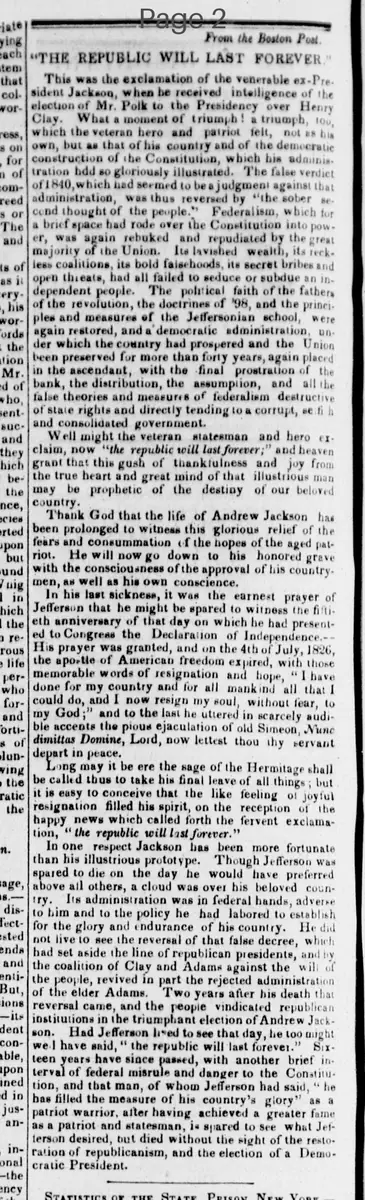
This was the exclamation of the venerable ex-President Jackson, when he received intelligence of the election of Mr. Polk to the Presidency over Henry Clay. What a moment of triumph! a triumph, too, which the veteran hero and patriot felt, not as his own, but as that of his country and of the democratic construction of the Constitution, which his administration had so gloriously illustrated. The false verdict of 1840, which had seemed to be a judgment against that administration, was thus reversed by "the sober second thought of the people." Federalism, which for a brief space had rode over the Constitution into power, was again rebuked and repudiated by the great majority of the Union. Its lavished wealth, its reckless coalitions, its bold falsehoods, its secret bribes and open threats, had all failed to seduce or subdue an independent people. The political faith of the fathers of the revolution, the doctrines of '98, and the principles and measures of the Jeffersonian school, were again restored, and a democratic administration, under which the country had prospered and the Union been preserved for more than forty years, again placed in the ascendant, with the final prostration of the bank, the distribution, the assumption, and all the false theories and measures of federalism destructive of state rights and directly tending to a corrupt, selfish and consolidated government.
Well might the veteran statesman and hero exclaim, now "the republic will last forever;" and heaven grant that this gush of thankfulness and joy from the true heart and great mind of that illustrious man may be prophetic of the destiny of our beloved country.
Thank God that the life of Andrew Jackson has been prolonged to witness this glorious relief of the fears and consummation of the hopes of the aged patriot. He will now go down to his honored grave with the consciousness of the approval of his countrymen, as well as his own conscience.
In his last sickness, it was the earnest prayer of Jefferson that he might be spared to witness the fiftieth anniversary of that day on which he had presented to Congress the Declaration of Independence.—His prayer was granted, and on the 4th of July, 1826, the apostle of American freedom expired, with those memorable words of resignation and hope, "I have done for my country and for all mankind all that I could do, and I now resign my soul, without fear, to my God;" and to the last he uttered in scarcely audible accents the pious ejaculation of old Simeon, Nunc dimittis Domine, Lord, now lettest thou thy servant depart in peace.
Long may it be ere the sage of the Hermitage shall be called thus to take his final leave of all things; but it is easy to conceive that the like feeling of joyful resignation filled his spirit, on the reception of the happy news which called forth the fervent exclamation, "the republic will last forever."
In one respect Jackson has been more fortunate than his illustrious prototype. Though Jefferson was spared to die on the day he would have preferred above all others, a cloud was over his beloved country. Its administration was in federal hands, adverse to him and to the policy he had labored to establish for the glory and endurance of his country. He did not live to see the reversal of that false decree, which had set aside the line of republican presidents, and by the coalition of Clay and Adams against the will of the people, revived in part the rejected administration of the elder Adams. Two years after his death that reversal came, and the people vindicated republican institutions in the triumphant election of Andrew Jackson. Had Jefferson lived to see that day, he too might well have said, "the republic will last forever." Sixteen years have since passed, with another brief interval of federal misrule and danger to the Constitution, and that man, of whom Jefferson had said, "he has filled the measure of his country's glory" as a patriot warrior, after having achieved a greater fame as a patriot and statesman, is spared to see what Jefferson desired, but died without the sight of the restoration of republicanism, and the election of a Democratic President.
"the Republic will Last forever."
This was the exclamation of the venerable ex-President Jackson, when he received intelligence of the election of Mr. Polk to the Presidency over Henry Clay. What a moment of triumph! a triumph, too, which the veteran hero and patriot felt, not as his own, but as that of his country and of the democratic construction of the Constitution, which his administration had so gloriously illustrated. The false verdict of 1840, which had seemed to be a judgment against that administration, was thus reversed by "the sober second thought of the people." Federalism, which for a brief space had rode over the Constitution into power, was again rebuked and repudiated by the great majority of the Union. Its lavished wealth, its reckless coalitions, its bold falsehoods, its secret bribes and open threats, had all failed to seduce or subdue an independent people. The political faith of the fathers of the revolution, the doctrines of '98, and the principles and measures of the Jeffersonian school, were again restored, and a democratic administration, under which the country had prospered and the Union been preserved for more than forty years, again placed in the ascendant, with the final prostration of the bank, the distribution, the assumption, and all the false theories and measures of federalism destructive of state rights and directly tending to a corrupt, selfish and consolidated government.
Well might the veteran statesman and hero exclaim, now "the republic will last forever;" and heaven grant that this gush of thankfulness and joy from the true heart and great mind of that illustrious man may be prophetic of the destiny of our beloved country.
Thank God that the life of Andrew Jackson has been prolonged to witness this glorious relief of the fears and consummation of the hopes of the aged patriot. He will now go down to his honored grave with the consciousness of the approval of his countrymen, as well as his own conscience.
In his last sickness, it was the earnest prayer of Jefferson that he might be spared to witness the fiftieth anniversary of that day on which he had presented to Congress the Declaration of Independence.—His prayer was granted, and on the 4th of July, 1826, the apostle of American freedom expired, with those memorable words of resignation and hope, "I have done for my country and for all mankind all that I could do, and I now resign my soul, without fear, to my God;" and to the last he uttered in scarcely audible accents the pious ejaculation of old Simeon, Nunc dimittis Domine, Lord, now lettest thou thy servant depart in peace.
Long may it be ere the sage of the Hermitage shall be called thus to take his final leave of all things; but it is easy to conceive that the like feeling of joyful resignation filled his spirit, on the reception of the happy news which called forth the fervent exclamation, "the republic will last forever."
In one respect Jackson has been more fortunate than his illustrious prototype. Though Jefferson was spared to die on the day he would have preferred above all others, a cloud was over his beloved country. Its administration was in federal hands, adverse to him and to the policy he had labored to establish for the glory and endurance of his country. He did not live to see the reversal of that false decree, which had set aside the line of republican presidents, and by the coalition of Clay and Adams against the will of the people, revived in part the rejected administration of the elder Adams. Two years after his death that reversal came, and the people vindicated republican institutions in the triumphant election of Andrew Jackson. Had Jefferson lived to see that day, he too might well have said, "the republic will last forever." Sixteen years have since passed, with another brief interval of federal misrule and danger to the Constitution, and that man, of whom Jefferson had said, "he has filled the measure of his country's glory" as a patriot warrior, after having achieved a greater fame as a patriot and statesman, is spared to see what Jefferson desired, but died without the sight of the restoration of republicanism, and the election of a Democratic President.
What sub-type of article is it?
Historical Event
Biography
Personal Triumph
What themes does it cover?
Triumph
Fortune Reversal
Justice
What keywords are associated?
Andrew Jackson
James Polk
Henry Clay
1844 Election
Democratic Victory
Republican Principles
Federalism Defeat
What entities or persons were involved?
Andrew Jackson
Mr. Polk
Henry Clay
Jefferson
Story Details
Key Persons
Andrew Jackson
Mr. Polk
Henry Clay
Jefferson
Event Date
1844
Story Details
Andrew Jackson exclaims 'the Republic will Last forever' upon learning of James K. Polk's election victory over Henry Clay, viewing it as a triumph for democratic principles, reversal of the 1840 verdict, and vindication of his administration's policies against federalism.