Thank you for visiting SNEWPapers!
Sign up free
Editorial
June 3, 1844
The Whig Standard
Washington, District Of Columbia
What is this article about?
A Whig-leaning editorial mocks a Locofoco (Democratic) ratification meeting in Washington, D.C., for the Baltimore Convention nominations of James K. Polk. Speakers defend Polk and attack Henry Clay with alleged lies and vulgarity, but the author ridicules their efforts and the party's desperation.
Clipping
OCR Quality
98%
Excellent
Full Text
THE LOCOFOCO RATIFICATION MEETING IN WASHINGTON.
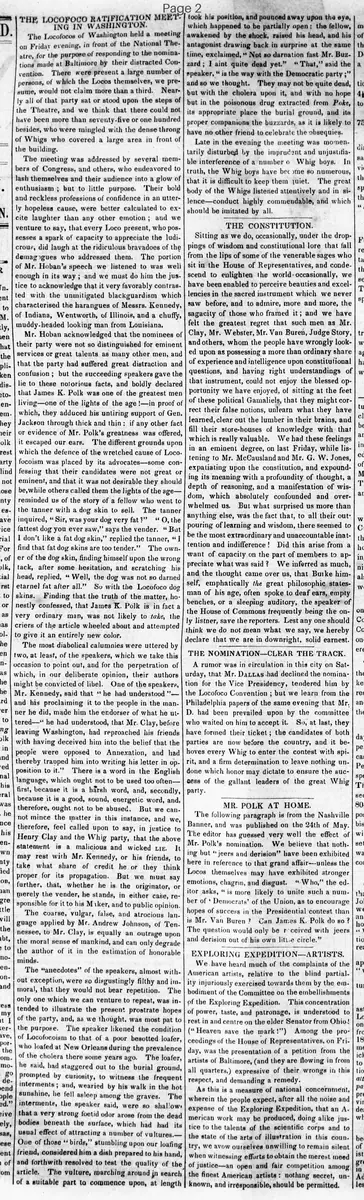
The Locofocos of Washington held a meeting on Friday evening, in front of the National Theatre, for the purpose of responding to the nominations made at Baltimore by their distracted Convention. There were present a large number of persons, of which the Locos themselves, we presume, would not claim more than a third. Nearly all of that party sat or stood upon the steps of the Theatre, and we think that there could not have been more than seventy-five or one hundred besides, who were mingled with the dense throng of Whigs who covered a large area in front of the building.
The meeting was addressed by several members of Congress, and others, who endeavored to lash themselves and their audience into a glow of enthusiasm; but to little purpose. Their bold and reckless professions of confidence in an utterly hopeless cause, were better calculated to excite laughter than any other emotion; and we venture to say, that every Loco present, who possesses a spark of capacity to appreciate the ludicrous, did laugh at the ridiculous bravadoes of the demagogues who addressed them. The portion of Mr. Hoban's speech we listened to was well enough in its way; and we must do him the justice to acknowledge that it very favorably contrasted with the unmitigated blackguardism which characterised the harangues of Messrs. Kennedy, of Indiana, Wentworth, of Illinois, and a chuffy, muddy-headed looking man from Louisiana.
Mr. Hoban acknowledged that the nominees of their party were not so distinguished for eminent services or great talents as many other men, and that the party had suffered great distraction and confusion; but the succeeding speakers gave the lie to these notorious facts, and boldly declared that James K. Polk was one of the greatest men living—one of the lights of the age!—in proof of which, they adduced his untiring support of Gen. Jackson through thick and thin: if any other fact or evidence of Mr. Polk's greatness was offered, it escaped our ears. The different grounds upon which the defence of the wretched cause of Locofocoism was placed by its advocates—some confessing that their candidates were not great or eminent, and that it was not desirable they should be, while others called them the lights of the age—reminded us of the story of a fellow who went to the tanner with a dog skin to sell. The tanner inquired, "Sir, was your dog very fat?" "O, the fattest dog you ever saw," says the vender. "But I don't like a fat dog skin," replied the tanner, "I find that fat dog skins are too tender." The owner of the dog skin, finding himself upon the wrong tack, after some hesitation, and scratching his head, replied, "Well, the dog was not so darned eternal fat after all." So with the Locofoco dog skins. Finding that the truth of the matter, honestly confessed, that James K. Polk is in fact a very ordinary man, was not likely to take, the criers of the article wheeled about and attempted to give it an entirely new color.
The most diabolical calumnies were uttered by two, at least, of the speakers, which we take this occasion to point out, and for the perpetration of which, in our deliberate opinion, their authors might be convicted of libel. One of the speakers, Mr. Kennedy, said that "he had understood" and his proclaiming it to the people in the manner he did, made him the endorser of what he uttered" he had understood, that Mr. Clay, before leaving Washington, had reproached his friends with having deceived him into the belief that the people were opposed to Annexation, and had thereby trapped him into writing his letter in opposition to it." There is a word in the English language, which ought not to be used too often—first, because it is a harsh word, and, secondly, because it is a good, sound, energetic word, and, therefore, ought not to be abused. But we cannot mince the matter in this instance, and we, therefore, feel called upon to say, in justice to Henry Clay and the Whig party, that the above statement is a malicious and wicked LIE. It may rest with Mr. Kennedy, or his friends, to take what share of credit he or they think proper for its propagation. But we must say further, that, whether he is the originator, or merely the vender, he stands, in either case, responsible for it to his Maker, and to public opinion.
The coarse, vulgar, false, and atrocious language applied by Mr. Andrew Johnson, of Tennessee, to Mr. Clay, is equally an outrage upon the moral sense of mankind, and can only degrade the author of it in the estimation of honorable minds.
The "anecdotes" of the speakers, almost without exception, were so disgustingly filthy and immoral, that they would not bear repetition. The only one which we can venture to repeat, was intended to illustrate the present prostrate hopes of the party, and, as we thought, was most pat to the purpose. The speaker likened the condition of Locofocoism to that of a poor besotted loafer, who loafed at New Orleans during the prevalence of the cholera there some years ago. The loafer, he said, had staggered out to the burial ground, prompted by curiosity, to witness the frequent interments; and, wearied by his walk in the hot sunshine, he fell asleep among the graves. The interments, the speaker said, were so shallow, that a very strong foetid odor arose from the dead bodies beneath the surface, which had had its usual effect of attracting a number of vultures.—One of those "birds," stumbling upon our loafing friend, considered him a dish prepared to his hand, and forthwith resolved to test the quality of the article. The vulture, marching around in search of a suitable part to commence upon, at length took his position, and pounced away upon the eye, which happened to be partially open: the fellow, awakened by the shock, raised his head, and his antagonist drawing back in surprise at the same time, exclaimed, "Not so darnation fast Mr. Buzzard; I aint quite dead yet." "That," said the speaker, "is the way with the Democratic party;" and so we thought. They may not be quite dead, but with the cholera upon it, and with no hope but in the poisonous drug extracted from Poke, its appropriate place the burial ground, and its proper companions the buzzards, as it is likely to have no other friend to celebrate the obsequies.
Late in the evening the meeting was momentarily disturbed by the imprudent and unjustifiable interference of a number of Whig boys. In truth, the Whig boys have become so numerous, that it is difficult to keep them quiet. The great body of the Whigs listened attentively and in silence—conduct highly commendable, and which should be imitated by all.
The Locofocos of Washington held a meeting on Friday evening, in front of the National Theatre, for the purpose of responding to the nominations made at Baltimore by their distracted Convention. There were present a large number of persons, of which the Locos themselves, we presume, would not claim more than a third. Nearly all of that party sat or stood upon the steps of the Theatre, and we think that there could not have been more than seventy-five or one hundred besides, who were mingled with the dense throng of Whigs who covered a large area in front of the building.
The meeting was addressed by several members of Congress, and others, who endeavored to lash themselves and their audience into a glow of enthusiasm; but to little purpose. Their bold and reckless professions of confidence in an utterly hopeless cause, were better calculated to excite laughter than any other emotion; and we venture to say, that every Loco present, who possesses a spark of capacity to appreciate the ludicrous, did laugh at the ridiculous bravadoes of the demagogues who addressed them. The portion of Mr. Hoban's speech we listened to was well enough in its way; and we must do him the justice to acknowledge that it very favorably contrasted with the unmitigated blackguardism which characterised the harangues of Messrs. Kennedy, of Indiana, Wentworth, of Illinois, and a chuffy, muddy-headed looking man from Louisiana.
Mr. Hoban acknowledged that the nominees of their party were not so distinguished for eminent services or great talents as many other men, and that the party had suffered great distraction and confusion; but the succeeding speakers gave the lie to these notorious facts, and boldly declared that James K. Polk was one of the greatest men living—one of the lights of the age!—in proof of which, they adduced his untiring support of Gen. Jackson through thick and thin: if any other fact or evidence of Mr. Polk's greatness was offered, it escaped our ears. The different grounds upon which the defence of the wretched cause of Locofocoism was placed by its advocates—some confessing that their candidates were not great or eminent, and that it was not desirable they should be, while others called them the lights of the age—reminded us of the story of a fellow who went to the tanner with a dog skin to sell. The tanner inquired, "Sir, was your dog very fat?" "O, the fattest dog you ever saw," says the vender. "But I don't like a fat dog skin," replied the tanner, "I find that fat dog skins are too tender." The owner of the dog skin, finding himself upon the wrong tack, after some hesitation, and scratching his head, replied, "Well, the dog was not so darned eternal fat after all." So with the Locofoco dog skins. Finding that the truth of the matter, honestly confessed, that James K. Polk is in fact a very ordinary man, was not likely to take, the criers of the article wheeled about and attempted to give it an entirely new color.
The most diabolical calumnies were uttered by two, at least, of the speakers, which we take this occasion to point out, and for the perpetration of which, in our deliberate opinion, their authors might be convicted of libel. One of the speakers, Mr. Kennedy, said that "he had understood" and his proclaiming it to the people in the manner he did, made him the endorser of what he uttered" he had understood, that Mr. Clay, before leaving Washington, had reproached his friends with having deceived him into the belief that the people were opposed to Annexation, and had thereby trapped him into writing his letter in opposition to it." There is a word in the English language, which ought not to be used too often—first, because it is a harsh word, and, secondly, because it is a good, sound, energetic word, and, therefore, ought not to be abused. But we cannot mince the matter in this instance, and we, therefore, feel called upon to say, in justice to Henry Clay and the Whig party, that the above statement is a malicious and wicked LIE. It may rest with Mr. Kennedy, or his friends, to take what share of credit he or they think proper for its propagation. But we must say further, that, whether he is the originator, or merely the vender, he stands, in either case, responsible for it to his Maker, and to public opinion.
The coarse, vulgar, false, and atrocious language applied by Mr. Andrew Johnson, of Tennessee, to Mr. Clay, is equally an outrage upon the moral sense of mankind, and can only degrade the author of it in the estimation of honorable minds.
The "anecdotes" of the speakers, almost without exception, were so disgustingly filthy and immoral, that they would not bear repetition. The only one which we can venture to repeat, was intended to illustrate the present prostrate hopes of the party, and, as we thought, was most pat to the purpose. The speaker likened the condition of Locofocoism to that of a poor besotted loafer, who loafed at New Orleans during the prevalence of the cholera there some years ago. The loafer, he said, had staggered out to the burial ground, prompted by curiosity, to witness the frequent interments; and, wearied by his walk in the hot sunshine, he fell asleep among the graves. The interments, the speaker said, were so shallow, that a very strong foetid odor arose from the dead bodies beneath the surface, which had had its usual effect of attracting a number of vultures.—One of those "birds," stumbling upon our loafing friend, considered him a dish prepared to his hand, and forthwith resolved to test the quality of the article. The vulture, marching around in search of a suitable part to commence upon, at length took his position, and pounced away upon the eye, which happened to be partially open: the fellow, awakened by the shock, raised his head, and his antagonist drawing back in surprise at the same time, exclaimed, "Not so darnation fast Mr. Buzzard; I aint quite dead yet." "That," said the speaker, "is the way with the Democratic party;" and so we thought. They may not be quite dead, but with the cholera upon it, and with no hope but in the poisonous drug extracted from Poke, its appropriate place the burial ground, and its proper companions the buzzards, as it is likely to have no other friend to celebrate the obsequies.
Late in the evening the meeting was momentarily disturbed by the imprudent and unjustifiable interference of a number of Whig boys. In truth, the Whig boys have become so numerous, that it is difficult to keep them quiet. The great body of the Whigs listened attentively and in silence—conduct highly commendable, and which should be imitated by all.
What sub-type of article is it?
Partisan Politics
Satire
What keywords are associated?
Locofoco Meeting
Polk Nomination
Whig Satire
Clay Defense
Baltimore Convention
Annexation Lie
Democratic Party Desperation
What entities or persons were involved?
Locofocos
James K. Polk
Henry Clay
Mr. Hoban
Mr. Kennedy
Wentworth
Andrew Johnson
Gen. Jackson
Editorial Details
Primary Topic
Mockery Of Locofoco Ratification Meeting For Polk Nominations
Stance / Tone
Pro Whig Satirical Attack On Locofocos
Key Figures
Locofocos
James K. Polk
Henry Clay
Mr. Hoban
Mr. Kennedy
Wentworth
Andrew Johnson
Gen. Jackson
Key Arguments
Locofoco Meeting Attendance Mostly Whigs
Speakers' Defenses Of Polk Inconsistent And Laughable
Kennedy's Claim About Clay Is A Malicious Lie
Johnson's Language Against Clay Is Vulgar And False
Locofoco Party Compared To Dying Loafer Attracting Vultures