Thank you for visiting SNEWPapers!
Sign up free
The Enquirer
Richmond, Henrico County, Virginia
What is this article about?
Russian Ukase issued on May 7, 1809, in St. Petersburg, establishing strict rules for neutral vessels entering Russian ports during the war with Britain to prevent enemy trade evasion. Includes requirements for documentation, seizure of enemy goods, and penalties for violations.
Clipping
OCR Quality
Full Text
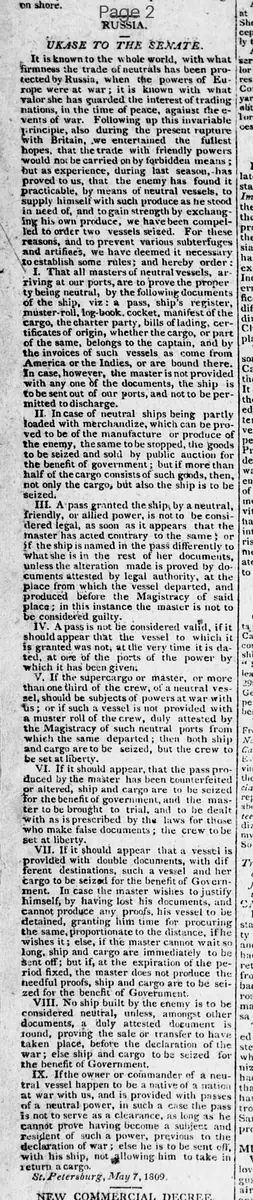
UKASE TO THE SENATE.
It is known to the whole world, with what firmness the trade of neutrals has been protected by Russia, when the powers of Europe were at war; it is known with what valor she has guarded the interest of trading nations, in the time of peace, against the events of war. Following up this invariable principle, also during the present rupture with Britain, we entertained the fullest hopes, that the trade with friendly powers would not be carried on by forbidden means; but as experience, during last season, has proved to us, that the enemy has found it practicable, by means of neutral vessels, to supply himself with such produce as he stood in need of, and to gain strength by exchanging his own produce, we have been compelled to order two vessels seized. For these reasons, and to prevent various subterfuges and artifices, we have deemed it necessary to establish some rules; and hereby order:
I. That all masters of neutral vessels, arriving at our ports, are to prove the property being neutral, by the following documents of the ship, viz: a pass, ship's register, muster-roll, log-book, cocket, manifest of the cargo, the charter party, bills of lading, certificates of origin, whether the cargo, or part of the same, belongs to the captain, and by the invoices of such vessels as come from America or the Indies, or are bound there. In case, however, the master is not provided with any one of the documents, the ship is to be sent out of our ports, and not to be permitted to discharge.
II. In case of neutral ships being partly loaded with merchandize, which can be proved to be of the manufacture or produce of the enemy, the same to be stopped, the goods to be seized and sold by public auction for the benefit of government; but if more than half of the cargo consists of such goods, then, not only the cargo, but also the ship is to be seized.
III. A pass granted the ship, by a neutral, friendly, or allied power, is not to be considered legal, as soon as it appears that the master has acted contrary to the same; or if the ship is named in the pass differently to what she is in the rest of her documents, unless the alteration made is proved by documents attested by legal authority, at the place from which the vessel departed, and produced before the Magistracy of said place: in this instance the master is not to be considered guilty.
IV. A pass is not be considered valid, if it should appear that the vessel to which it is granted was not, at the very time it is dated, at one of the ports of the power by which it has been given:
V. If the supercargo or master, or more than one third of the crew, of a neutral vessel, should be subjects of powers at war with us; or if such a vessel is not provided with a muster roll of the crew, duly attested by the Magistracy of such neutral ports from which the same departed; then both ship and cargo are to be seized, but the crew to be set at liberty.
VI. If it should appear, that the pass produced by the master has been counterfeited or altered, ship and cargo are to be seized for the benefit of government, and the master to be brought to trial, and to be dealt with as is prescribed by the laws for those who make false documents; the crew to be set at liberty.
VII. If it should appear that a vessel is provided with double documents, with different destinations, such a vessel and her cargo to be seized for the benefit of Government. In case the master wishes to justify himself, by having lost his documents, and cannot produce any proofs, his vessel to be detained, granting him time for procuring the same, proportionate to the distance, if he wishes it; else, if the master cannot wait so long, ship and cargo are immediately to be sent off; but if, at the expiration of the period fixed, the master does not produce the needful proofs, ship and cargo are to be seized for the benefit of Government.
VIII. No ship built by the enemy is to be considered neutral, unless, amongst other documents, a duly attested document is found, proving the sale or transfer to have taken place, before the declaration of the war; else ship and cargo to be seized for the benefit of Government.
IX. If the owner or commander of a neutral vessel happen to be a native of a nation at war with us, and is provided with passes of a neutral power, in such a case the pass is not to serve as a clearance, as long as he cannot prove having become a subject and resident of such a power, previous to the declaration of war; else he is to be sent off, with his ship, not allowing him to take in return a cargo.
St. Petersburg, May 7, 1809.
What sub-type of article is it?
What keywords are associated?
Where did it happen?
Foreign News Details
Primary Location
St. Petersburg
Event Date
1809 05 07
Outcome
issuance of ukase establishing rules for neutral vessels; provisions for seizure of ships, cargo, and goods proven to be enemy produce or in violation of documentation requirements, with sales benefiting government.
Event Details
The Ukase outlines nine rules for verifying neutrality of vessels entering Russian ports during the rupture with Britain, including required documents, seizure of enemy goods (especially if over half the cargo), invalidation of suspicious passes, checks on crew nationality, and penalties for counterfeiting or double documents.