Thank you for visiting SNEWPapers!
Sign up free
The Daily Telegram
Clarksburg, Harrison County, West Virginia
What is this article about?
Congressional committees in Washington on Dec. 19 discussed national defense appropriations for navy and national guard. Chief of Staff Maj. Gen. Hugh L. Scott urged universal training over volunteer systems, citing the beneficial but flawed Mexican border mobilization that protected U.S. interests without combat.
Merged-components note: Sequential reading orders (11 and 12) on page 1; the first is a headline/title, the second is the continuing body text on National Guard and Mexican border; merged into single domestic_news article.
Clipping
OCR Quality
Full Text
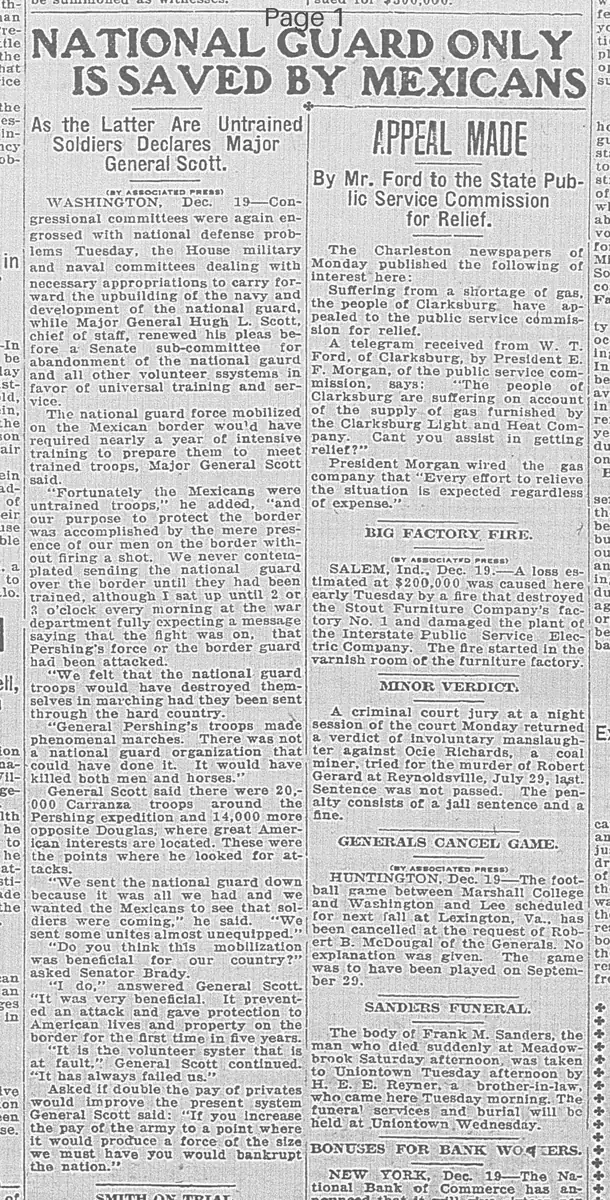
As Soldiers the Latter Declares Are Untrained Major APPEAL MADE
(BY ASSOCIATED PRESS)
WASHINGTON, Dec. 19—Congressional committees were again engrossed with national defense problems Tuesday, the House military and naval committees dealing with necessary appropriations to carry forward the upbuilding of the navy and development of the national guard, while Major General Hugh L. Scott, chief of staff, renewed his pleas before a Senate sub-committee for abandonment of the national guard and all other volunteer systems in favor of universal training and service.
The national guard force mobilized on the Mexican border would have required nearly a year of intensive training to prepare them to meet trained troops, Major General Scott said.
"Fortunately the Mexicans were untrained troops," he added, "and our purpose to protect the border was accomplished by the mere presence of our men on the border without firing a shot. We never contemplated sending the national guard over the border until they had been trained, although I sat up until 2 or 3 o'clock every morning at the war department fully expecting a message saying that the fight was on, that Pershing's force or the border guard had been attacked.
"We felt that the national guard troops would have destroyed themselves in marching had they been sent through the hard country.
"General Pershing's troops made phenomenal marches. There was not a national guard organization that could have done it. It would have killed both men and horses."
General Scott said there were 20,000 Carranza troops around the Pershing expedition and 14,000 more opposite Douglas, where great American interests are located. These were the points where he looked for attacks.
"We sent the national guard down because it was all we had and we wanted the Mexicans to see that soldiers were coming," he said.
"We sent some units almost unequipped."
"Do you think this mobilization was beneficial for our country?" asked Senator Brady.
"I do," answered General Scott. "It was very beneficial. It prevented an attack and gave protection to American lives and property on the border for the first time in five years.
"It is the volunteer system that is at fault," General Scott continued. "It has always failed us.
Asked if double the pay of privates would improve the present system General Scott said: "If you increase the pay of the army to a point where it would produce a force of the size we must have you would bankrupt the nation."
What sub-type of article is it?
What keywords are associated?
What entities or persons were involved?
Where did it happen?
Domestic News Details
Primary Location
Washington
Event Date
Dec. 19
Key Persons
Outcome
mobilization of national guard prevented an attack and gave protection to american lives and property on the border for the first time in five years.
Event Details
Congressional committees dealt with national defense problems, including appropriations for navy and national guard development. Major General Hugh L. Scott advocated for abandonment of national guard and volunteer systems in favor of universal training and service. He stated the national guard on the Mexican border required nearly a year of training to meet trained troops, but Mexicans were untrained, accomplishing protection by presence without shots fired. National guard was sent unequipped to show presence to Mexicans. Mobilization was beneficial despite volunteer system faults.