Thank you for visiting SNEWPapers!
Sign up free
Story
January 23, 1886
The Daily Clarion
Jackson, Hinds County, Mississippi
What is this article about?
The persistence of Irish linen manufacture is attributed to Ireland's soil suitability for flax growth and the superior natural bleaching process using Irish water, which avoids discoloration unlike in England or Scotland due to iron in their water.
Clipping
OCR Quality
98%
Excellent
Full Text
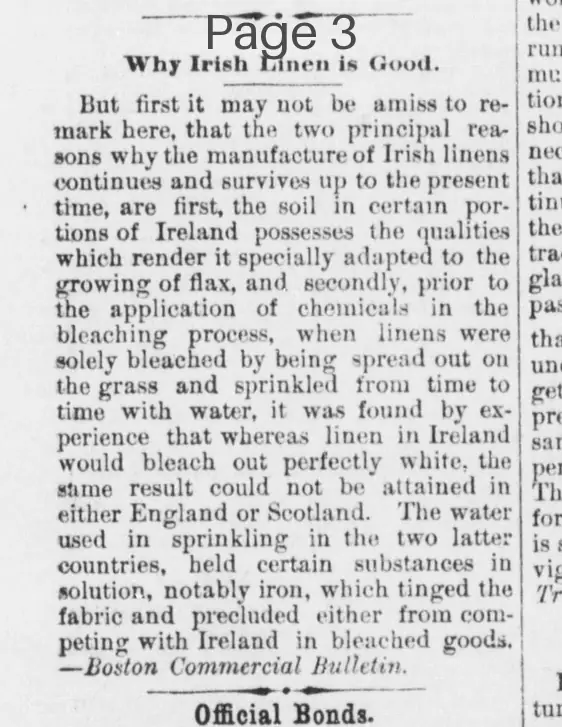
Why Irish Linen is Good.
But first it may not be amiss to remark here, that the two principal reasons why the manufacture of Irish linens continues and survives up to the present time, are first, the soil in certain portions of Ireland possesses the qualities which render it specially adapted to the growing of flax, and secondly, prior to the application of chemicals in the bleaching process, when linens were solely bleached by being spread out on the grass and sprinkled from time to time with water, it was found by experience that whereas linen in Ireland would bleach out perfectly white, the same result could not be attained in either England or Scotland. The water used in sprinkling in the two latter countries, held certain substances in solution, notably iron, which tinged the fabric and precluded either from competing with Ireland in bleached goods.—Boston Commercial Bulletin.
But first it may not be amiss to remark here, that the two principal reasons why the manufacture of Irish linens continues and survives up to the present time, are first, the soil in certain portions of Ireland possesses the qualities which render it specially adapted to the growing of flax, and secondly, prior to the application of chemicals in the bleaching process, when linens were solely bleached by being spread out on the grass and sprinkled from time to time with water, it was found by experience that whereas linen in Ireland would bleach out perfectly white, the same result could not be attained in either England or Scotland. The water used in sprinkling in the two latter countries, held certain substances in solution, notably iron, which tinged the fabric and precluded either from competing with Ireland in bleached goods.—Boston Commercial Bulletin.
What sub-type of article is it?
Curiosity
Historical Event
What themes does it cover?
Nature
Triumph
What keywords are associated?
Irish Linen
Flax Growing
Bleaching Process
Natural Advantages
Where did it happen?
Ireland, England, Scotland
Story Details
Location
Ireland, England, Scotland
Story Details
Irish linen manufacture survives due to soil adapted for flax and natural bleaching on grass with water that yields perfect white results, unlike in England and Scotland where water contains iron that discolors the fabric.