Thank you for visiting SNEWPapers!
Sign up free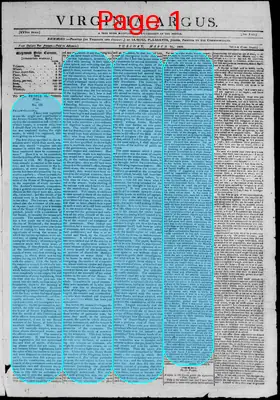
Editorial
March 21, 1809
Virginia Argus
Richmond, Virginia
What is this article about?
John Clarke addresses Virginians defending the state armory's management since 1799, refuting a legislative committee's report as biased, procedurally flawed, and based on unreliable witnesses like discarded workmen, while ignoring authentic executive records and prior legislative approvals.
Clipping
OCR Quality
98%
Excellent
Full Text
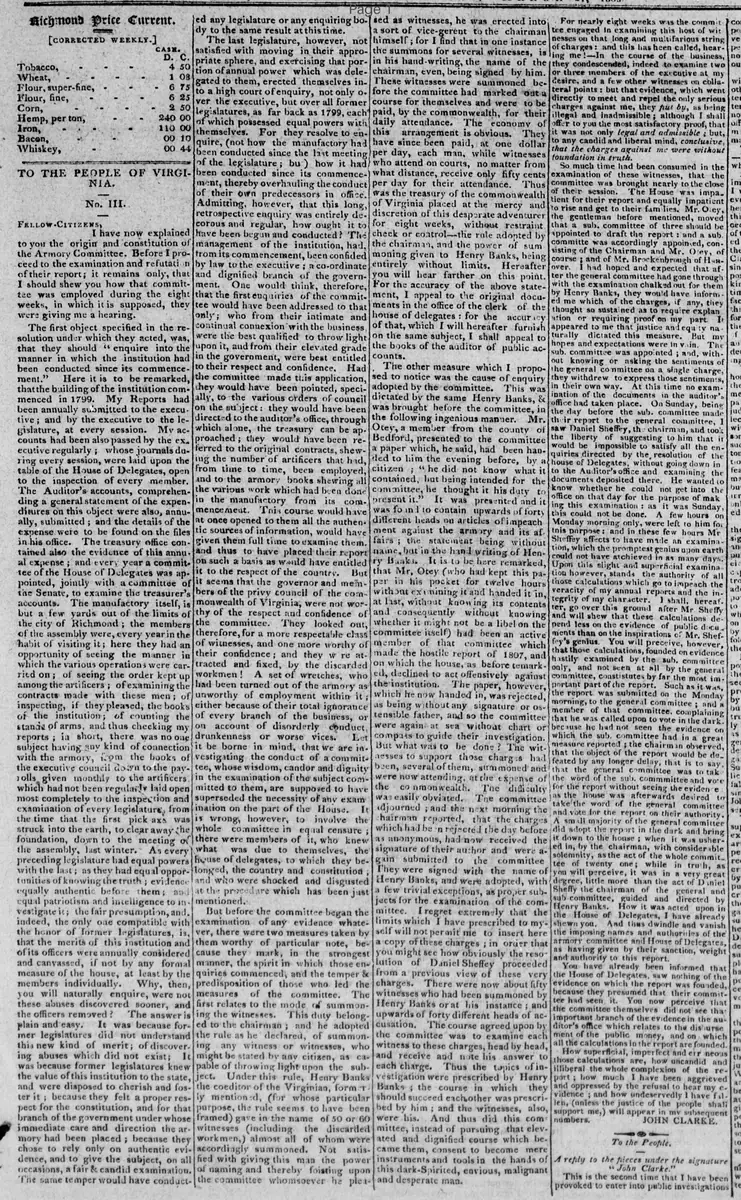
TO THE PEOPLE OF VIRGINIA.
FELLOW-CITIZENS,
I have now explained to you the origin and constitution of the Armory Committee. Before I proceed to the examination and refutation of their report; it remains only, that I should shew you how that committee was employed during the eight weeks, in which it is supposed, they were giving me a hearing.
The first object specified in the resolution under which they acted, was, that they should "enquire into the manner in which the institution had been conducted since its commencement." Here it is to be remarked, that the building of the institution commenced in 1799. My Reports had been annually submitted to the executive; and by the executive to the legislature, at every session. My accounts had been also passed by the executive regularly; whose journals during every session, were laid upon the table of the House of Delegates, open to the inspection of every member.
The Auditor's accounts, comprehending a general statement of the expenditures on this object were also, annually, submitted; and the details of the expense were to be found on the files in his office. The treasury office contained also the evidence of this annual expense; and every year a committee of the House of Delegates was appointed, jointly with a committee of the Senate, to examine the treasurer's accounts. The manufactory itself, is but a few yards out of the limits of the city of Richmond; the members of the assembly were, every year in the habit of visiting it; here they had an opportunity of seeing the manner in which the various operations were carried on; of seeing the order kept up among the artificers; of examining the contracts made with these men; of inspecting, if they pleased, the books of the institution; of counting the stand of arms, and thus checking my reports; in short, there was no one subject having any kind of connection with the armory, from the books of the executive council down to the pay-rolls given monthly to the artificers, which had not been regularly laid open most completely to the inspection and examination of every legislature, from the time that the first pick axe was struck into the earth, to clear away the foundation, down to the meeting of the assembly, last winter. As every preceding legislature had equal powers with the last; as they had equal opportunities of knowing the truth; evidence equally authentic before them; and equal patriotism and intelligence to investigate it; the fair presumption, and indeed, the only one compatible with the honor of former legislatures, is, that the merits of this institution and of its officers were annually considered and canvassed, if not by any formal measure of the house, at least by the members individually. Why, then, you will naturally enquire, were not these abuses discovered sooner, and the officers removed? The answer is plain and easy. It was because former legislatures did not understand this new kind of merit; of discovering abuses which did not exist; It was because former legislatures knew the value of this institution to the state, and were disposed to cherish and foster it; because they felt a proper respect for the constitution, and for that branch of the government under whose immediate care and direction the armory had been placed; because they chose to rely only on authentic evidence, and to give the subject, on all occasions, a fair & candid examination.
The same temper would have conducted any legislature or any enquiring body to the same result at this time. The last legislature, however, not satisfied with moving in their appropriate sphere, and exercising that portion of annual power which was delegated to them, erected themselves into a high court of enquiry, not only over the executive, but over all former legislatures, as far back as 1799, each of which possessed equal powers with themselves. For they resolve to enquire, (not how the manufactory had been conducted since the last meeting of the legislature; but) how it had been conducted since its commencement, thereby overhauling the conduct of their own predecessors in office. Admitting, however, that this long, retrospective enquiry was entirely decorous and regular, how ought it to have been begun and conducted? The management of the institution, had, from its commencement, been confided by law to the executive; a co-ordinate and dignified branch of the government. One would think, therefore, that the first enquiries of the committee would have been addressed to that only; who from their intimate and continual connexion with the business, were the best qualified to throw light upon it, and from their elevated grade in the government, were best entitled to their respect and confidence. Had the committee made this application, they would have been pointed, specifically, to the various orders of council on the subject: they would have been directed to the auditor's office, through which alone, the treasury can be approached; they would have been referred to the original contracts, shewing the number of artificers that had, from time to time, been employed, and to the armory books shewing all the various work which had been done in the manufactory from its commencement. This course would have at once opened to them all the authentic sources of information, would have given them full time to examine them, and thus to have placed their report on such a basis as would have entitled it to the respect of the country. But it seems that the governor and members of the privy council of the commonwealth of Virginia, were not worthy of the respect and confidence of the committee. They looked out, therefore, for a more respectable class of witnesses, and one more worthy of their confidence; and they were attracted and fixed, by the discarded workmen! A set of wretches, who had been turned out of the armory as unworthy of employment within it; either because of their total ignorance of every branch of the business, or on account of disorderly conduct, drunkenness or worse vices. Let it be borne in mind, that we are investigating the conduct of a committee, whose wisdom, candor and dignity in the examination of the subject committed to them, are supposed to have superseded the necessity of any examination on the part of the House. It is wrong, however, to involve the whole committee in equal censure; there were members of it, who knew what was due to themselves, the house of delegates, to which they belonged, the country and constitution; and who were shocked and disgusted at the procedure which has been just mentioned.
But before the committee began the examination of any evidence whatever, there were two measures taken by them worthy of particular note, because they mark, in the strongest manner, the spirit in which those enquiries commenced, and the temper & predisposition of those who led the measures of the committee. The first relates to the mode of summoning the witnesses. This duty belonged to the chairman; and he adopted the rule as he declared, of summoning any witness or witnesses, who might be stated by any citizen, as capable of throwing light upon the subject. Under this rule, Henry Banks the coeditor of the Virginian, formerly mentioned, (for whose particular purpose, the rule seems to have been framed) gave in the name of 50 or 60 witnesses (including the discarded workmen,) almost all of whom were accordingly summoned. Not satisfied with giving this man the power of naming and thereby foisting upon the committee whomsoever he pleased as witnesses, he was erected into a sort of vice-gerent to the chairman himself: for I find that in one instance the summons for several witnesses, is in his hand-writing, the name of the chairman, even, being signed by him. These witnesses were summoned before the committee had marked out a course for themselves and were to be paid, by the commonwealth, for their daily attendance. The economy of this arrangement is obvious. They have since been paid, at one dollar per day, each man, while witnesses who attend on courts, no matter from what distance, receive only fifty cents per day for their attendance. Thus was the treasury of the commonwealth of Virginia placed at the mercy and discretion of this desperate adventurer for eight weeks, without restraint check or control--the rule adopted by the chairman, and the power of summoning given to Henry Banks, being entirely without limits. Hereafter you will hear farther on this point.
For the accuracy of the above statement, I appeal to the original documents in the office of the clerk of the house of delegates: for the accuracy of that, which I will hereafter furnish on the same subject, I shall appeal to the books of the auditor of public accounts.
The other measure which I proposed to notice was the course of enquiry adopted by the committee. This was dictated by the same Henry Banks, & was brought before the committee, in the following ingenious manner. Mr. Otey, a member from the county of Bedford, presented to the committee a paper which, he said, had been handed to him the evening before, by a citizen; "he did not know what it contained, but being intended for the committee, he thought it his duty to present it." It was presented and it was found to contain upwards of forty different heads on articles of impeachment against the armory and its affairs; the statement being without name, but in the hand writing of Henry Banks. It is to be here remarked, that Mr. Otey (who had kept this paper in his pocket for twelve hours without examining it and handed it in, at last, without knowing its contents and consequently without knowing whether it might not be a libel on the committee itself) had been an active member of that committee which made the hostile report of 1807, and on which the house, as before remarked, declined to act offensively against the institution. The paper, however, which he now handed in, was rejected, as being without any signature or ostensible author, and so the committee were again at sea without chart or compass to guide their investigation.
But what was to be done? The witnesses to support those charges had been, several of them, summoned and were now attending, at the expense of the commonwealth. The difficulty was easily obviated. The committee adjourned; and the next morning the chairman reported, that the charges which had been rejected the day before as anonymous, had now received the signature of their author and were again submitted to the committee. They were signed with the name of Henry Banks, and were adopted, with a few trivial exceptions, as proper subjects for the examination of the committee. I regret extremely that the limits which I have prescribed to myself will not permit me to insert here a copy of these charges; in order that you might see how obviously the resolution of Daniel Sheffey proceeded from a previous view of these very charges. There were now about fifty witnesses who had been summoned by Henry Banks or at his instance; and upwards of forty different heads of accusation. The course agreed upon by the committee was to examine each witness to these charges, head by head, and receive and note his answer to each charge. Thus the topics of investigation were prescribed by Henry Banks: the course in which they should succeed each other was prescribed by him; and the witnesses, also, were his. And thus did this committee, instead of pursuing that elevated and dignified course which became them, consent to become mere instruments and tools in the hands of this dark-Spirited, envious, malignant and desperate man.
For nearly eight weeks was the committee engaged in examining this host of witnesses on that long and multifarious string of charges: and this has been called, hearing me!--In the course of the business, they condescended, indeed to examine two or three members of the executive at my desire, and a few other witnesses on collateral points: but that evidence, which went directly to meet and repel the only serious charges against me, they put by, as being illegal and inadmissible; although I shall offer to you the most satisfactory proof, that it was not only legal and admissible; but, to any candid and liberal mind, conclusive, that the charges against me were without foundation in truth.
So much time had been consumed in the examination of these witnesses, that the committee was brought nearly to the close of their session. The House was impatient for their report and equally impatient to rise and get to their families. Mr. Otey, the gentleman before mentioned, moved that a sub-committee of three should be appointed to draft the report: and a sub-committee was accordingly appointed, consisting of the Chairman and Mr. Otey, of course: and of Mr. Brockenborough of Hanover. I had hoped and expected that after the general committee had gone through with the examination chalked out for them by Henry Banks, they would have informed me which of the charges, if any, they thought so sustained as to require explanation or requiring proof on my part. It appeared to me that justice and equity naturally dictated this measure. But my hopes and expectations were in vain. The sub-committee was appointed; and, without knowing or asking the sentiments of the general committee on a single charge, they withdrew to express those sentiments, in their own way. At this time no examination of the documents in the auditor's office had taken place. On Sunday, being the day before the sub-committee made their report to the general committee, I saw Daniel Sheffey, the chairman, and took the liberty of suggesting to him that it would be impossible to satisfy all the enquiries directed by the resolution of the house of Delegates, without going down into the Auditor's office and examining the documents deposited there. He wanted to know whether he could not get into the office on that day for the purpose of making this examination: as it was Sunday, this could not be done. A few hours on Monday morning only, were left to him for this purpose: and in these few hours Mr. Sheffey affects to have made an examination, which the promptest genius upon earth could not have achieved in as many days.
Upon this slight and superficial examination however, stands the authority of all those calculations which go to impeach the veracity of my annual reports and the integrity of my character. I shall, hereafter, go over this ground after Mr. Sheffey and will shew that these calculations depend less on the evidence of public documents than on the inspirations of Mr. Sheffey's genius. You will perceive, however, that those calculations, founded on evidence hastily examined by the sub-committee only, and not seen at all by the general committee, constitutes by far the most important part of the report. Such as it was, the report was submitted on the Monday morning, to the general committee; and a member of that committee, complaining that he was called upon to vote in the dark, because he had not seen the evidence on which the sub-committee had in a great measure reported; the chairman observed, that the object of the report would be defeated by any longer delay, that is to say, that the general committee was to take the word of the sub-committee and vote for the report without seeing the evidence, as the house was afterwards desired to take the word of the general committee and vote for the report on their authority. A small majority of the general committee did adopt the report in the dark and bring it down to the house; when it was ushered in, by the chairman, with considerable solemnity, as the act of the whole committee of twenty one; while in truth, as you will perceive, it was in a very great degree, little more than the act of Daniel Sheffey the chairman of the general and sub committee, guided and directed by Henry Banks. How it was acted upon in the House of Delegates, I have already shewn you. And thus dwindle and vanish those imposing names and authorities of the armory committee and House of Delegates, as having given by their sanction, weight and authority to this report.
You have already been informed that the House of Delegates, saw nothing of the evidence on which the report was founded, because they presumed that their committee had seen it. You now perceive that the committee themselves did not see that important branch of the evidence in the auditor's office which relates to the disbursement of the public money, and on which all the calculations in the report are founded. How superficial, imperfect and erroneous those calculations are, how uncandid and illiberal the whole complexion of the report: how much I have been aggrieved and oppressed by the refusal to hear my evidence; and how undeservedly I have fallen, (unless the justice of the people shall support me,) will appear in my subsequent numbers.
JOHN CLARKE.
FELLOW-CITIZENS,
I have now explained to you the origin and constitution of the Armory Committee. Before I proceed to the examination and refutation of their report; it remains only, that I should shew you how that committee was employed during the eight weeks, in which it is supposed, they were giving me a hearing.
The first object specified in the resolution under which they acted, was, that they should "enquire into the manner in which the institution had been conducted since its commencement." Here it is to be remarked, that the building of the institution commenced in 1799. My Reports had been annually submitted to the executive; and by the executive to the legislature, at every session. My accounts had been also passed by the executive regularly; whose journals during every session, were laid upon the table of the House of Delegates, open to the inspection of every member.
The Auditor's accounts, comprehending a general statement of the expenditures on this object were also, annually, submitted; and the details of the expense were to be found on the files in his office. The treasury office contained also the evidence of this annual expense; and every year a committee of the House of Delegates was appointed, jointly with a committee of the Senate, to examine the treasurer's accounts. The manufactory itself, is but a few yards out of the limits of the city of Richmond; the members of the assembly were, every year in the habit of visiting it; here they had an opportunity of seeing the manner in which the various operations were carried on; of seeing the order kept up among the artificers; of examining the contracts made with these men; of inspecting, if they pleased, the books of the institution; of counting the stand of arms, and thus checking my reports; in short, there was no one subject having any kind of connection with the armory, from the books of the executive council down to the pay-rolls given monthly to the artificers, which had not been regularly laid open most completely to the inspection and examination of every legislature, from the time that the first pick axe was struck into the earth, to clear away the foundation, down to the meeting of the assembly, last winter. As every preceding legislature had equal powers with the last; as they had equal opportunities of knowing the truth; evidence equally authentic before them; and equal patriotism and intelligence to investigate it; the fair presumption, and indeed, the only one compatible with the honor of former legislatures, is, that the merits of this institution and of its officers were annually considered and canvassed, if not by any formal measure of the house, at least by the members individually. Why, then, you will naturally enquire, were not these abuses discovered sooner, and the officers removed? The answer is plain and easy. It was because former legislatures did not understand this new kind of merit; of discovering abuses which did not exist; It was because former legislatures knew the value of this institution to the state, and were disposed to cherish and foster it; because they felt a proper respect for the constitution, and for that branch of the government under whose immediate care and direction the armory had been placed; because they chose to rely only on authentic evidence, and to give the subject, on all occasions, a fair & candid examination.
The same temper would have conducted any legislature or any enquiring body to the same result at this time. The last legislature, however, not satisfied with moving in their appropriate sphere, and exercising that portion of annual power which was delegated to them, erected themselves into a high court of enquiry, not only over the executive, but over all former legislatures, as far back as 1799, each of which possessed equal powers with themselves. For they resolve to enquire, (not how the manufactory had been conducted since the last meeting of the legislature; but) how it had been conducted since its commencement, thereby overhauling the conduct of their own predecessors in office. Admitting, however, that this long, retrospective enquiry was entirely decorous and regular, how ought it to have been begun and conducted? The management of the institution, had, from its commencement, been confided by law to the executive; a co-ordinate and dignified branch of the government. One would think, therefore, that the first enquiries of the committee would have been addressed to that only; who from their intimate and continual connexion with the business, were the best qualified to throw light upon it, and from their elevated grade in the government, were best entitled to their respect and confidence. Had the committee made this application, they would have been pointed, specifically, to the various orders of council on the subject: they would have been directed to the auditor's office, through which alone, the treasury can be approached; they would have been referred to the original contracts, shewing the number of artificers that had, from time to time, been employed, and to the armory books shewing all the various work which had been done in the manufactory from its commencement. This course would have at once opened to them all the authentic sources of information, would have given them full time to examine them, and thus to have placed their report on such a basis as would have entitled it to the respect of the country. But it seems that the governor and members of the privy council of the commonwealth of Virginia, were not worthy of the respect and confidence of the committee. They looked out, therefore, for a more respectable class of witnesses, and one more worthy of their confidence; and they were attracted and fixed, by the discarded workmen! A set of wretches, who had been turned out of the armory as unworthy of employment within it; either because of their total ignorance of every branch of the business, or on account of disorderly conduct, drunkenness or worse vices. Let it be borne in mind, that we are investigating the conduct of a committee, whose wisdom, candor and dignity in the examination of the subject committed to them, are supposed to have superseded the necessity of any examination on the part of the House. It is wrong, however, to involve the whole committee in equal censure; there were members of it, who knew what was due to themselves, the house of delegates, to which they belonged, the country and constitution; and who were shocked and disgusted at the procedure which has been just mentioned.
But before the committee began the examination of any evidence whatever, there were two measures taken by them worthy of particular note, because they mark, in the strongest manner, the spirit in which those enquiries commenced, and the temper & predisposition of those who led the measures of the committee. The first relates to the mode of summoning the witnesses. This duty belonged to the chairman; and he adopted the rule as he declared, of summoning any witness or witnesses, who might be stated by any citizen, as capable of throwing light upon the subject. Under this rule, Henry Banks the coeditor of the Virginian, formerly mentioned, (for whose particular purpose, the rule seems to have been framed) gave in the name of 50 or 60 witnesses (including the discarded workmen,) almost all of whom were accordingly summoned. Not satisfied with giving this man the power of naming and thereby foisting upon the committee whomsoever he pleased as witnesses, he was erected into a sort of vice-gerent to the chairman himself: for I find that in one instance the summons for several witnesses, is in his hand-writing, the name of the chairman, even, being signed by him. These witnesses were summoned before the committee had marked out a course for themselves and were to be paid, by the commonwealth, for their daily attendance. The economy of this arrangement is obvious. They have since been paid, at one dollar per day, each man, while witnesses who attend on courts, no matter from what distance, receive only fifty cents per day for their attendance. Thus was the treasury of the commonwealth of Virginia placed at the mercy and discretion of this desperate adventurer for eight weeks, without restraint check or control--the rule adopted by the chairman, and the power of summoning given to Henry Banks, being entirely without limits. Hereafter you will hear farther on this point.
For the accuracy of the above statement, I appeal to the original documents in the office of the clerk of the house of delegates: for the accuracy of that, which I will hereafter furnish on the same subject, I shall appeal to the books of the auditor of public accounts.
The other measure which I proposed to notice was the course of enquiry adopted by the committee. This was dictated by the same Henry Banks, & was brought before the committee, in the following ingenious manner. Mr. Otey, a member from the county of Bedford, presented to the committee a paper which, he said, had been handed to him the evening before, by a citizen; "he did not know what it contained, but being intended for the committee, he thought it his duty to present it." It was presented and it was found to contain upwards of forty different heads on articles of impeachment against the armory and its affairs; the statement being without name, but in the hand writing of Henry Banks. It is to be here remarked, that Mr. Otey (who had kept this paper in his pocket for twelve hours without examining it and handed it in, at last, without knowing its contents and consequently without knowing whether it might not be a libel on the committee itself) had been an active member of that committee which made the hostile report of 1807, and on which the house, as before remarked, declined to act offensively against the institution. The paper, however, which he now handed in, was rejected, as being without any signature or ostensible author, and so the committee were again at sea without chart or compass to guide their investigation.
But what was to be done? The witnesses to support those charges had been, several of them, summoned and were now attending, at the expense of the commonwealth. The difficulty was easily obviated. The committee adjourned; and the next morning the chairman reported, that the charges which had been rejected the day before as anonymous, had now received the signature of their author and were again submitted to the committee. They were signed with the name of Henry Banks, and were adopted, with a few trivial exceptions, as proper subjects for the examination of the committee. I regret extremely that the limits which I have prescribed to myself will not permit me to insert here a copy of these charges; in order that you might see how obviously the resolution of Daniel Sheffey proceeded from a previous view of these very charges. There were now about fifty witnesses who had been summoned by Henry Banks or at his instance; and upwards of forty different heads of accusation. The course agreed upon by the committee was to examine each witness to these charges, head by head, and receive and note his answer to each charge. Thus the topics of investigation were prescribed by Henry Banks: the course in which they should succeed each other was prescribed by him; and the witnesses, also, were his. And thus did this committee, instead of pursuing that elevated and dignified course which became them, consent to become mere instruments and tools in the hands of this dark-Spirited, envious, malignant and desperate man.
For nearly eight weeks was the committee engaged in examining this host of witnesses on that long and multifarious string of charges: and this has been called, hearing me!--In the course of the business, they condescended, indeed to examine two or three members of the executive at my desire, and a few other witnesses on collateral points: but that evidence, which went directly to meet and repel the only serious charges against me, they put by, as being illegal and inadmissible; although I shall offer to you the most satisfactory proof, that it was not only legal and admissible; but, to any candid and liberal mind, conclusive, that the charges against me were without foundation in truth.
So much time had been consumed in the examination of these witnesses, that the committee was brought nearly to the close of their session. The House was impatient for their report and equally impatient to rise and get to their families. Mr. Otey, the gentleman before mentioned, moved that a sub-committee of three should be appointed to draft the report: and a sub-committee was accordingly appointed, consisting of the Chairman and Mr. Otey, of course: and of Mr. Brockenborough of Hanover. I had hoped and expected that after the general committee had gone through with the examination chalked out for them by Henry Banks, they would have informed me which of the charges, if any, they thought so sustained as to require explanation or requiring proof on my part. It appeared to me that justice and equity naturally dictated this measure. But my hopes and expectations were in vain. The sub-committee was appointed; and, without knowing or asking the sentiments of the general committee on a single charge, they withdrew to express those sentiments, in their own way. At this time no examination of the documents in the auditor's office had taken place. On Sunday, being the day before the sub-committee made their report to the general committee, I saw Daniel Sheffey, the chairman, and took the liberty of suggesting to him that it would be impossible to satisfy all the enquiries directed by the resolution of the house of Delegates, without going down into the Auditor's office and examining the documents deposited there. He wanted to know whether he could not get into the office on that day for the purpose of making this examination: as it was Sunday, this could not be done. A few hours on Monday morning only, were left to him for this purpose: and in these few hours Mr. Sheffey affects to have made an examination, which the promptest genius upon earth could not have achieved in as many days.
Upon this slight and superficial examination however, stands the authority of all those calculations which go to impeach the veracity of my annual reports and the integrity of my character. I shall, hereafter, go over this ground after Mr. Sheffey and will shew that these calculations depend less on the evidence of public documents than on the inspirations of Mr. Sheffey's genius. You will perceive, however, that those calculations, founded on evidence hastily examined by the sub-committee only, and not seen at all by the general committee, constitutes by far the most important part of the report. Such as it was, the report was submitted on the Monday morning, to the general committee; and a member of that committee, complaining that he was called upon to vote in the dark, because he had not seen the evidence on which the sub-committee had in a great measure reported; the chairman observed, that the object of the report would be defeated by any longer delay, that is to say, that the general committee was to take the word of the sub-committee and vote for the report without seeing the evidence, as the house was afterwards desired to take the word of the general committee and vote for the report on their authority. A small majority of the general committee did adopt the report in the dark and bring it down to the house; when it was ushered in, by the chairman, with considerable solemnity, as the act of the whole committee of twenty one; while in truth, as you will perceive, it was in a very great degree, little more than the act of Daniel Sheffey the chairman of the general and sub committee, guided and directed by Henry Banks. How it was acted upon in the House of Delegates, I have already shewn you. And thus dwindle and vanish those imposing names and authorities of the armory committee and House of Delegates, as having given by their sanction, weight and authority to this report.
You have already been informed that the House of Delegates, saw nothing of the evidence on which the report was founded, because they presumed that their committee had seen it. You now perceive that the committee themselves did not see that important branch of the evidence in the auditor's office which relates to the disbursement of the public money, and on which all the calculations in the report are founded. How superficial, imperfect and erroneous those calculations are, how uncandid and illiberal the whole complexion of the report: how much I have been aggrieved and oppressed by the refusal to hear my evidence; and how undeservedly I have fallen, (unless the justice of the people shall support me,) will appear in my subsequent numbers.
JOHN CLARKE.
What sub-type of article is it?
Partisan Politics
Constitutional
Military Affairs
What keywords are associated?
Virginia Armory
Legislative Committee
Henry Banks
Daniel Sheffey
Executive Oversight
Political Bias
Witness Summoning
Report Refutation
What entities or persons were involved?
John Clarke
Armory Committee
Daniel Sheffey
Henry Banks
Mr. Otey
House Of Delegates
Executive Council
Governor And Privy Council
Discarded Workmen
Editorial Details
Primary Topic
Defense Of Virginia Armory Management Against Legislative Committee's Report
Stance / Tone
Strongly Defensive And Accusatory
Key Figures
John Clarke
Armory Committee
Daniel Sheffey
Henry Banks
Mr. Otey
House Of Delegates
Executive Council
Governor And Privy Council
Discarded Workmen
Key Arguments
Previous Legislatures Had Full Access To Armory Records And Found No Abuses
Committee Ignored Executive Branch And Relied On Unreliable Discarded Workmen As Witnesses
Henry Banks Dictated Witnesses, Charges, And Investigation Course
Subcommittee Conducted Superficial Examination Of Auditor's Documents
Report Based On Hasty, Incomplete Evidence Without Full Committee Review
Procedural Irregularities Undermined Committee's Authority And Fairness