Thank you for visiting SNEWPapers!
Sign up free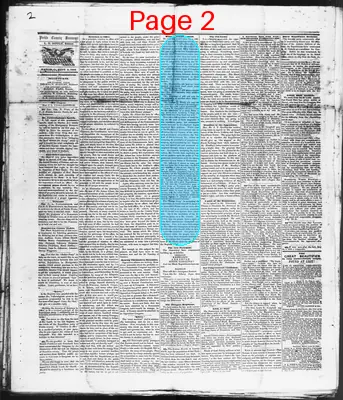
Story
September 9, 1858
Preble County Democrat
Eaton, Preble County, Ohio
What is this article about?
Political commentary mocking Republican Party's shifting stances on slavery expansion, from anti-slave state vows to supporting Crittenden bill and popular sovereignty, with quotes from leaders like Farnsworth and contradictions between Corwin and Butler Pony.
Clipping
OCR Quality
95%
Excellent
Full Text
What is Republicanism?
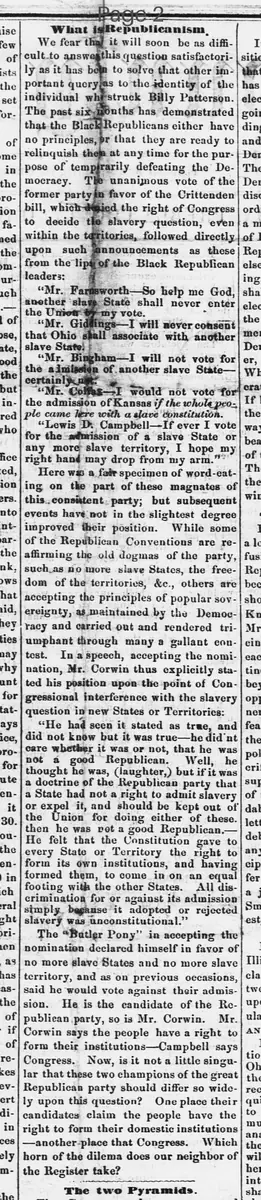
We fear that it will soon be as difficult to answer this question satisfactorily as it has been to solve that other important query as to the identity of the individual who struck Billy Patterson. The past six months has demonstrated that the Black Republicans either have no principles, or that they are ready to relinquish them at any time for the purpose of temporarily defeating the Democracy. The unanimous vote of the former party in favor of the Crittenden bill, which denied the right of Congress to decide the slavery question, even within the territories, followed directly upon such announcements as these from the lip of the Black Republican leaders:
"Mr. Farnsworth. So help me God, another slave State shall never enter the Union by my vote."
"Mr. Giddings—I will never consent that Ohio shall associate with another slave State."
"Mr. Bingham—I will not vote for the admission of another slave State—certainly not."
"Mr. Colfax—I would not vote for the admission of Kansas if the whole people came here with a slave Constitution."
"Lewis D. Campbell—If ever I vote for the admission of a slave State or any more slave territory, I hope my right hand may drop from my arm."
Here was a fair specimen of word-eating on the part of these magnates of this consistent party; but subsequent events have not in the slightest degree improved their position. While some of the Republican Conventions are re-affirming the old dogmas of the party, such as no more slave States, the freedom of the territories, &c., others are accepting the principles of popular sovereignty, as maintained by the Democracy and carried out and rendered triumphant through many a gallant contest. In a speech, accepting the nomination, Mr. Corwin thus explicitly stated his position upon the point of Congressional interference with the slavery question in new States or Territories:
"He had seen it stated as true, and did not know but it was true—he didn't care whether it was or not, that he was not a good Republican. Well, he thought he was, (laughter,) but if it was a doctrine of the Republican party that a State had not a right to admit slavery or expel it, and should be kept out of the Union for doing either of these, then he was not a good Republican.—He felt that the Constitution gave to every State or Territory the right to form its own institutions, and having formed them, to come in on an equal footing with the other States. All discrimination for or against its admission simply because it adopted or rejected slavery was unconstitutional."
The "Butler Pony" in accepting the nomination declared himself in favor of no more slave States and no more slave territory, and as on previous occasions, said he would vote against their admission. He is the candidate of the Republican party, so is Mr. Corwin. Mr. Corwin says the people have a right to form their institutions—Campbell says Congress. Now, is it not a little singular that these two champions of the great Republican party should differ so widely upon this question? One place their candidates claim the people have the right to form their domestic institutions—another place that Congress. Which horn of the dilemma does our neighbor of the Register take?
We fear that it will soon be as difficult to answer this question satisfactorily as it has been to solve that other important query as to the identity of the individual who struck Billy Patterson. The past six months has demonstrated that the Black Republicans either have no principles, or that they are ready to relinquish them at any time for the purpose of temporarily defeating the Democracy. The unanimous vote of the former party in favor of the Crittenden bill, which denied the right of Congress to decide the slavery question, even within the territories, followed directly upon such announcements as these from the lip of the Black Republican leaders:
"Mr. Farnsworth. So help me God, another slave State shall never enter the Union by my vote."
"Mr. Giddings—I will never consent that Ohio shall associate with another slave State."
"Mr. Bingham—I will not vote for the admission of another slave State—certainly not."
"Mr. Colfax—I would not vote for the admission of Kansas if the whole people came here with a slave Constitution."
"Lewis D. Campbell—If ever I vote for the admission of a slave State or any more slave territory, I hope my right hand may drop from my arm."
Here was a fair specimen of word-eating on the part of these magnates of this consistent party; but subsequent events have not in the slightest degree improved their position. While some of the Republican Conventions are re-affirming the old dogmas of the party, such as no more slave States, the freedom of the territories, &c., others are accepting the principles of popular sovereignty, as maintained by the Democracy and carried out and rendered triumphant through many a gallant contest. In a speech, accepting the nomination, Mr. Corwin thus explicitly stated his position upon the point of Congressional interference with the slavery question in new States or Territories:
"He had seen it stated as true, and did not know but it was true—he didn't care whether it was or not, that he was not a good Republican. Well, he thought he was, (laughter,) but if it was a doctrine of the Republican party that a State had not a right to admit slavery or expel it, and should be kept out of the Union for doing either of these, then he was not a good Republican.—He felt that the Constitution gave to every State or Territory the right to form its own institutions, and having formed them, to come in on an equal footing with the other States. All discrimination for or against its admission simply because it adopted or rejected slavery was unconstitutional."
The "Butler Pony" in accepting the nomination declared himself in favor of no more slave States and no more slave territory, and as on previous occasions, said he would vote against their admission. He is the candidate of the Republican party, so is Mr. Corwin. Mr. Corwin says the people have a right to form their institutions—Campbell says Congress. Now, is it not a little singular that these two champions of the great Republican party should differ so widely upon this question? One place their candidates claim the people have the right to form their domestic institutions—another place that Congress. Which horn of the dilemma does our neighbor of the Register take?
What sub-type of article is it?
Historical Event
What themes does it cover?
Deception
What keywords are associated?
Republican Inconsistency
Slavery Debate
Crittenden Bill
Slave States
Popular Sovereignty
What entities or persons were involved?
Mr. Farnsworth
Mr. Giddings
Mr. Bingham
Mr. Colfax
Lewis D. Campbell
Mr. Corwin
Butler Pony
Story Details
Key Persons
Mr. Farnsworth
Mr. Giddings
Mr. Bingham
Mr. Colfax
Lewis D. Campbell
Mr. Corwin
Butler Pony
Event Date
The Past Six Months
Story Details
The article criticizes the Republican Party's inconsistency on slavery, citing their vote for the Crittenden bill despite leaders' prior vows against new slave states, and highlights contradictions between candidates Corwin and Butler Pony on states' rights versus congressional control.