Thank you for visiting SNEWPapers!
Sign up free
Story
January 8, 1855
Daily American Organ
Washington, District Of Columbia
What is this article about?
Article details a low-attendance Democratic ratification meeting in Culpeper, VA, on the 18th ultimo for Henry A. Wise's nomination, featuring speeches by J.W. Bell and Mr. Barbour, opposition resolutions, and editorial defense against Know-Nothing central control accusations.
Clipping
OCR Quality
98%
Excellent
Full Text
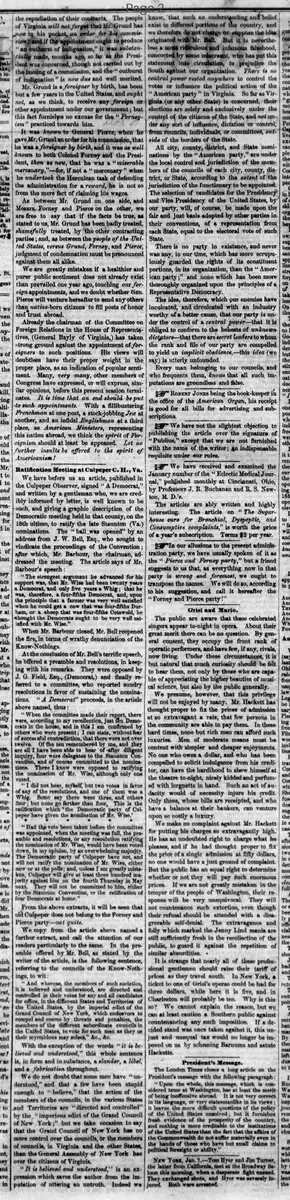
Ratification Meeting at Culpeper C. H., Va.
We have before us an article, published in the Culpeper Observer, signed "A Democrat," and written by a gentleman who, we are credibly informed by letter, is well known to be such, and giving a graphic description of the Democratic meeting held in that county, on the 18th ultimo, to ratify the late Staunton (Va.) nominations. The "ball was opened" by an address from J. W. Bell, Esq., who sought to vindicate the proceedings of the Convention: after which, Mr. Barbour, the chairman, addressed the meeting. The article says of Mr. Barbour's speech:
"The strongest argument he advanced for his support was, that Mr. Wise had been twenty years a Democrat, and only five years a Whig; that he was, therefore, a four-fifths Democrat, and, upon the principle that a farmer was very well satisfied when he could get a cow that was four-fifths Durham, or a sheep that was four-fifths Cotswold, he thought the Democrats ought to be very well satisfied with Mr. Wise."
When Mr. Barbour closed, Mr. Bell reopened the fire, in terms of wrathful denunciation of the Know-Nothings.
At the conclusion of Mr. Bell's terrific speech, he offered a preamble and resolutions, in keeping with his remarks. They were opposed by J. G. Field, Esq., (Democrat,) and finally referred to a committee, who reported sundry resolutions in favor of sustaining the nominations. "A Democrat" proceeds, in the article above named, thus:
"When the committee made their report, there were, according to my recollection, just ten Democrats in the house, and in this I am confirmed by others who were present; I can state, without fear of successful contradiction, that there were not over twelve. Of the ten remembered by me, and they are all I have been able to hear of—after diligent inquiry, four were delegates to the Staunton Convention, and of course committed to the nominations. Three I know were opposed to ratifying the nomination of Mr. Wise, although only one voted.
"I did not hear, myself, but two votes in favor of any of the resolutions, and one of them was a Whig. Some say there were three, and others four; but none go farther than four. This is the ratification which the Democratic party of Culpeper have given the nomination of Mr. Wise."
"Had the vote been taken before the committee was appointed, when the meeting was full, the preamble and resolutions, or any resolution ratifying the nomination of Mr. Wise, would have been voted down, in my opinion, by an overwhelming majority. The Democratic party of Culpeper have not, and will not ratify the nomination of Mr. Wise, either now or at the polls; and, unless I am greatly mistaken, Culpeper will give at least three hundred majority against him on the fourth Thursday in May next. They will not be committed to him, either by the Staunton Convention, or the ratification of four Democrats at home.'"
From the above extracts, it will be seen that old Culpeper does not belong to the Forney and Pierce party—not quite.
We copy from the article above named a further extract, and call the attention of our readers particularly to the same. In the preamble offered by Mr. Bell, as stated by the writer of the article, is the following sentence, referring to the councils of the Know-Nothings, to wit:
"And whereas, the members of such societies it is believed and understood, are directed and controlled in their votes for any and all candidates for office, in the different States and Territories of the United States, by the imperial edict of the Grand Council of New York, which endeavors to compel and coerce by threats and penalties, the members of the different subordinate councils in the United States, to vote for such men as they or their myrmidons may select," &c., &c.
With the exception of the words "it is believed and understood," this whole sentence is, in form and in substance, a slander, a libel, and a fabrication throughout.
We do not doubt that some men have "understood" and that a few have been stupid enough to "believe," that the action of the members of the councils, in the various States and Territories are "directed and controlled" by the "imperious edict of the Grand Council of New York:" but we take occasion to say that the Grand Council of New York has no more control over the councils, or the members of councils, in Virginia and the other States, than the General Assembly of New York has over the citizens of Virginia.
"It is believed and understood," is an expression which saves the author from the imputation of uttering an untruth. Indeed we know, that such an understanding and belief exist in different portions of the country, and we therefore do not charge or suppose the idea originated with Mr. Bell. But it is nevertheless a most ridiculous and infamous falsehood, concocted by some miscreant, who has put this statement into circulation, to prejudice the South against our organization. There is no central power vested anywhere to control the votes or influence the political action of the "American party" in Virginia. So far as Virginia (or any other State) is concerned, their elections are solely and exclusively under the control of the citizens of the State, and not under any sort of influence, dictation or control, from councils, individuals, or committees, outside of the borders of the State.
All city, county, district, and State nominations by the "American party," are under the local control and jurisdiction of the members of the councils of each city, county, district, or State, according to the extent of the jurisdiction of the functionary to be appointed. The selection of candidates for the Presidency and Vice Presidency of the United States, by our party, will, of course, be made upon the fair and just basis adopted by other parties in their conventions, of a representation from each State, equal to the electoral vote of such State.
There is no party in existence, and never was any, in our time, which has more scrupulously guarded the rights of its constituent portions, in its organization, than the "American party;" and none which has been more thoroughly organized upon the principles of a Representative Democracy.
The idea, therefore, which our enemies have inculcated, and circulated with an industry worthy of a better cause, that our party is under the control of a central power—that it is obliged to conform to the behests of unknown dictators—that there are secret leaders to whom the rank and file of our party are compelled to yield an implicit obedience,—this idea (we say) is utterly unfounded.
Every man belonging to our councils, and who frequents them, knows that all such imputations are groundless and false.
We have before us an article, published in the Culpeper Observer, signed "A Democrat," and written by a gentleman who, we are credibly informed by letter, is well known to be such, and giving a graphic description of the Democratic meeting held in that county, on the 18th ultimo, to ratify the late Staunton (Va.) nominations. The "ball was opened" by an address from J. W. Bell, Esq., who sought to vindicate the proceedings of the Convention: after which, Mr. Barbour, the chairman, addressed the meeting. The article says of Mr. Barbour's speech:
"The strongest argument he advanced for his support was, that Mr. Wise had been twenty years a Democrat, and only five years a Whig; that he was, therefore, a four-fifths Democrat, and, upon the principle that a farmer was very well satisfied when he could get a cow that was four-fifths Durham, or a sheep that was four-fifths Cotswold, he thought the Democrats ought to be very well satisfied with Mr. Wise."
When Mr. Barbour closed, Mr. Bell reopened the fire, in terms of wrathful denunciation of the Know-Nothings.
At the conclusion of Mr. Bell's terrific speech, he offered a preamble and resolutions, in keeping with his remarks. They were opposed by J. G. Field, Esq., (Democrat,) and finally referred to a committee, who reported sundry resolutions in favor of sustaining the nominations. "A Democrat" proceeds, in the article above named, thus:
"When the committee made their report, there were, according to my recollection, just ten Democrats in the house, and in this I am confirmed by others who were present; I can state, without fear of successful contradiction, that there were not over twelve. Of the ten remembered by me, and they are all I have been able to hear of—after diligent inquiry, four were delegates to the Staunton Convention, and of course committed to the nominations. Three I know were opposed to ratifying the nomination of Mr. Wise, although only one voted.
"I did not hear, myself, but two votes in favor of any of the resolutions, and one of them was a Whig. Some say there were three, and others four; but none go farther than four. This is the ratification which the Democratic party of Culpeper have given the nomination of Mr. Wise."
"Had the vote been taken before the committee was appointed, when the meeting was full, the preamble and resolutions, or any resolution ratifying the nomination of Mr. Wise, would have been voted down, in my opinion, by an overwhelming majority. The Democratic party of Culpeper have not, and will not ratify the nomination of Mr. Wise, either now or at the polls; and, unless I am greatly mistaken, Culpeper will give at least three hundred majority against him on the fourth Thursday in May next. They will not be committed to him, either by the Staunton Convention, or the ratification of four Democrats at home.'"
From the above extracts, it will be seen that old Culpeper does not belong to the Forney and Pierce party—not quite.
We copy from the article above named a further extract, and call the attention of our readers particularly to the same. In the preamble offered by Mr. Bell, as stated by the writer of the article, is the following sentence, referring to the councils of the Know-Nothings, to wit:
"And whereas, the members of such societies it is believed and understood, are directed and controlled in their votes for any and all candidates for office, in the different States and Territories of the United States, by the imperial edict of the Grand Council of New York, which endeavors to compel and coerce by threats and penalties, the members of the different subordinate councils in the United States, to vote for such men as they or their myrmidons may select," &c., &c.
With the exception of the words "it is believed and understood," this whole sentence is, in form and in substance, a slander, a libel, and a fabrication throughout.
We do not doubt that some men have "understood" and that a few have been stupid enough to "believe," that the action of the members of the councils, in the various States and Territories are "directed and controlled" by the "imperious edict of the Grand Council of New York:" but we take occasion to say that the Grand Council of New York has no more control over the councils, or the members of councils, in Virginia and the other States, than the General Assembly of New York has over the citizens of Virginia.
"It is believed and understood," is an expression which saves the author from the imputation of uttering an untruth. Indeed we know, that such an understanding and belief exist in different portions of the country, and we therefore do not charge or suppose the idea originated with Mr. Bell. But it is nevertheless a most ridiculous and infamous falsehood, concocted by some miscreant, who has put this statement into circulation, to prejudice the South against our organization. There is no central power vested anywhere to control the votes or influence the political action of the "American party" in Virginia. So far as Virginia (or any other State) is concerned, their elections are solely and exclusively under the control of the citizens of the State, and not under any sort of influence, dictation or control, from councils, individuals, or committees, outside of the borders of the State.
All city, county, district, and State nominations by the "American party," are under the local control and jurisdiction of the members of the councils of each city, county, district, or State, according to the extent of the jurisdiction of the functionary to be appointed. The selection of candidates for the Presidency and Vice Presidency of the United States, by our party, will, of course, be made upon the fair and just basis adopted by other parties in their conventions, of a representation from each State, equal to the electoral vote of such State.
There is no party in existence, and never was any, in our time, which has more scrupulously guarded the rights of its constituent portions, in its organization, than the "American party;" and none which has been more thoroughly organized upon the principles of a Representative Democracy.
The idea, therefore, which our enemies have inculcated, and circulated with an industry worthy of a better cause, that our party is under the control of a central power—that it is obliged to conform to the behests of unknown dictators—that there are secret leaders to whom the rank and file of our party are compelled to yield an implicit obedience,—this idea (we say) is utterly unfounded.
Every man belonging to our councils, and who frequents them, knows that all such imputations are groundless and false.
What sub-type of article is it?
Historical Event
What themes does it cover?
Deception
Justice
What keywords are associated?
Democratic Ratification
Culpeper Meeting
Wise Nomination
Know Nothings
American Party
Political Slander
What entities or persons were involved?
J. W. Bell
Mr. Barbour
J. G. Field
Mr. Wise
A Democrat
Where did it happen?
Culpeper C. H., Va.
Story Details
Key Persons
J. W. Bell
Mr. Barbour
J. G. Field
Mr. Wise
A Democrat
Location
Culpeper C. H., Va.
Event Date
18th Ultimo
Story Details
Democratic meeting in Culpeper to ratify Staunton nominations, including Wise's, features speeches defending Wise and denouncing Know-Nothings; low attendance leads to minimal support; editorial refutes claims of Know-Nothing central control as slander.