Thank you for visiting SNEWPapers!
Sign up free
Editorial
November 17, 1796
Gazette Of The United States, & Philadelphia Daily Advertiser
Philadelphia, Philadelphia County, Pennsylvania
What is this article about?
A Federalist critiques John Adams' letters for doubting the viability of elective governments while endorsing hereditary elements from ancient theorists like Polybius and Plato. Defends the success of the U.S. representative system amid challenges and urges perseverance.
Clipping
OCR Quality
98%
Excellent
Full Text
For the Gazette of the United States.
No. V.
To the Electors of the President of the United States.
Respectable Fellow Citizens,
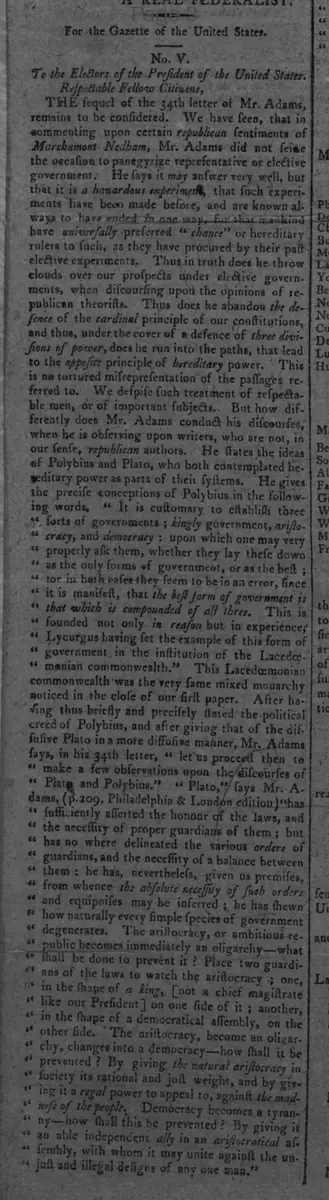
THE sequel of the 34th letter of Mr. Adams, remains to be considered. We have seen, that in commenting upon certain republican sentiments of Marchamont Nedham, Mr. Adams did not seize the occasion to panegyrize representative or elective government. He says it may answer very well, but that it is a hazardous experiment, that such experiments have been made before, and are known always to have ended in one way, for that mankind have universally preferred "chance" or hereditary rulers to such, as they have procured by their past elective experiments. Thus in truth does he throw clouds over our prospects under elective governments, when discoursing upon the opinions of republican theorists. Thus does he abandon the defence of the cardinal principle of our constitutions, and thus, under the cover of a defence of three divisions of power, does he run into the paths, that lead to the opposite principle of hereditary power. This is no tortured misrepresentation of the passages referred to. We despise such treatment of respectable men, or of important subjects. But how differently does Mr. Adams conduct his discourses, when he is observing upon writers, who are not, in our sense, republican authors. He states the ideas of Polybius and Plato, who both contemplated hereditary power as parts of their systems. He gives the precise conceptions of Polybius in the following words. "It is customary to establish three sorts of governments; kingly government, aristocracy, and democracy: upon which one may very properly ask them, whether they lay these down as the only forms of government, or as the best; for in both cases they seem to be in an error, since as it is manifest, that the best form of government is that which is compounded of all three. This is founded not only in reason but in experience; Lycurgus having set the example of this form of government, in the institution of the Lacedemonian commonwealth." This Lacedemonian commonwealth was the very same mixed monarchy noticed in the close of our first paper. After having thus briefly and precisely stated the political creed of Polybius, and after giving that of the diffusive Plato in a more diffuse manner, Mr. Adams says, in his 24th letter, "let us proceed then to make a few observations upon the discourses of Plato and Polybius." "Plato," says Mr. Adams, (p. 209, Philadelphia & London edition) "has sufficiently asserted the honour of the laws, and the necessity of proper guardians of them; but has no where delineated the various orders of guardians, and the necessity of a balance between them: he has, nevertheless, given us premises from whence the absolute necessity of such orders and equipoises may be inferred; he has shewn how naturally every simple species of government degenerates. The aristocracy, or ambitious republic becomes immediately an oligarchy—what shall be done to prevent it? Place two guardians of the laws to watch the aristocracy; one, in the shape of a king, not a chief magistrate like our President) on one side of it; another, in the shape of a democratical assembly, on the other side. The aristocracy, become an oligarchy, changes into a democracy—how shall it be prevented? By giving the natural aristocracy in society its rational and just weight, and by giving it a regal power to appeal to, against the madness of the people. Democracy becomes a tyranny—how shall this be prevented? By giving it an able independent ally in an aristocratical assembly, with whom it may unite against the unjust and illegal designs of any one man."
Here we see, that Mr. Adams having got a royal theme to discourse upon, does not run into doubt about hereditary governments, as he had before done in regard to elective governments. The royal governments must then appear to him free from all cause of doubt. He does not throw out the smallest caution against them. But he takes pains to shew that the regal and aristocratical powers are proper and necessary checks upon the madness of the people. Let us ask ourselves however where and when such a government has been exhibited. Where and when were a king and nobles each having a negative combined, with a real representation of the people? No where but in books. How then can it be thus decidedly affirmed from unexecuted theories, that the three would work so well together as our excellent government has done. For a new government, organized in a storm, in a country half wilderness, placed over a various people, in a time of unexampled and extreme difficulties, amidst a belligerent and infuriated world, having to struggle with the arrearages of many years, embarrassed by disputes with two neighbouring powers, and by Indian wars, to carry us through with safety and prosperity is more than any mixed monarchy ever accomplished. Let it be here remembered, that it is the first genuine representative government the world had seen in 1789. Human affairs do not appear to admit of more success and advantages under any form of government. This ought to operate as the most encouraging inducement to persevere on our present ground. We ought not to discourage or alarm the people by committing the most dangerous and tempting situation to any, who doubt or disbelieve the practicability of our system, and who may incline to realize the favorite theory of their maturer years in themselves and their descendants.
A FEDERALIST.
No. V.
To the Electors of the President of the United States.
Respectable Fellow Citizens,
THE sequel of the 34th letter of Mr. Adams, remains to be considered. We have seen, that in commenting upon certain republican sentiments of Marchamont Nedham, Mr. Adams did not seize the occasion to panegyrize representative or elective government. He says it may answer very well, but that it is a hazardous experiment, that such experiments have been made before, and are known always to have ended in one way, for that mankind have universally preferred "chance" or hereditary rulers to such, as they have procured by their past elective experiments. Thus in truth does he throw clouds over our prospects under elective governments, when discoursing upon the opinions of republican theorists. Thus does he abandon the defence of the cardinal principle of our constitutions, and thus, under the cover of a defence of three divisions of power, does he run into the paths, that lead to the opposite principle of hereditary power. This is no tortured misrepresentation of the passages referred to. We despise such treatment of respectable men, or of important subjects. But how differently does Mr. Adams conduct his discourses, when he is observing upon writers, who are not, in our sense, republican authors. He states the ideas of Polybius and Plato, who both contemplated hereditary power as parts of their systems. He gives the precise conceptions of Polybius in the following words. "It is customary to establish three sorts of governments; kingly government, aristocracy, and democracy: upon which one may very properly ask them, whether they lay these down as the only forms of government, or as the best; for in both cases they seem to be in an error, since as it is manifest, that the best form of government is that which is compounded of all three. This is founded not only in reason but in experience; Lycurgus having set the example of this form of government, in the institution of the Lacedemonian commonwealth." This Lacedemonian commonwealth was the very same mixed monarchy noticed in the close of our first paper. After having thus briefly and precisely stated the political creed of Polybius, and after giving that of the diffusive Plato in a more diffuse manner, Mr. Adams says, in his 24th letter, "let us proceed then to make a few observations upon the discourses of Plato and Polybius." "Plato," says Mr. Adams, (p. 209, Philadelphia & London edition) "has sufficiently asserted the honour of the laws, and the necessity of proper guardians of them; but has no where delineated the various orders of guardians, and the necessity of a balance between them: he has, nevertheless, given us premises from whence the absolute necessity of such orders and equipoises may be inferred; he has shewn how naturally every simple species of government degenerates. The aristocracy, or ambitious republic becomes immediately an oligarchy—what shall be done to prevent it? Place two guardians of the laws to watch the aristocracy; one, in the shape of a king, not a chief magistrate like our President) on one side of it; another, in the shape of a democratical assembly, on the other side. The aristocracy, become an oligarchy, changes into a democracy—how shall it be prevented? By giving the natural aristocracy in society its rational and just weight, and by giving it a regal power to appeal to, against the madness of the people. Democracy becomes a tyranny—how shall this be prevented? By giving it an able independent ally in an aristocratical assembly, with whom it may unite against the unjust and illegal designs of any one man."
Here we see, that Mr. Adams having got a royal theme to discourse upon, does not run into doubt about hereditary governments, as he had before done in regard to elective governments. The royal governments must then appear to him free from all cause of doubt. He does not throw out the smallest caution against them. But he takes pains to shew that the regal and aristocratical powers are proper and necessary checks upon the madness of the people. Let us ask ourselves however where and when such a government has been exhibited. Where and when were a king and nobles each having a negative combined, with a real representation of the people? No where but in books. How then can it be thus decidedly affirmed from unexecuted theories, that the three would work so well together as our excellent government has done. For a new government, organized in a storm, in a country half wilderness, placed over a various people, in a time of unexampled and extreme difficulties, amidst a belligerent and infuriated world, having to struggle with the arrearages of many years, embarrassed by disputes with two neighbouring powers, and by Indian wars, to carry us through with safety and prosperity is more than any mixed monarchy ever accomplished. Let it be here remembered, that it is the first genuine representative government the world had seen in 1789. Human affairs do not appear to admit of more success and advantages under any form of government. This ought to operate as the most encouraging inducement to persevere on our present ground. We ought not to discourage or alarm the people by committing the most dangerous and tempting situation to any, who doubt or disbelieve the practicability of our system, and who may incline to realize the favorite theory of their maturer years in themselves and their descendants.
A FEDERALIST.
What sub-type of article is it?
Constitutional
Partisan Politics
What keywords are associated?
Elective Government
Hereditary Power
Mixed Monarchy
John Adams
Representative System
Us Constitution
Federalist
What entities or persons were involved?
John Adams
Marchamont Nedham
Polybius
Plato
Lycurgus
Editorial Details
Primary Topic
Critique Of John Adams' Skepticism Toward Elective Government
Stance / Tone
Defense Of U.S. Representative System Against Hereditary Monarchy Advocacy
Key Figures
John Adams
Marchamont Nedham
Polybius
Plato
Lycurgus
Key Arguments
Adams Doubts Elective Governments As Hazardous Experiments That Historically Fail
Adams Praises Mixed Monarchy From Polybius And Plato Without Caution
Elective Governments Like The U.S. Have Succeeded Despite Extreme Challenges
No Real Historical Example Of Balanced King, Nobles, And People Representation Exists
U.S. System Is The First Genuine Representative Government Since 1789
Persevere In Current System And Avoid Electing Doubters