Thank you for visiting SNEWPapers!
Sign up free
Weekly Expositor
Yale, Saint Clair County, Michigan
What is this article about?
Louis Riel, leader of the North-West Rebellion, was captured on Friday near Batoche by Canadian scouts Diehl, Howrie, and Armstrong. He surrendered unconcerned but fearful, was taken to General Middleton's camp without incident, as the rebellion ends with rebels surrendering arms.
Clipping
OCR Quality
Full Text
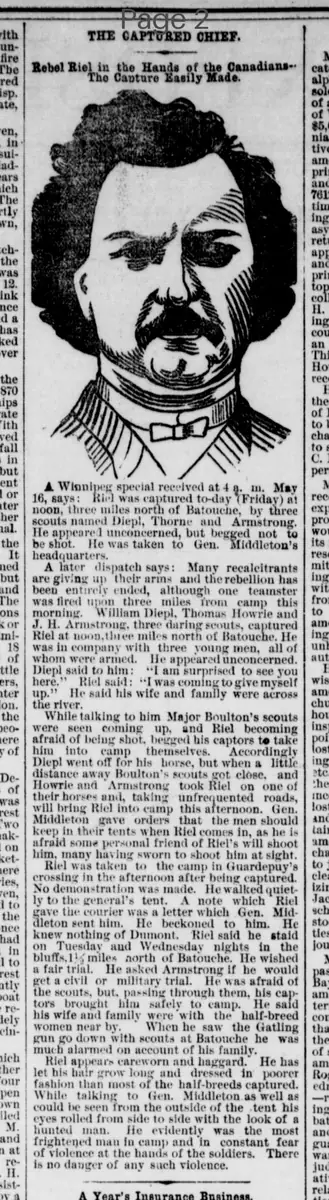
Bobol Riel in the Hands of the Canadians.
The Capture Daily Made.
Winnipeg special received at 4 p. m. May 16, says: Riel was captured to-day (Friday) at noon, three miles north of Batoche, by three scouts named Diehl, Thorne and Armstrong. He appeared unconcerned, but begged not to be shot. He was taken to Gen. Middleton's headquarters.
A later dispatch says: Many recalcitrants are giving up their arms and the rebellion has been entirely ended, although one teamster was fired upon three miles from camp this morning. William Diehl, Thomas Howrie and J. H. Armstrong, three daring scouts, captured Riel at noon, three miles north of Batoche. He was in company with three young men, all of whom were armed. He appeared unconcerned. Diehl said to him: "I am surprised to see you here." Riel said: "I was coming to give myself up." He said his wife and family were across the river.
While talking to him Major Boulton's scouts were seen coming up, and Riel becoming afraid of being shot, begged his captors to take him into camp themselves. Accordingly Diehl went off for his horse, but when a little distance away Boulton's scouts got close, and Howrie and Armstrong took Riel on one of their horses and, taking unfrequented roads, will bring Riel into camp this afternoon. Gen. Middleton gave orders that the men should keep in their tents when Riel comes in, as he is afraid some personal friend of Riel's will shoot him, many having sworn to shoot him at sight.
Riel was taken to the camp in Guardepuy's crossing in the afternoon after being captured. No demonstration was made. He walked quietly to the general's tent. A note which Riel gave the courier was a letter which Gen. Middleton sent him. He beckoned to him. He knew nothing of Dumont. Riel said he staid on Tuesday and Wednesday nights in the bluffs, 1 1/2 miles north of Batoche. He wished a fair trial. He asked Armstrong if he would get a civil or military trial. He was afraid of the scouts, but, passing through them, his captors brought him safely to camp. He said his wife and family were with the half-breed women near by. When he saw the Gatling gun go down with scouts at Batoche he was much alarmed on account of his family. Riel appears careworn and haggard. He has let his hair grow long and dressed in poorer fashion than most of the half-breeds captured. While talking to Gen. Middleton as well as could be seen from the outside of the tent his eyes rolled from side to side with the look of a hunted man. He evidently was the most frightened man in camp and in constant fear of violence at the hands of the soldiers. There is no danger of any such violence.
What sub-type of article is it?
What keywords are associated?
What entities or persons were involved?
Where did it happen?
Foreign News Details
Primary Location
Batoche
Event Date
Friday (Dispatch Received May 16)
Key Persons
Outcome
rebellion entirely ended; many recalcitrants giving up arms; riel captured without incident, no demonstration or violence.
Event Details
Riel captured at noon three miles north of Batoche by scouts Diehl, Howrie, and Armstrong while with three armed young men. He claimed he was surrendering, mentioned family across river, appeared unconcerned but fearful of being shot. Taken to camp via unfrequented roads to avoid other scouts; arrived afternoon, walked to general's tent; expressed desire for fair trial, fear of military trial; appeared careworn and haggard.