Thank you for visiting SNEWPapers!
Sign up free
Alexandria Daily Advertiser
Alexandria, Virginia
What is this article about?
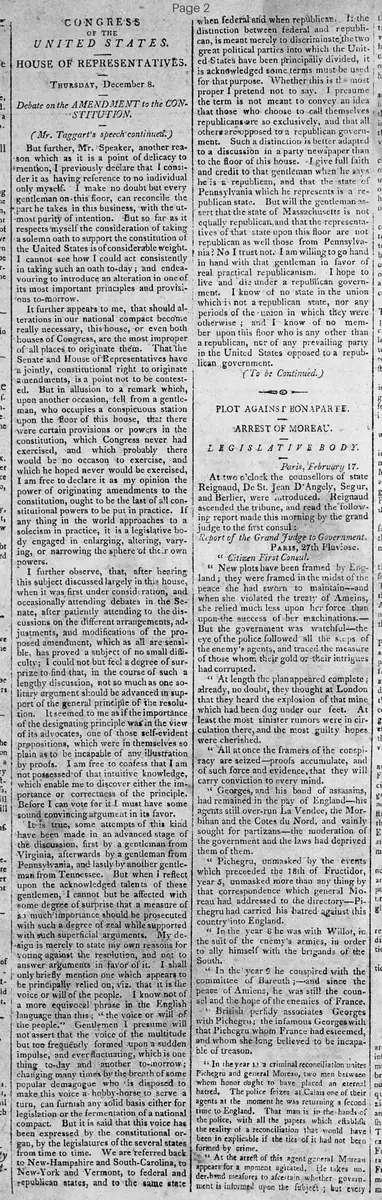
On December 8, in the U.S. House of Representatives, Mr. Taggart continues his speech against an amendment to the Constitution. He argues that Congress is unfit to originate changes, questions the lack of strong arguments for the proposal, and critiques the 'voice of the people' as expressed by state legislatures, emphasizing republican principles across parties.
Clipping
OCR Quality
Full Text
OF THE
UNITED STATES.
HOUSE OF REPRESENTATIVES.
Thursday, December 8.
Debate on the AMENDMENT to the CONSTITUTION.
(Mr. Taggart's speech continued.)
But further, Mr. Speaker, another reason which as it is a point of delicacy to mention, I previously declare that I consider it as having reference to no individual only myself. I make no doubt but every gentleman on this floor, can reconcile the part he takes in this business, with the utmost purity of intention. But so far as it respects myself the consideration of taking a solemn oath to support the constitution of the United States is of considerable weight. I cannot see how I could act consistently in taking such an oath to-day; and endeavouring to introduce an alteration in one of its most important principles and provisions to-morrow.
It further appears to me, that should alterations in our national compact become really necessary, this house, or even both houses of Congress, are the most improper of all places to originate them. That the Senate and House of Representatives have a jointly, constitutional right to originate amendments, is a point not to be contested. But in allusion to a remark which, upon another occasion, fell from a gentleman, who occupies a conspicuous station upon the floor of this house, that there were certain provisions or powers in the constitution, which Congress never had exercised, and which probably there would be no occasion to exercise, and which he hoped never would be exercised, I am free to declare it as my opinion the power of originating amendments to the constitution, ought to be the last of all constitutional powers to be put in practice. If any thing in the world approaches to a solecism in practice, it is a legislative body engaged in enlarging, altering, varying, or narrowing the sphere of their own powers.
I further observe, that, after hearing this subject discussed largely in this house, when it was first under consideration, and occasionally attending debates in the Senate, after patiently attending to the discussions on the different arrangements, adjustments, and modifications of the proposed amendment, which as all are sensible, has proved a subject of no small difficulty; I could not but feel a degree of surprise to find that, in the course of such a lengthy discussion, not so much as one solitary argument should be advanced in support of the general principle of the resolution. It seemed to me as if the importance of the designating principle was in the view of its advocates, one of those self-evident propositions, which were in themselves so plain as to be incapable of any illustration by proofs. I am free to confess that I am not possessed of that intuitive knowledge, which enable me to discover either the importance or correctness of the principle. Before I can vote for it I must have some sound convincing argument in its favor.
It is true, some attempts of this kind have been made in an advanced stage of the discussion, first by a gentleman from Virginia, afterwards by a gentleman from Pennsylvania, and lastly by another gentleman from Tennessee. But when I reflect upon the acknowledged talents of these gentlemen, I cannot but be affected with some degree of surprise that a measure of so much importance should be prosecuted with such a degree of zeal while supported with such superficial arguments. My design is merely to state my own reasons for voting against the resolution, and not to answer arguments in favor of it. I shall only briefly mention one which appears to be principally relied on, viz. that it is the voice or will of the people. I know not of a more equivocal phrase in the English language than this; "the voice or will of the people." Gentlemen I presume will not assert that the voice of the multitude but too frequently formed upon a sudden impulse, and ever fluctuating, which is one thing to-day and another to-morrow; changing many times by the breath of some popular demagogue who is disposed to make this voice a hobby-horse to serve a turn, can furnish any solid basis either for legislation or the fermentation of a national compact. But it is said that this voice has been expressed by the constitutional organ, by the legislatures of the several states from time to time. We are referred back to New-Hampshire and South-Carolina, to New-York and Vermont, to federal and republican states, and to the same state when federal and when republican. If the distinction between federal and republican, is meant merely to discriminate the two great political parties into which the United States have been principally divided, it is acknowledged some terms must be used for that purpose. Whether this is the most proper I pretend not to say. I presume the term is not meant to convey an idea that those who choose to call themselves republicans are so exclusively, and that all others are opposed to a republican government. Such a distinction is better adapted to a discussion in a party newspaper than to the floor of this house. I give full faith and credit to that gentleman when he says he is a republican, and that the state of Pennsylvania which he represents is a republican state. But will the gentleman assert that the state of Massachusetts is not equally republican and that the representatives of that state upon this floor are not republican as well those from Pennsylvania? No I trust not. I am willing to go hand in hand with that gentleman in favor of real practical republicanism. I hope to live and die under a republican government. I know of no state in the union which is not a republican state, nor any periods of the union in which they were otherwise; and I know of no member upon this floor who is any other than a republican, nor of any prevailing party in the United States opposed to a republican government.
(To be Continued.)
What sub-type of article is it?
What themes does it cover?
What keywords are associated?
What entities or persons were involved?
Where did it happen?
Story Details
Key Persons
Location
House Of Representatives, United States Congress
Event Date
Thursday, December 8
Story Details
Mr. Taggart expresses personal reluctance to amend the Constitution due to his oath, argues Congress is improper for originating changes, notes lack of strong arguments for the amendment's principle, and critiques the 'voice of the people' as expressed by state legislatures while affirming universal republicanism in the U.S.